Misra Ramprasad, Hirshfeld Amiram, Sheves Mordechai
Department of Organic Chemistry , Weizmann Institute of Science , Rehovot 76100 , Israel . Email:
Chem Sci. 2019 Jun 20;10(31):7365-7374. doi: 10.1039/c9sc00855a. eCollection 2019 Aug 21.
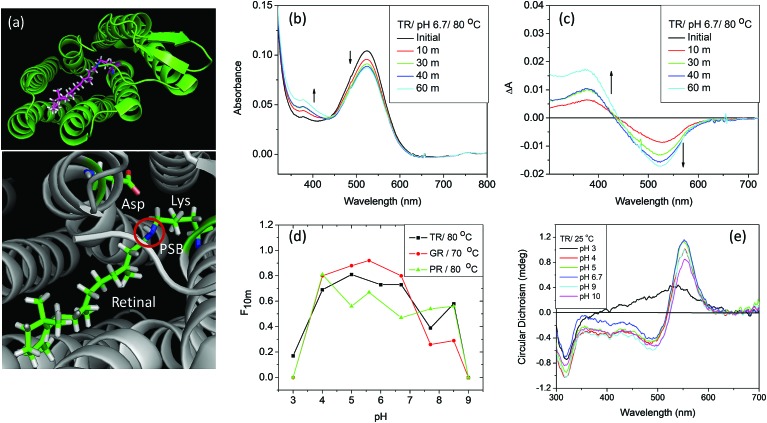
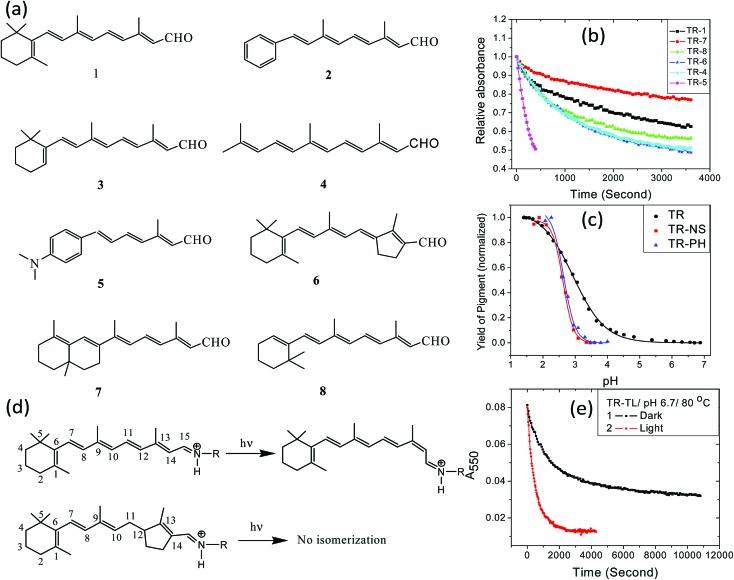
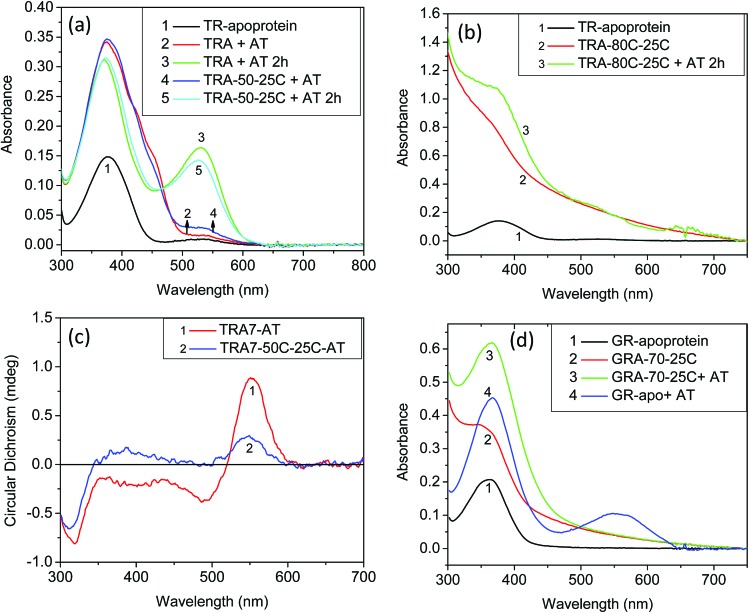
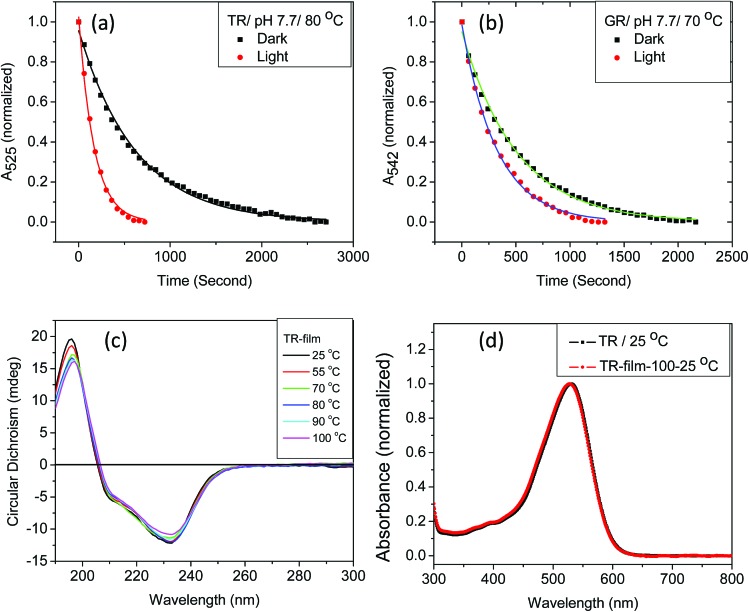
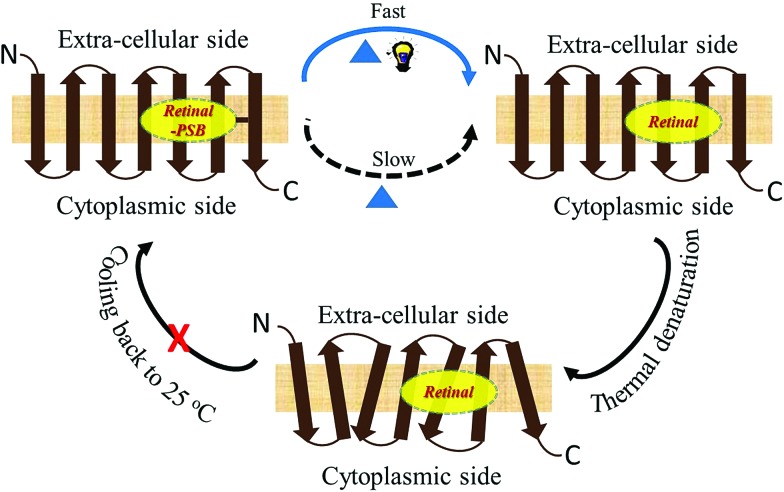
Understanding the factors affecting the stability and function of proteins at the molecular level is of fundamental importance. In spite of their use in bioelectronics and optogenetics, factors influencing thermal stability of microbial rhodopsins, a class of photoreceptor protein ubiquitous in nature are not yet well-understood. Here we report on the molecular mechanism for thermal denaturation of microbial retinal proteins, including, a highly thermostable protein, thermophilic rhodopsin (TR). External stimuli-dependent thermal denaturation of TR, the proton pumping rhodopsin of bacterium, and other microbial rhodopsins are spectroscopically studied to decipher the common factors guiding their thermal stability. The thermal denaturation process of the studied proteins is light-catalyzed and the apo-protein is thermally less stable than the corresponding retinal-covalently bound opsin. In addition, changes in structure of the retinal chromophore affect the thermal stability of TR. Our results indicate that the hydrolysis of the retinal protonated Schiff base (PSB) is the rate-determining step for denaturation of the TR as well as other retinal proteins. Unusually high thermal stability of TR multilayers, in which PSB hydrolysis is restricted due to lack of bulk water, strongly supports this proposal. Our results also show that the protonation state of the PSB counter-ion does not affect the thermal stability of the studied proteins. Thermal photo-bleaching of an artificial TR pigment derived from non-isomerizable -locked retinal suggests, rather counterintuitively, that the photoinduced retinal - isomerization is not a pre-requisite for light catalyzed thermal denaturation of TR. Protein conformation alteration triggered by light-induced retinal excited state formation is likely to facilitate the PSB hydrolysis.
在分子水平上理解影响蛋白质稳定性和功能的因素至关重要。尽管微生物视紫红质在生物电子学和光遗传学中有应用,但这类自然界中普遍存在的光感受器蛋白,其热稳定性的影响因素尚未得到充分理解。在此,我们报告微生物视网膜蛋白热变性的分子机制,包括一种高度耐热的蛋白——嗜热视紫红质(TR)。我们通过光谱研究了TR(一种细菌的质子泵视紫红质)以及其他微生物视紫红质的外部刺激依赖性热变性,以解析指导它们热稳定性的共同因素。所研究蛋白质的热变性过程是光催化的,脱辅基蛋白在热稳定性上低于相应的视网膜共价结合视蛋白。此外,视网膜发色团结构的变化会影响TR的热稳定性。我们的结果表明,视网膜质子化席夫碱(PSB)的水解是TR以及其他视网膜蛋白变性的速率决定步骤。由于缺乏大量水而限制了PSB水解的TR多层膜具有异常高的热稳定性,这有力地支持了这一观点。我们的结果还表明,PSB抗衡离子的质子化状态不影响所研究蛋白质的热稳定性。源自非异构化的锁状视网膜的人工TR色素的热光漂白表明,与直觉相反,光诱导的视网膜异构化不是TR光催化热变性的先决条件。光诱导的视网膜激发态形成引发的蛋白质构象改变可能会促进PSB水解。