Holden Selma C, Manor Brad, Zhou Junhong, Zera Chloe, Davis Roger B, Yeh Gloria Y
Department of Primary Care, University of New England College of Osteopathic Medicine, Biddeford, Maine.
Mobility and Falls Translational Research Center, Hebrew Senior Life, Roslindale, Massachusetts.
Glob Adv Health Med. 2019 Aug 26;8:2164956119870984. doi: 10.1177/2164956119870984. eCollection 2019.
The objective was to assess the feasibility of a prenatal yoga randomized controlled trial (RCT) for gestational low back pain (LBP), mobility, and maternal well-being.
In this pilot, women aged 18 to 39 years with uncomplicated pregnancies at 12 to 26 weeks were randomized, stratified by presence of LBP, to attend a weekly yoga class or a time-matched educational support group for 12 weeks. Sample size was based on anticipated enrollment of 2 subjects per month. Primary outcomes were measures of feasibility and acceptability. Secondary outcomes included LBP disability, pregnancy symptom burden, childbirth self-efficacy, instrumented gait, balance, and falls at baseline, every 4 weeks, and 6 weeks postpartum.
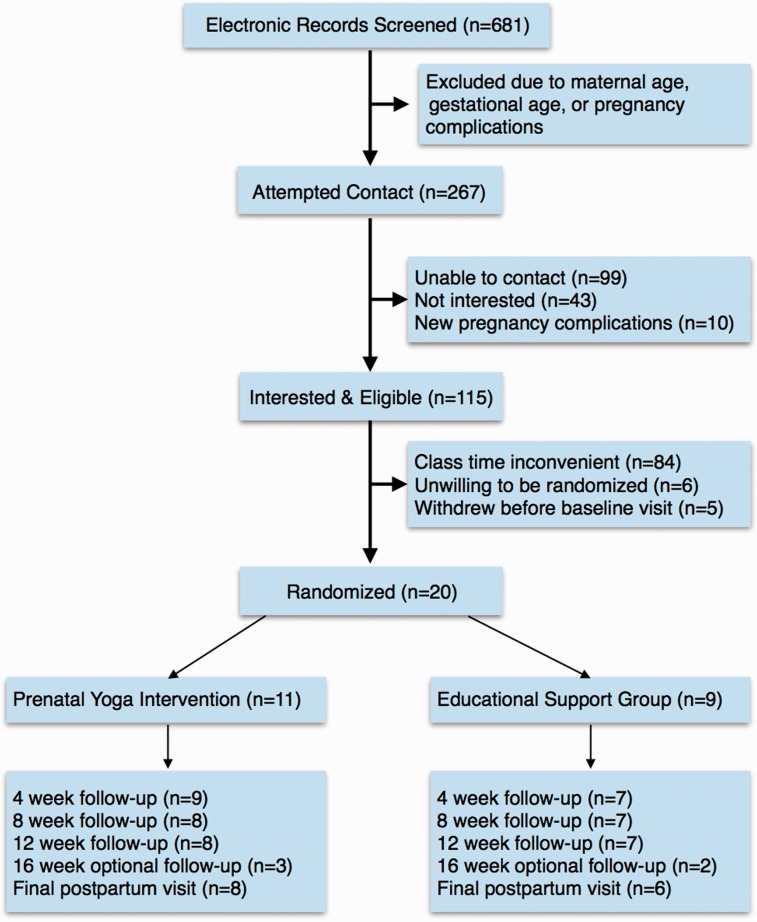
From April 2015 to December 2015, 168 women were contacted and 115 (68%) were eligible. Twenty women enrolled (N = 11 yoga; N = 9 control; mean gestational age 20.2 weeks). Retention at 12 weeks was 81% in yoga and 77% in control. There were no yoga-related adverse events. Exploratory analyses show no differences in back pain disability between groups. Significant groups effects were found on biomechanical assessments, including percentage change in gait speed ( = 4.4, = .04), double support time ( = 23.6, < .01), instrumented timed-up-and-go ( = 8.6, < .01), and turn time ( = 5.7, = .02) suggesting clinically relevant improvements with yoga. Pregnancy Symptom Inventory (PSI) scores improved (13.1 point difference, 95% confidence interval, 5.1-21.1) at 12 weeks in yoga compared to control, adjusted for baseline gestational age.
Conducting an RCT of prenatal yoga to improve gestational LBP and maternal well-being is feasible and safe. While no differences in back pain were observed, biomechanical measures were sensitive assessments for evaluating gestational LBP-related mobility impairment and showed group differences. Additionally, the PSI showed significant differences in symptom burden over 12 weeks, supporting the ongoing claims that yoga improves a pregnant woman's overall well-being.
目的是评估一项针对妊娠性下背痛(LBP)、身体活动能力和孕产妇幸福感的产前瑜伽随机对照试验(RCT)的可行性。
在这项试点研究中,将年龄在18至39岁、怀孕12至26周且无并发症的女性按是否存在下背痛进行分层随机分组,分别参加每周一次的瑜伽课程或时间匹配的教育支持小组,为期12周。样本量基于每月预计招募2名受试者确定。主要结局指标是可行性和可接受性的测量。次要结局指标包括下背痛残疾程度、妊娠症状负担、分娩自我效能感、仪器测量的步态、平衡能力以及基线时、每4周和产后6周的跌倒情况。
2015年4月至2015年12月,联系了168名女性,其中115名(68%)符合条件。20名女性入组(N = 11名瑜伽组;N = 9名对照组;平均孕周20.2周)。瑜伽组12周时的保留率为81%,对照组为77%。未发生与瑜伽相关的不良事件。探索性分析显示两组间下背痛残疾程度无差异。在生物力学评估方面发现了显著的组间效应,包括步态速度变化百分比( = 4.4, = .04)、双支撑时间( = 23.6, < .01)、仪器测量的计时起立行走试验( = 8.6, < .01)和转身时间( = 5.7, = .02),表明瑜伽带来了具有临床意义的改善。与对照组相比,在根据基线孕周进行调整后,瑜伽组在12周时的妊娠症状量表(PSI)评分有所改善(差异为13.1分,95%置信区间为5.1 - 21.1)。
开展一项产前瑜伽随机对照试验以改善妊娠性下背痛和孕产妇幸福感是可行且安全的。虽然未观察到下背痛方面的差异,但生物力学测量是评估与妊娠性下背痛相关的身体活动能力损害的敏感指标,并显示出组间差异。此外,PSI显示在12周内症状负担存在显著差异,支持了关于瑜伽可改善孕妇整体幸福感的现有观点。