Swain Thomas A, McGwin Gerald
Center for Injury Sciences and Section of Trauma, Burns, and Surgical Critical Care, Division of General Surgery, Department of Surgery, School of Medicine, University of Alabama at Birmingham, Birmingham, Alabama, USA.; Department of Epidemiology, School of Public Health, University of Alabama at Birmingham, Birmingham, Alabama, USA.
Orthop J Sports Med. 2016 Nov 16;4(11):2325967116671703. doi: 10.1177/2325967116671703. eCollection 2016 Nov.
Yoga has become more popular among people in the United States and has been touted by both yoga participants as well as some physicians and researchers for its health benefits. While the health benefits have been studied, the frequency of injury among yoga participants has not been well documented.
Injury incidence, rates, and types associated with yoga in the United States have not been quantified. This study estimates US yoga-associated injury incidence and characterizes injury type over a 13-year period.
Descriptive epidemiology study.
Data from the National Electronic Injury Surveillance System (NEISS) from 2001 to 2014 were used to estimate the incidence and type of yoga-associated injuries. The number and age distribution of yoga participants was estimated using data from National Health Statistics Reports. These national population estimates were applied to the NEISS data to determine injury rates overall and stratified according to age categories.
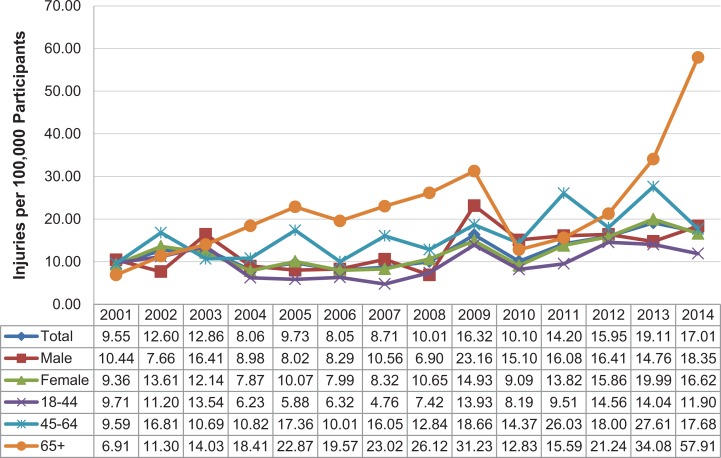
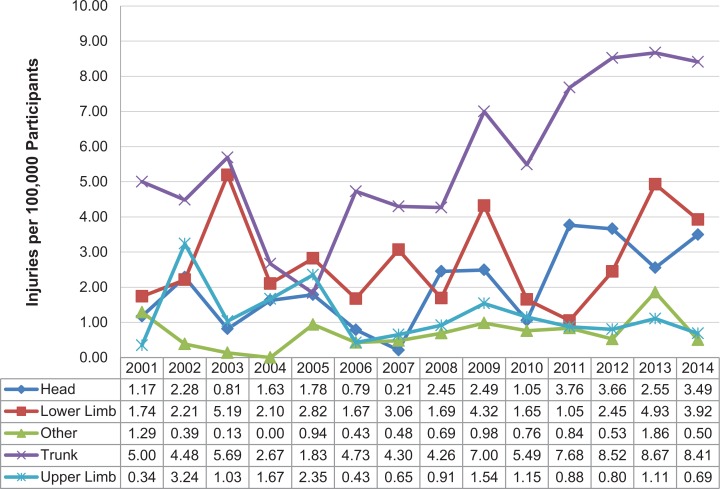
There were 29,590 yoga-related injuries seen in hospital emergency departments from 2001 to 2014. The trunk (46.6%) was the most frequent region injured, and sprain/strain (45.0%) accounted for the majority of diagnoses. The injury rate increased overall from 2001 to 2014, and it was greatest for those aged 65 years and older (57.9/100,000) compared with those aged 18 to 44 years (11.9/100,000) and 45 to 64 years (17.7/100,000) in 2014.
Participants aged 65 years and older have a greater rate of injury from practicing yoga when compared with other age groups. Most injuries sustained were to the trunk and involved a sprain/strain. While there are many health benefits to practicing yoga, participants and those wishing to become participants should confer with a physician prior to engaging in physical activity and practice only under the guidance of certified instructors.
瑜伽在美国民众中越来越受欢迎,瑜伽练习者以及一些医生和研究人员都称赞其对健康有益。虽然已经对其健康益处进行了研究,但瑜伽练习者的受伤频率尚未得到充分记录。
美国与瑜伽相关的损伤发生率、比率和类型尚未得到量化。本研究估计了13年间美国与瑜伽相关的损伤发生率,并对损伤类型进行了特征描述。
描述性流行病学研究。
使用2001年至2014年国家电子伤害监测系统(NEISS)的数据来估计与瑜伽相关的损伤发生率和类型。使用国家卫生统计报告的数据估计瑜伽练习者的数量和年龄分布。将这些全国人口估计数应用于NEISS数据,以确定总体损伤率,并按年龄类别进行分层。
2001年至2014年期间,医院急诊科共出现29590例与瑜伽相关的损伤。躯干(46.6%)是最常受伤的部位,扭伤/拉伤(45.0%)占诊断的大多数。从2001年到2014年,损伤率总体上升,2014年65岁及以上人群的损伤率最高(57.9/10万),而18至44岁人群(11.9/10万)和45至64岁人群(17.7/10万)的损伤率较低。
与其他年龄组相比,65岁及以上的瑜伽练习者受伤率更高。大多数受伤发生在躯干,且涉及扭伤/拉伤。虽然练习瑜伽有许多健康益处,但练习者和希望成为练习者的人在进行体育活动前应咨询医生,并仅在认证教练的指导下练习。