Fleisig Glenn S, Diffendaffer Alek Z, Drogosz Monika, Cain E Lyle, Emblom Benton A, Dugas Jeffrey R
American Sports Medicine Institute, Birmingham, Alabama, USA.
Investigation performed at the American Sports Medicine Institute, Birmingham, Alabama, USA.
Orthop J Sports Med. 2019 Aug 27;7(8):2325967119866199. doi: 10.1177/2325967119866199. eCollection 2019 Aug.
The probability of returning to competition for injured baseball pitchers is similar after ulnar collateral ligament (UCL) repair as after UCL reconstruction, but the time to return is significantly quicker after UCL repair. Previous research has found no differences in pitching biomechanics between pitchers with and without a history of UCL reconstruction, but pitching biomechanics after UCL repair has not been studied.
There will be significant differences in pitching biomechanics between pitchers returning to play after UCL repair and pitchers with no injury history.
Controlled laboratory study.
A total of 33 pitchers were tested shortly after UCL repair (9.8 ± 2.6 months) and compared with a matched group of 33 uninjured pitchers. Each group comprised 14 college pitchers and 19 high school pitchers. Shoulder and elbow passive ranges of motion were measured. The biomechanics of 10 fastballs was then collected using a 12-camera automated motion capture system. Ball velocity was measured using a separate 3-camera optical tracking system. Data were compared between the UCL repair group and the control group using the Student test (significance set at < .05).
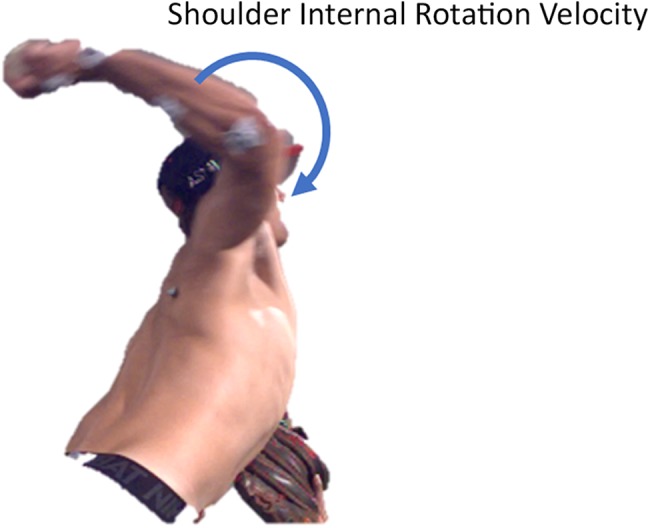
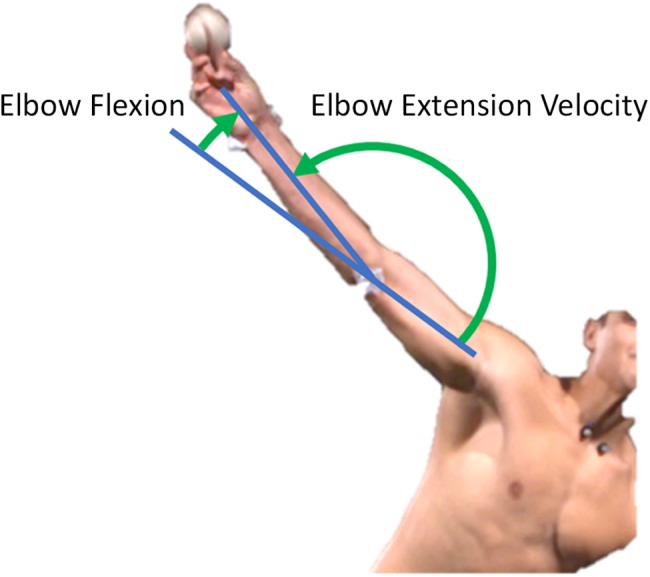
There were no differences in passive range of motion or fastball velocity between the 2 groups. There were no differences in joint kinetics during pitching, but 3 kinematic variables showed significant differences. Specifically, the UCL repair group produced less elbow extension (flexion: 27° ± 6° vs 24° ± 4°, respectively; = .03), less elbow extension velocity (2442 ± 367 vs 2631 ± 292 deg/s, respectively; = .02), and less shoulder internal rotation velocity (6273 ± 1093 vs 6771 ± 914 deg/s, respectively; = .049 ) compared with the control group.
Elbow extension, elbow velocity, and shoulder velocity differed between pitchers with a recent history of UCL repair and a matched control group, but it is unclear whether this has clinical significance, as there were no differences in ball velocity and passive range of motion. Furthermore, it is unknown whether these few differences in pitching biomechanics resolve with time.
Elbow and shoulder kinematics during pitching might not be completely regained within the first year after UCL repair, although passive range of motion and pitch velocity show no difference in comparison to other healthy pitchers.
尺侧副韧带(UCL)修复术后受伤的棒球投手恢复比赛的概率与UCL重建术后相似,但UCL修复术后恢复比赛的时间明显更快。先前的研究发现,有和没有UCL重建病史的投手在投球生物力学方面没有差异,但尚未对UCL修复后的投球生物力学进行研究。
UCL修复后恢复比赛的投手与没有受伤史的投手在投球生物力学方面存在显著差异。
对照实验室研究。
共对33名UCL修复后不久(9.8±2.6个月)的投手进行了测试,并与33名未受伤的投手匹配组进行比较。每组包括14名大学投手和19名高中投手。测量了肩和肘的被动活动范围。然后使用12台摄像机的自动运动捕捉系统收集10次快球的生物力学数据。使用单独的3台摄像机光学跟踪系统测量球速。使用学生t检验比较UCL修复组和对照组的数据(显著性设定为P<0.05)。
两组之间的被动活动范围或快球速度没有差异。投球过程中的关节动力学没有差异,但3个运动学变量显示出显著差异。具体而言,与对照组相比,UCL修复组的肘部伸展角度更小(屈曲分别为27°±6°和24°±4°;P=0.03),肘部伸展速度更低(分别为2442±367和2631±292度/秒;P=0.02),肩部内旋速度更低(分别为6273±1093和6771±914度/秒;P=0.049)。
近期有UCL修复病史的投手与匹配的对照组在肘部伸展、肘部速度和肩部速度方面存在差异,但由于球速和被动活动范围没有差异,尚不清楚这是否具有临床意义。此外,尚不清楚投球生物力学方面的这几个差异是否会随着时间而消除。
UCL修复术后第一年,投球时的肘部和肩部运动学可能无法完全恢复,尽管与其他健康投手相比,被动活动范围和投球速度没有差异。