Eyre Thomas S, Eaton David W, Garagash Dmitry I, Zecevic Megan, Venieri Marco, Weir Ronald, Lawton Donald C
Department of Geoscience, University of Calgary, Calgary, Alberta T1N 1N4, Canada.
Department of Civil and Resource Engineering, Dalhousie University, Halifax, Nova Scotia B3H 4R2, Canada.
Sci Adv. 2019 Aug 28;5(8):eaav7172. doi: 10.1126/sciadv.aav7172. eCollection 2019 Aug.
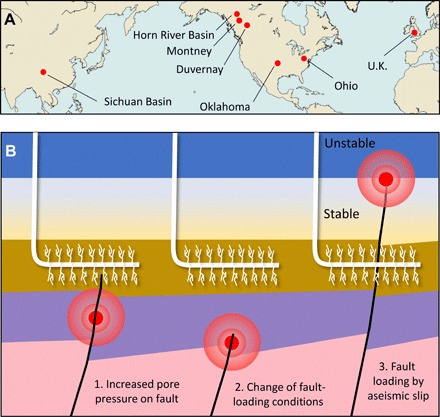
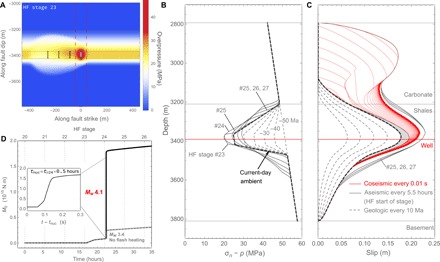
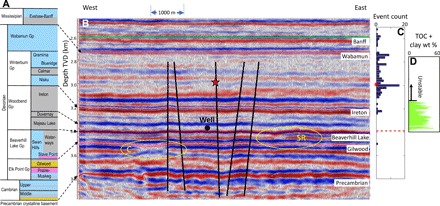
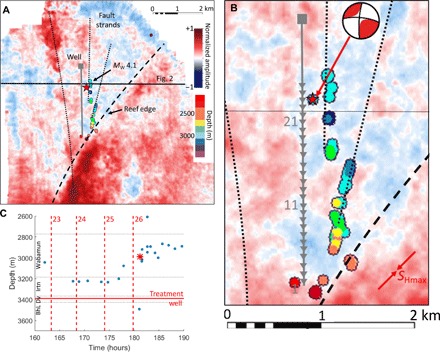
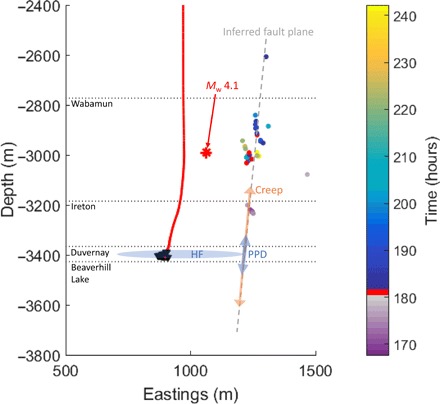
Models for hydraulic fracturing-induced earthquakes in shales typically ascribe fault activation to elevated pore pressure or increased shear stress; however, these mechanisms are incompatible with experiments and rate-state frictional models, which predict stable sliding (aseismic slip) on faults that penetrate rocks with high clay or total organic carbon. Recent studies further indicate that the earthquakes tend to nucleate over relatively short injection time scales and sufficiently far from the injection zone that triggering by either poroelastic stress changes or pore pressure diffusion is unlikely. Here, we invoke an alternative model based on recent laboratory and in situ experiments, wherein distal, unstable regions of a fault are progressively loaded by aseismic slip on proximal, stable regions stimulated by hydraulic fracturing. This model predicts that dynamic rupture initiates when the creep front impinges on a fault region where rock composition favors dynamic and slip rate weakening behavior.
页岩中水力压裂诱发地震的模型通常将断层活化归因于孔隙压力升高或剪应力增加;然而,这些机制与实验和速率状态摩擦模型不相符,后者预测在穿透高粘土或总有机碳岩石的断层上会发生稳定滑动(无震滑动)。最近的研究进一步表明,地震往往在相对较短的注入时间尺度内成核,且距离注入区足够远,因此孔隙弹性应力变化或孔隙压力扩散引发地震的可能性不大。在此,我们基于最近的实验室和现场实验提出一种替代模型:在该模型中,断层远端的不稳定区域通过水力压裂刺激近端稳定区域的无震滑动而逐渐加载。该模型预测,当蠕变前沿撞击岩石成分有利于动态和滑动速率弱化行为的断层区域时,动态破裂就会开始。