Institute of Cardiovascular Disease and Key Lab for Arteriosclerology of Hunan Province, Hengyang Medical School, University of South China, Hengyang, China.
Department of Cardiology, Vascular Center, Guangdong Cardiovascular Institute, Guangdong Provincial Key Laboratory of Coronary Heart Disease Prevention, Guangdong Provincial People's Hospital, Guangdong Academy of Medical Sciences, Guangzhou, China.
J Clin Lab Anal. 2020 Jan;34(1):e23028. doi: 10.1002/jcla.23028. Epub 2019 Sep 6.
The current study aimed to examine miR-145's contribution to thoracic aortic dissection (AD) development by modulating the biological functions of vascular smooth muscle cells (VSMCs).
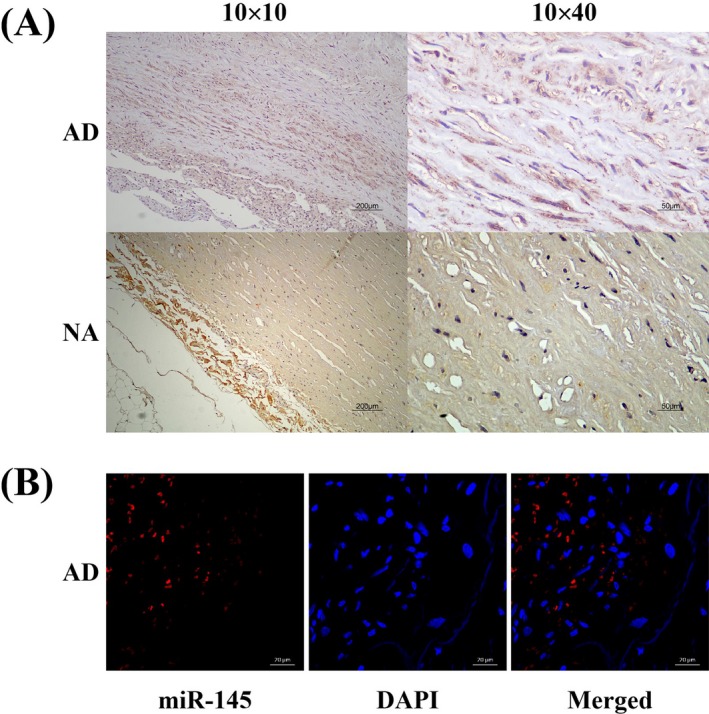
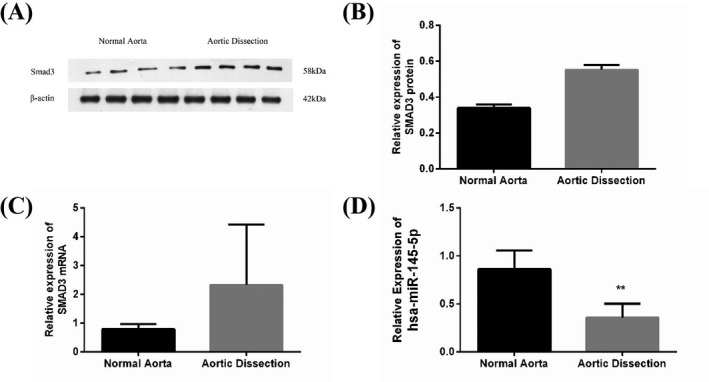
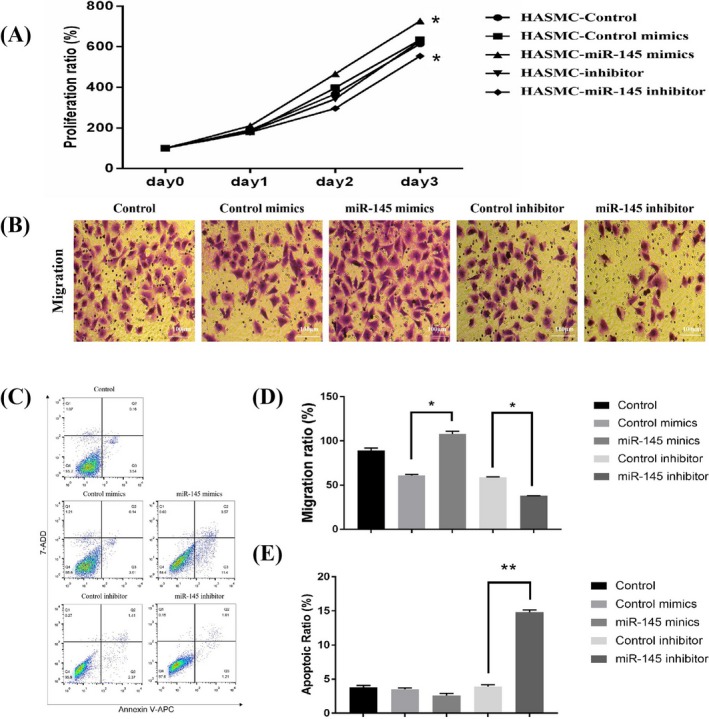
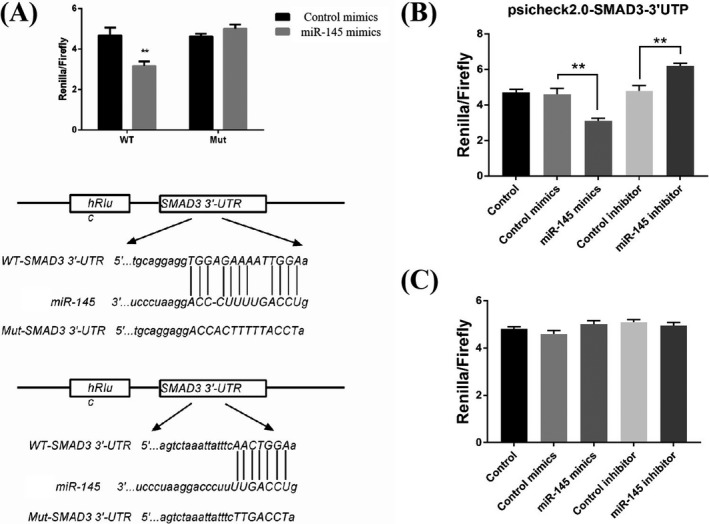
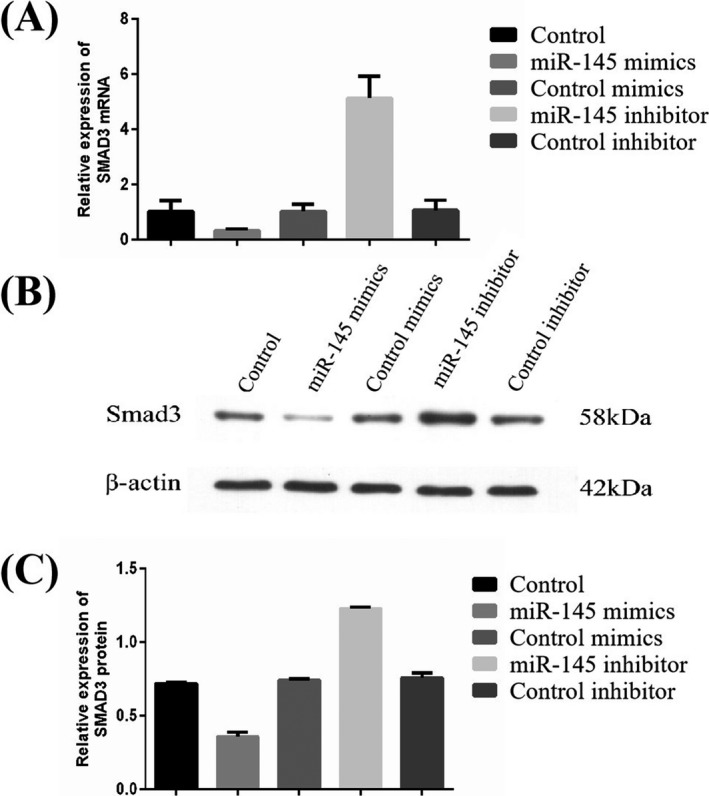
The concentration of circulating miR-145 was determined in patients with AD and healthy controls using quantitative polymerase chain reaction (qPCR). Aortic specimens were obtained from both individuals with Stanford type A AD undergoing surgical treatment and deceased organ donors (serving as controls) whose causes of death were nonvascular diseases. Then, qPCR and fluorescence in situ hybridization were applied to assess miR-145 amounts and location, respectively. Furthermore, qPCR and immunoblot were employed to determine SMAD3 (the target gene of miR-145, involved in the TGF-β pathway) amounts at the gene and protein levels, respectively. Moreover, in vitro transfection of VSMCs with miR-145 mimics or inhibitors was conducted. Finally, the 3-(4,5-Dimethylthiazol-2-yl)-2,5-diphenyltetrazolium bromide (MTT) assay, Transwell assay and flow cytometry were employed for detecting VSMC proliferation, migration, and apoptosis, respectively.
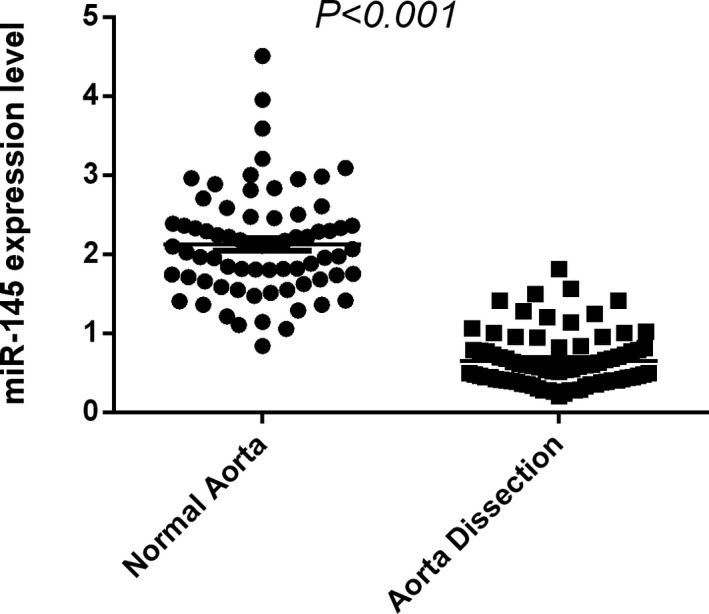
The amounts of miR-145 in plasma and aortic specimens were markedly reduced in the AD group in comparison with control values (P < .05). miR-145 was mostly located in VSMCs. Proliferation and apoptosis of VSMCs were significantly induced in vitro by the downregulation of miR-145. Also, miR-145 modulated SMAD3 expression.
miR-145 was found to be downregulated in patients with AD, which induced the proliferation, migration, and apoptosis of VSMCs by targeting SMAD3. This suggested the involvement of miR-145 in the pathogenesis of AD.
本研究旨在通过调节血管平滑肌细胞(VSMCs)的生物学功能,探讨 miR-145 在胸主动脉夹层(AD)发展中的作用。
采用实时定量聚合酶链反应(qPCR)检测 AD 患者和健康对照者循环 miR-145 的浓度。从接受手术治疗的 Stanford 型 A 型 AD 患者和因非血管疾病死亡的已故器官捐献者(作为对照)的主动脉标本中获得 qPCR 和荧光原位杂交,分别用于评估 miR-145 的含量和位置。此外,qPCR 和免疫印迹用于分别确定 SMAD3(miR-145 的靶基因,参与 TGF-β 通路)的基因和蛋白水平。此外,通过 miR-145 模拟物或抑制剂转染 VSMCs。最后,采用 3-(4,5-二甲基噻唑-2-基)-2,5-二苯基四氮唑溴盐(MTT)测定法、Transwell 测定法和流式细胞术分别检测 VSMC 的增殖、迁移和凋亡。
与对照组相比,AD 组患者血浆和主动脉标本中的 miR-145 含量明显降低(P <.05)。miR-145 主要位于 VSMCs 中。miR-145 的下调显著促进了体外 VSMCs 的增殖和凋亡。此外,miR-145 调节 SMAD3 的表达。
AD 患者中发现 miR-145 下调,通过靶向 SMAD3 诱导 VSMCs 的增殖、迁移和凋亡,提示 miR-145 参与 AD 的发病机制。