Department of Urology, The Fifth Affiliated Hospital of Guangzhou Medical University, Guangzhou, China.
Center for the Innovation and Translation of Minimally Invasive Techniques, Guangzhou Medical University, Guangzhou, China.
Cancer Sci. 2019 Nov;110(11):3533-3542. doi: 10.1111/cas.14192. Epub 2019 Sep 28.
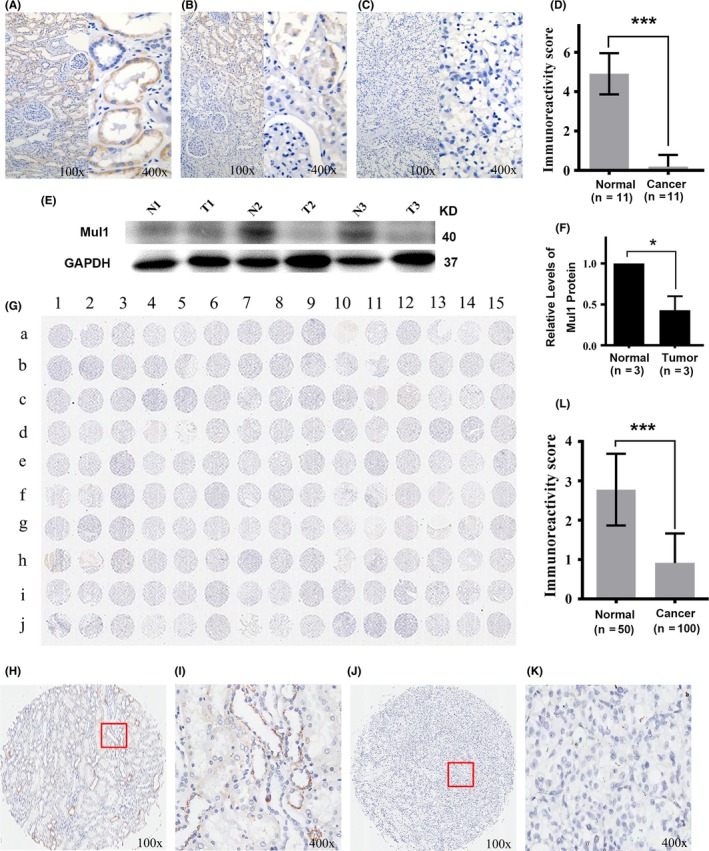
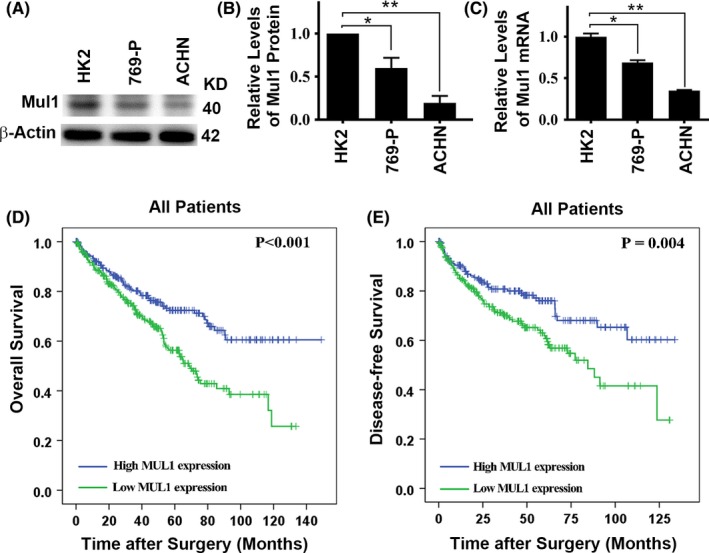
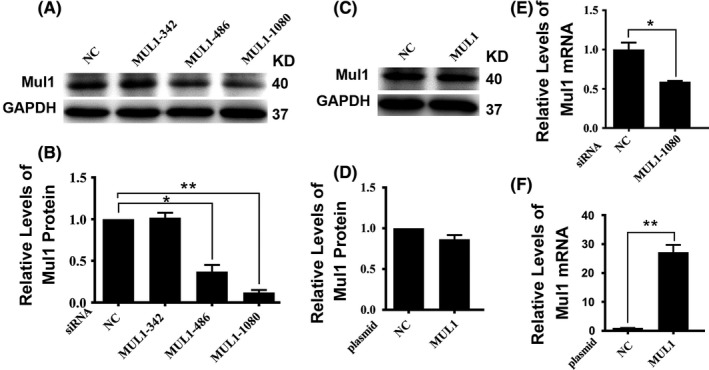
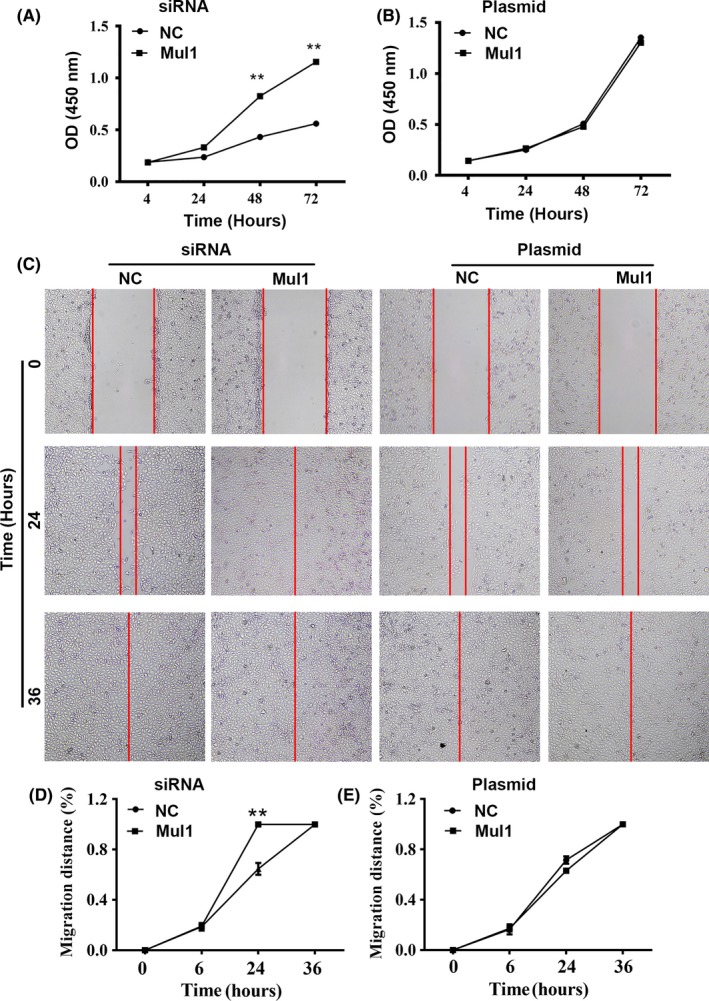
Clear cell renal cell carcinoma (ccRCC) is one of the most common malignant tumors in the urinary system. Surgical intervention is the preferred treatment for ccRCC, but targeted biological therapy is required for postoperative recurrent or metastatic ccRCC. Autophagy is an intracellular degradation system for misfolded/aggregated proteins and dysfunctional organelles. Defective autophagy is associated with many diseases. Mul1 is a mitochondrion-associated E3 ubiquitin ligase and involved in the regulation of divergent pathophysiological processes such as mitochondrial dynamics, and thus affects the development of various diseases including cancers. Whether Mul1 regulates ccRCC development and what is the mechanism remain unclear. Histochemical staining and immunoblotting were used to analyze the levels of Mul1 protein in human renal tissues. Statistical analysis of information associated with tissue microarray and The Cancer Genome Atlas (TCGA) database was conducted to show the relationship between Mul1 expression and clinical features and survival of ccRCC patients. Impact of Mul1 on rates of cell growth and migration and autophagy flux were tested in cultured cancer cells. Herein we show that Mul1 promoted autophagy flux to facilitate the degradation of P62-associated protein aggresomes and adipose differentiation-related protein (ADFP)-associated lipid droplets and suppressed the growth and migration of ccRCC cells. Levels of Mul1 protein and mRNA were significantly reduced so that autophagy flux was likely blocked in ccRCC tissues, which is potentially correlated with enhancement of malignancy of ccRCC and impairment of patient survival. Therefore, Mul1 may promote autophagy to suppress the development of ccRCC.
透明细胞肾细胞癌 (ccRCC) 是泌尿系统最常见的恶性肿瘤之一。手术干预是 ccRCC 的首选治疗方法,但对于术后复发或转移性 ccRCC,需要进行靶向生物治疗。自噬是一种细胞内降解错误折叠/聚集蛋白和功能失调细胞器的系统。自噬缺陷与许多疾病有关。Mul1 是一种与线粒体相关的 E3 泛素连接酶,参与调节线粒体动力学等不同的病理生理过程,因此影响包括癌症在内的各种疾病的发展。Mul1 是否调节 ccRCC 的发展以及其机制尚不清楚。组织化学染色和免疫印迹用于分析人肾组织中 Mul1 蛋白的水平。对组织微阵列和癌症基因组图谱 (TCGA) 数据库相关信息进行统计分析,以显示 Mul1 表达与 ccRCC 患者临床特征和生存的关系。在培养的癌细胞中测试 Mul1 对细胞生长和迁移以及自噬通量的影响。在此,我们表明 Mul1 促进自噬通量,以促进 P62 相关蛋白聚集体和脂肪分化相关蛋白 (ADFP) 相关脂滴的降解,并抑制 ccRCC 细胞的生长和迁移。Mul1 蛋白和 mRNA 的水平显著降低,因此自噬通量可能在 ccRCC 组织中被阻断,这可能与 ccRCC 恶性程度的增强和患者生存的损害有关。因此,Mul1 可能通过促进自噬来抑制 ccRCC 的发展。