Division of Infectious Diseases, CUB-Hôpital Erasme, Université libre de Bruxelles, Brussels, Belgium.
Service de Néphrologie et Transplantation Adulte, Université Paris Descartes Sorbonne Paris Cité, RTRS Centaure, Labex Transplantex, Paris, France.
PLoS One. 2019 Sep 6;14(9):e0221820. doi: 10.1371/journal.pone.0221820. eCollection 2019.
During routine post-kidney transplant care, most European transplant physicians screen patients for asymptomatic bacteriuria. The usefulness of this strategy is debated. To make screening cost-effective, asymptomatic bacteriuria should be prevalent enough to justify the expense, and antibiotics should improve patient outcomes significantly if asymptomatic bacteriuria is detected. Regrettably, the prevalence of asymptomatic bacteriuria among kidney transplant recipients is not well defined.
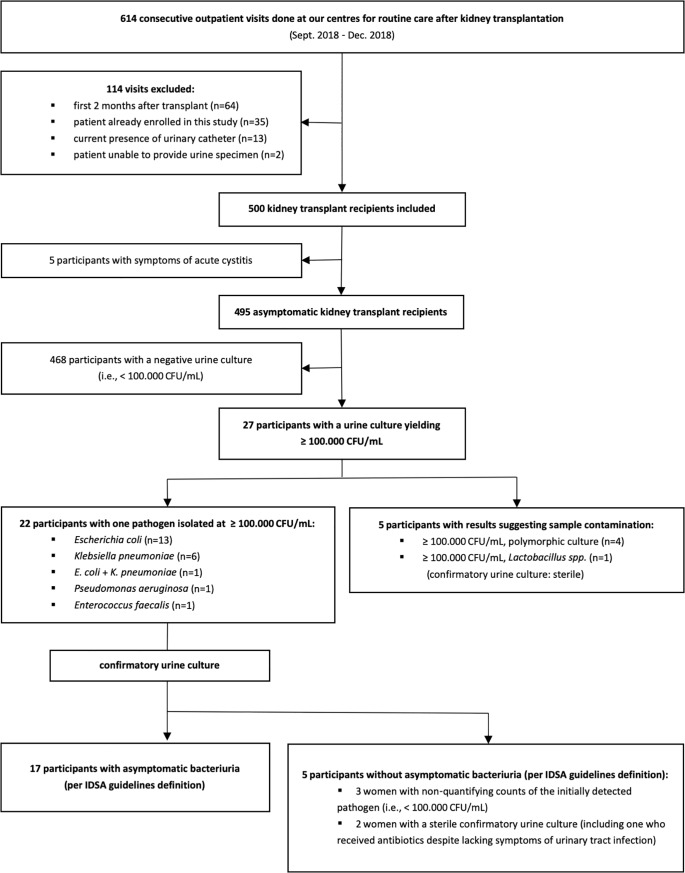
To determine the prevalence of asymptomatic bacteriuria among kidney transplant recipients, we did a cross-sectional study among kidney transplant recipients undergoing routine surveillance in three outpatient transplant clinics in Belgium and France. We excluded patients who were in the first two months post-transplantation and/or had a urinary catheter. Asymptomatic participants who had a urine culture with one organism isolated at ≥ 105 CFU/mL were asked to provide a confirmatory urine specimen. Asymptomatic bacteriuria was defined per Infectious Diseases Society of America guidelines.
We screened 500 consecutive kidney transplant recipients. Overall, the prevalence of asymptomatic bacteriuria was 3.4% (17/500 patients). It was similarly low among kidney transplant recipients who were between 2 and 12 months after transplantation (1.3%, 1/76 patients) and those who were farther after transplantation (3.8%, 16/424 patients: p = 0.49). Asymptomatic bacteriuria was significantly associated with female gender (risk ratio 3.7, 95% CI 1.3-10.3, p = 0.007) and older age (mean age: 61 ± 12 years [bacteriuric participants], versus 53 ± 15 years [non-bacteriuric participants], p = 0.03). One participant's colistin-resistant Escherichia coli isolate carried the globally disseminated mcr-1 gene.
Among kidney transplant recipients who are beyond the second month post-transplant, the prevalence of asymptomatic bacteriuria is low. Further studies are needed to ascertain the cost-effectiveness of a screen-and-treat strategy for asymptomatic bacteriuria in this population.
在肾移植后的常规护理中,大多数欧洲移植医生会对无症状菌尿症患者进行筛查。然而,这种策略的有效性存在争议。为了使筛查具有成本效益,无症状菌尿症的患病率应该足够高,以证明费用是合理的,如果检测到无症状菌尿症,抗生素应该显著改善患者的预后。遗憾的是,肾移植受者中无症状菌尿症的患病率尚未明确。
为了确定肾移植受者中无症状菌尿症的患病率,我们在比利时和法国的三个门诊移植诊所中进行了一项横断面研究,纳入了正在接受常规监测的肾移植受者。我们排除了移植后 2 个月内和/或有导尿管的患者。对无症状的尿液培养物中分离出≥105 CFU/mL 单一病原体的患者,我们要求其提供确认性尿液标本。无症状菌尿症的定义采用美国传染病学会的指南。
我们筛查了 500 例连续的肾移植受者。总体而言,无症状菌尿症的患病率为 3.4%(500 例患者中有 17 例)。在移植后 2-12 个月的患者(1.3%,76 例患者中有 1 例)和移植后时间更长的患者(3.8%,424 例患者中有 16 例)中,患病率也相似(p=0.49)。无症状菌尿症与女性(风险比 3.7,95%CI 1.3-10.3,p=0.007)和年龄较大(平均年龄:菌尿组 61±12 岁,非菌尿组 53±15 岁,p=0.03)显著相关。1 例患者的多粘菌素耐药大肠埃希菌分离株携带全球传播的 mcr-1 基因。
在移植后超过 2 个月的肾移植受者中,无症状菌尿症的患病率较低。需要进一步研究来确定在该人群中筛查和治疗无症状菌尿症的成本效益。