• 文献检索
  • 文档翻译
  • 深度研究
  • 学术资讯
  • Suppr Zotero 插件Zotero 插件
  • 邀请有礼
  • 套餐&价格
  • 历史记录
应用&插件
Suppr Zotero 插件Zotero 插件浏览器插件Mac 客户端Windows 客户端微信小程序
定价
高级版会员购买积分包购买API积分包
服务
文献检索文档翻译深度研究API 文档MCP 服务
关于我们
关于 Suppr公司介绍联系我们用户协议隐私条款
关注我们

Suppr 超能文献

核心技术专利:CN118964589B侵权必究
粤ICP备2023148730 号-1Suppr @ 2026

文献检索

告别复杂PubMed语法,用中文像聊天一样搜索,搜遍4000万医学文献。AI智能推荐,让科研检索更轻松。

立即免费搜索

文件翻译

保留排版,准确专业,支持PDF/Word/PPT等文件格式,支持 12+语言互译。

免费翻译文档

深度研究

AI帮你快速写综述,25分钟生成高质量综述,智能提取关键信息,辅助科研写作。

立即免费体验

基于病灶和连接的慢性失语症恢复的层级模型将患者和健康对照组区分开来。

A lesion and connectivity-based hierarchical model of chronic aphasia recovery dissociates patients and healthy controls.

机构信息

Department of Speech, Language, & Hearing Sciences, Sargent College of Health and Rehabilitation Sciences, Boston University, 635 Commonwealth Avenue, Room 326, Boston, MA 02215, United States of America.

Department of Speech, Language, & Hearing Sciences, Sargent College of Health and Rehabilitation Sciences, Boston University, 635 Commonwealth Avenue, Room 326, Boston, MA 02215, United States of America.

出版信息

Neuroimage Clin. 2019;23:101919. doi: 10.1016/j.nicl.2019.101919. Epub 2019 Jul 2.

DOI:10.1016/j.nicl.2019.101919
PMID:31491828
原文链接:https://pmc.ncbi.nlm.nih.gov/articles/PMC6702239/
Abstract

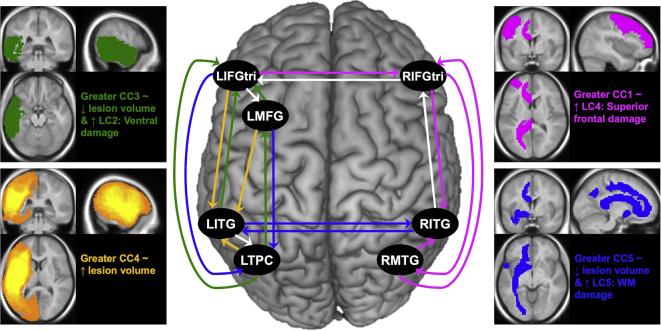
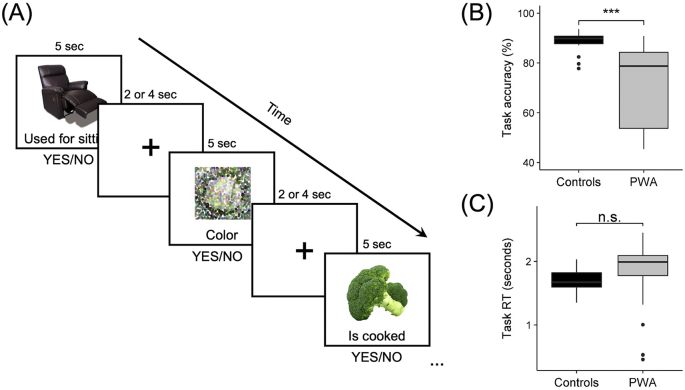
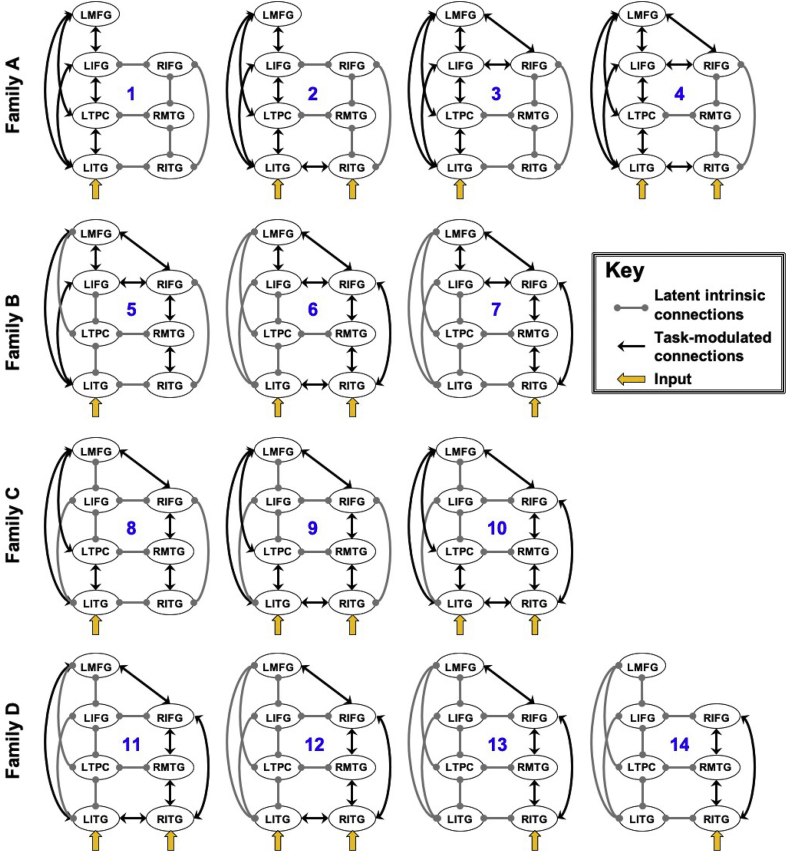
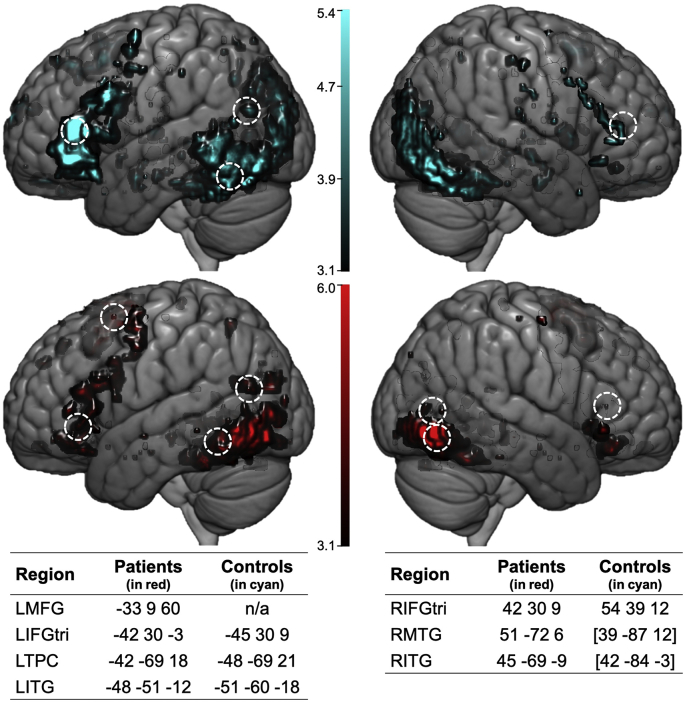
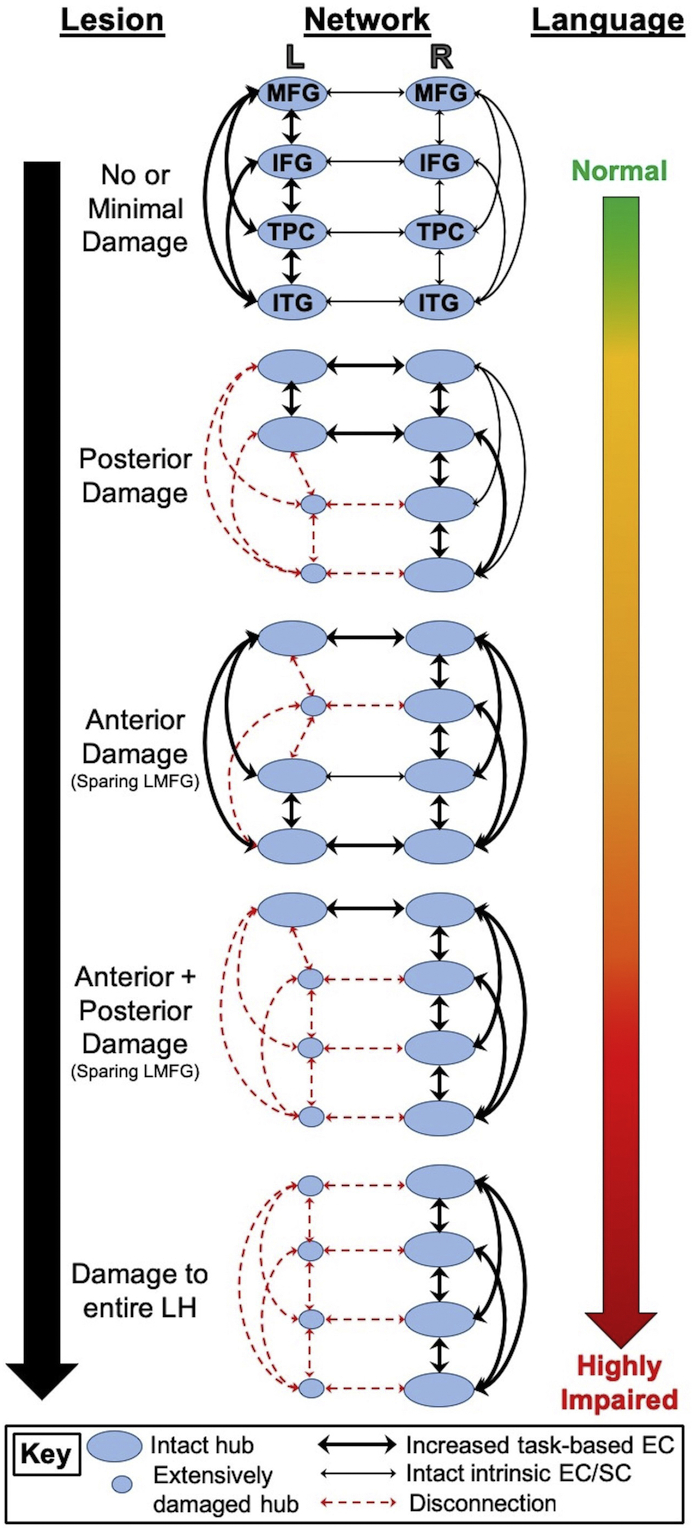
Traditional models of left hemisphere stroke recovery propose that reactivation of remaining ipsilesional tissue is optimal for language processing whereas reliance on contralesional right hemisphere homologues is less beneficial or possibly maladaptive in the chronic recovery stage. However, neuroimaging evidence for this proposal is mixed. This study aimed to elucidate patterns of effective connectivity in patients with chronic aphasia in light of healthy control connectivity patterns and in relation to damaged tissue within left hemisphere regions of interest and according to performance on a semantic decision task. Using fMRI and dynamic causal modeling, biologically-plausible models within four model families were created to correspond to potential neural recovery patterns, including Family A: Left-lateralized connectivity (i.e., no/minimal damage), Family B: Bilateral anterior-weighted connectivity (i.e., posterior damage), Family C: Bilateral posterior-weighted connectivity (i.e., anterior damage) and Family D: Right-lateralized connectivity (i.e., extensive damage). Controls exhibited a strong preference for left-lateralized network models (Family A) whereas patients demonstrated a split preference for Families A and C. At the level of connections, controls exhibited stronger left intrahemispheric task-modulated connections than did patients. Within the patient group, damage to left superior frontal structures resulted in greater right intrahemispheric connectivity whereas damage to left ventral structures resulted in heightened modulation of left frontal regions. Lesion metrics best predicted accuracy on the fMRI task and aphasia severity whereas left intrahemispheric connectivity predicted fMRI task reaction times. These results are discussed within the context of the hierarchical recovery model of chronic aphasia.

摘要

传统的左半球卒中恢复模型提出,剩余同侧组织的再激活对于语言处理是最佳的,而依赖对侧右半球同功是在慢性恢复阶段不太有益或可能适应不良的。然而,对于这一建议的神经影像学证据是混杂的。本研究旨在阐明慢性失语症患者的有效连接模式,根据健康对照组的连接模式,并根据左半球感兴趣区域内受损组织和语义决策任务的表现,阐明有效连接模式。使用 fMRI 和动态因果建模,在四个模型家族中创建了符合潜在神经恢复模式的生物合理模型,包括家族 A:左侧连接(即,无/最小损伤)、家族 B:双侧前加权连接(即,后损伤)、家族 C:双侧后加权连接(即,前损伤)和家族 D:右侧连接(即,广泛损伤)。对照组表现出对左侧网络模型(家族 A)的强烈偏好,而患者则表现出对家族 A 和 C 的偏好。在连接水平上,对照组表现出比患者更强的左侧半球内任务调节连接。在患者组中,左侧额上结构的损伤导致右侧半球内连接增强,而左侧腹侧结构的损伤导致左侧额叶区域的调节增强。损伤指标最好预测 fMRI 任务和失语症严重程度的准确性,而左侧半球内连接预测 fMRI 任务反应时间。这些结果在慢性失语症的层次恢复模型的背景下进行了讨论。
https://cdn.ncbi.nlm.nih.gov/pmc/blobs/f761/6702239/6600a21fed01/gr9.jpg
https://cdn.ncbi.nlm.nih.gov/pmc/blobs/f761/6702239/ba6b39fc15e3/gr1.jpg
https://cdn.ncbi.nlm.nih.gov/pmc/blobs/f761/6702239/be2a7908896e/gr2.jpg
https://cdn.ncbi.nlm.nih.gov/pmc/blobs/f761/6702239/bbb925aaa7bf/gr3.jpg
https://cdn.ncbi.nlm.nih.gov/pmc/blobs/f761/6702239/1a5718d05a94/gr4.jpg
https://cdn.ncbi.nlm.nih.gov/pmc/blobs/f761/6702239/9263c27fc5be/gr5.jpg
https://cdn.ncbi.nlm.nih.gov/pmc/blobs/f761/6702239/a54ef6c1bdb2/gr6.jpg
https://cdn.ncbi.nlm.nih.gov/pmc/blobs/f761/6702239/cdb0f5753bcb/gr7.jpg
https://cdn.ncbi.nlm.nih.gov/pmc/blobs/f761/6702239/4c142db88165/gr8.jpg
https://cdn.ncbi.nlm.nih.gov/pmc/blobs/f761/6702239/6600a21fed01/gr9.jpg
https://cdn.ncbi.nlm.nih.gov/pmc/blobs/f761/6702239/ba6b39fc15e3/gr1.jpg
https://cdn.ncbi.nlm.nih.gov/pmc/blobs/f761/6702239/be2a7908896e/gr2.jpg
https://cdn.ncbi.nlm.nih.gov/pmc/blobs/f761/6702239/bbb925aaa7bf/gr3.jpg
https://cdn.ncbi.nlm.nih.gov/pmc/blobs/f761/6702239/1a5718d05a94/gr4.jpg
https://cdn.ncbi.nlm.nih.gov/pmc/blobs/f761/6702239/9263c27fc5be/gr5.jpg
https://cdn.ncbi.nlm.nih.gov/pmc/blobs/f761/6702239/a54ef6c1bdb2/gr6.jpg
https://cdn.ncbi.nlm.nih.gov/pmc/blobs/f761/6702239/cdb0f5753bcb/gr7.jpg
https://cdn.ncbi.nlm.nih.gov/pmc/blobs/f761/6702239/4c142db88165/gr8.jpg
https://cdn.ncbi.nlm.nih.gov/pmc/blobs/f761/6702239/6600a21fed01/gr9.jpg

相似文献

1
A lesion and connectivity-based hierarchical model of chronic aphasia recovery dissociates patients and healthy controls.基于病灶和连接的慢性失语症恢复的层级模型将患者和健康对照组区分开来。
Neuroimage Clin. 2019;23:101919. doi: 10.1016/j.nicl.2019.101919. Epub 2019 Jul 2.
2
Left frontotemporal effective connectivity during semantic feature judgments in patients with chronic aphasia and age-matched healthy controls.慢性失语症患者和年龄匹配的健康对照者在语义特征判断过程中的左额颞叶有效连通性。
Cortex. 2018 Nov;108:173-192. doi: 10.1016/j.cortex.2018.08.006. Epub 2018 Aug 27.
3
Therapy-Induced Plasticity in Chronic Aphasia Is Associated with Behavioral Improvement and Time Since Stroke.慢性失语症治疗诱导的可塑性与行为改善和卒中后时间有关。
Brain Connect. 2018 Apr;8(3):179-188. doi: 10.1089/brain.2017.0508. Epub 2018 Mar 23.
4
Right hemisphere grey matter structure and language outcomes in chronic left hemisphere stroke.慢性左半球卒中患者的右半球灰质结构与语言结局
Brain. 2016 Jan;139(Pt 1):227-41. doi: 10.1093/brain/awv323. Epub 2015 Oct 31.
5
The relationships between the amount of spared tissue, percent signal change, and accuracy in semantic processing in aphasia.失语症中保留组织量、信号变化百分比与语义加工准确性之间的关系。
Neuropsychologia. 2016 Apr;84:113-26. doi: 10.1016/j.neuropsychologia.2015.10.019. Epub 2016 Jan 13.
6
Isolating the white matter circuitry of the dorsal language stream: Connectome-Symptom Mapping in stroke induced aphasia.孤立背侧语言流的白质回路:中风后失语症的连接体-症状映射。
Hum Brain Mapp. 2021 Dec 1;42(17):5689-5702. doi: 10.1002/hbm.25647. Epub 2021 Sep 1.
7
The canonical semantic network supports residual language function in chronic post-stroke aphasia.典型语义网络支持慢性中风后失语症中的残余语言功能。
Hum Brain Mapp. 2017 Mar;38(3):1636-1658. doi: 10.1002/hbm.23476. Epub 2016 Dec 16.
8
Resting-State Functional Magnetic Resonance Imaging Connectivity Between Semantic and Phonological Regions of Interest May Inform Language Targets in Aphasia.静息态功能磁共振成像中语义和语音感兴趣区域之间的连接性可能为失语症的语言目标提供信息。
J Speech Lang Hear Res. 2020 Sep 15;63(9):3051-3067. doi: 10.1044/2020_JSLHR-19-00117. Epub 2020 Aug 5.
9
Functional reorganization of language networks for semantics and syntax in chronic stroke: Evidence from MEG.慢性卒中患者语言网络语义和句法功能重组:来自脑磁图的证据
Hum Brain Mapp. 2016 Aug;37(8):2869-93. doi: 10.1002/hbm.23212. Epub 2016 Apr 19.
10
Task-based and resting-state fMRI reveal compensatory network changes following damage to left inferior frontal gyrus.任务态和静息态 fMRI 揭示左额下回损伤后的补偿性网络变化。
Cortex. 2018 Feb;99:150-165. doi: 10.1016/j.cortex.2017.10.004. Epub 2017 Oct 17.

引用本文的文献

1
Aphasia severity prediction using a multi-modal machine learning approach.使用多模态机器学习方法进行失语症严重程度预测。
Neuroimage. 2025 Jun 17:121300. doi: 10.1016/j.neuroimage.2025.121300.
2
Using unsupervised dimensionality reduction to identify lesion patterns predictive of post-stroke aphasia severity.使用无监督降维来识别预测中风后失语严重程度的病变模式。
Cortex. 2025 Jul;188:25-41. doi: 10.1016/j.cortex.2025.04.015. Epub 2025 May 9.
3
White matter microstructural integrity pre- and post-treatment in individuals with chronic post-stroke aphasia.

本文引用的文献

1
Interhemispheric interactions during sentence comprehension in patients with aphasia.失语症患者句子理解过程中的大脑两半球间相互作用。
Cortex. 2018 Dec;109:74-91. doi: 10.1016/j.cortex.2018.08.022. Epub 2018 Sep 11.
2
Left frontotemporal effective connectivity during semantic feature judgments in patients with chronic aphasia and age-matched healthy controls.慢性失语症患者和年龄匹配的健康对照者在语义特征判断过程中的左额颞叶有效连通性。
Cortex. 2018 Nov;108:173-192. doi: 10.1016/j.cortex.2018.08.006. Epub 2018 Aug 27.
3
Age-related changes in the neural networks supporting semantic cognition: A meta-analysis of 47 functional neuroimaging studies.
慢性卒中后失语症个体治疗前后的白质微观结构完整性。
Brain Lang. 2022 Sep;232:105163. doi: 10.1016/j.bandl.2022.105163. Epub 2022 Jul 31.
4
LEX-BADAT: Language EXperience in Bilinguals With and Without Aphasia DATaset.LEX - BADAT:有和无失语症双语者的语言经验数据集
Front Psychol. 2022 Jun 13;13:875928. doi: 10.3389/fpsyg.2022.875928. eCollection 2022.
5
Understanding, facilitating and predicting aphasia recovery after rehabilitation.理解、促进和预测康复后失语症的恢复。
Int J Speech Lang Pathol. 2022 Jun;24(3):248-259. doi: 10.1080/17549507.2022.2075036. Epub 2022 May 23.
6
Understanding Language Reorganization With Neuroimaging: How Language Adapts to Different Focal Lesions and Insights Into Clinical Applications.利用神经影像学理解语言重组:语言如何适应不同局灶性病变及对临床应用的启示。
Front Hum Neurosci. 2022 Feb 18;16:747215. doi: 10.3389/fnhum.2022.747215. eCollection 2022.
7
Abnormally weak functional connections get stronger in chronic stroke patients who benefit from naming therapy.在受益于命名治疗的慢性中风患者中,异常弱的功能连接变得更强。
Brain Lang. 2021 Dec;223:105042. doi: 10.1016/j.bandl.2021.105042. Epub 2021 Oct 22.
8
Simultaneous Normalization and Compensatory Changes in Right Hemisphere Connectivity during Aphasia Therapy.失语症治疗期间右半球连接性的同步归一化和代偿性变化
Brain Sci. 2021 Oct 8;11(10):1330. doi: 10.3390/brainsci11101330.
9
Investigating Language and Domain-General Processing in Neurotypicals and Individuals With Aphasia - A Functional Near-Infrared Spectroscopy Pilot Study.探究神经典型个体和失语症患者的语言及一般领域加工——一项功能近红外光谱初步研究
Front Hum Neurosci. 2021 Sep 17;15:728151. doi: 10.3389/fnhum.2021.728151. eCollection 2021.
10
Defining Hypoperfusion in Chronic Aphasia: An Individualized Thresholding Approach.慢性失语症中灌注不足的定义:一种个体化阈值方法
Brain Sci. 2021 Apr 13;11(4):491. doi: 10.3390/brainsci11040491.
年龄相关的语义认知神经回路变化:47 项功能神经影像学研究的荟萃分析。
Neurosci Biobehav Rev. 2018 Jan;84:134-150. doi: 10.1016/j.neubiorev.2017.11.010. Epub 2017 Nov 26.
4
Domain-general subregions of the medial prefrontal cortex contribute to recovery of language after stroke.内侧前额叶皮质的一般领域亚区域有助于中风后语言功能的恢复。
Brain. 2017 Jul 1;140(7):1947-1958. doi: 10.1093/brain/awx134.
5
Neuroimaging of stroke recovery from aphasia - Insights into plasticity of the human language network.神经影像学在失语症中风康复中的应用——人类语言网络可塑性的研究进展。
Neuroimage. 2019 Apr 15;190:14-31. doi: 10.1016/j.neuroimage.2017.11.056. Epub 2017 Nov 23.
6
Temporal lobe networks supporting the comprehension of spoken words.支持口语理解的颞叶神经网络。
Brain. 2017 Sep 1;140(9):2370-2380. doi: 10.1093/brain/awx169.
7
Linking left hemispheric tissue preservation to fMRI language task activation in chronic stroke patients.将左半球组织保护与慢性中风患者 fMRI 语言任务激活联系起来。
Cortex. 2017 Nov;96:1-18. doi: 10.1016/j.cortex.2017.08.031. Epub 2017 Sep 5.
8
A Tri-network Model of Human Semantic Processing.人类语义处理的三网络模型。
Front Psychol. 2017 Sep 12;8:1538. doi: 10.3389/fpsyg.2017.01538. eCollection 2017.
9
Resting-state functional connectivity: An emerging method for the study of language networks in post-stroke aphasia.静息态功能连接性:一种用于研究中风后失语症语言网络的新兴方法。
Brain Cogn. 2019 Apr;131:22-33. doi: 10.1016/j.bandc.2017.08.005. Epub 2017 Aug 31.
10
Injured Brains and Adaptive Networks: The Benefits and Costs of Hyperconnectivity.受伤的大脑与适应的网络:超连接的好处与代价。
Trends Cogn Sci. 2017 May;21(5):385-401. doi: 10.1016/j.tics.2017.03.003. Epub 2017 Apr 1.