Department of Social and Developmental Psychology, Sapienza, University of Rome, 00185 Rome, Italy.
Department of Psychology, University of Regina, Regina, SK S4S 0A2, Canada.
Int J Environ Res Public Health. 2019 Sep 5;16(18):3253. doi: 10.3390/ijerph16183253.
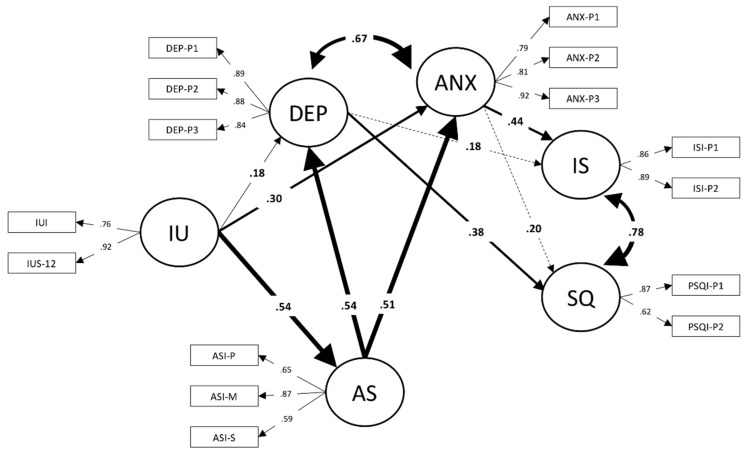
In this study, we used structural equation modeling to investigate the interplay among Intolerance of Uncertainty (IU), Anxiety Sensitivity (AS), and sleep problems. Three hundred undergraduate students completed the Intolerance of Uncertainty Scale, the Intolerance of Uncertainty Inventory, the Anxiety Sensitivity Index, the Beck Depression Inventory, the State-Trait Anxiety Inventory, the Pittsburgh Sleep Quality Index and the Insomnia Severity Index. 68% and 40% of the students reported poor sleep quality or sub-threshold insomnia problems, respectively. Depression and anxiety levels were above the cut-off for about one-fourth of the participants. Structural equation modeling revealed that IU was strongly associated with AS, in turn influencing both insomnia severity and sleep quality via depression and anxiety. Significant indirect effects revealed that an anxious pathway was more strongly associated with insomnia severity, while a depression pathway was more relevant for worsening the quality of sleep. We discussed the results in the frameworks of cognitive models of insomnia. Viewing AS and IU as antecedents of sleep problems and assigning to AS a pivotal role, our study suggested indications for clinical interventions on a population at risk for sleep disorders.
在这项研究中,我们使用结构方程模型来探讨不确定性容忍度(IU)、焦虑敏感性(AS)和睡眠问题之间的相互作用。300 名大学生完成了不确定性容忍度量表、不确定性容忍度问卷、焦虑敏感性指数、贝克抑郁量表、状态-特质焦虑量表、匹兹堡睡眠质量指数和失眠严重程度指数。分别有 68%和 40%的学生报告睡眠质量差或亚阈值失眠问题。大约四分之一的参与者的抑郁和焦虑水平超过了临界值。结构方程模型显示,IU 与 AS 密切相关,进而通过抑郁和焦虑影响失眠严重程度和睡眠质量。显著的间接效应表明,焦虑途径与失眠严重程度的相关性更强,而抑郁途径与睡眠质量的恶化更相关。我们在失眠的认知模型框架内讨论了结果。将 AS 和 IU 视为睡眠问题的前提,并赋予 AS 关键作用,我们的研究为针对有睡眠障碍风险的人群的临床干预提供了依据。