Department of Dermatology, Jichi Medical University, 3311-1 Yakushiji, Shimotsuke, Tochigi 329-0498, Japan.
Int J Mol Sci. 2019 Sep 5;20(18):4347. doi: 10.3390/ijms20184347.
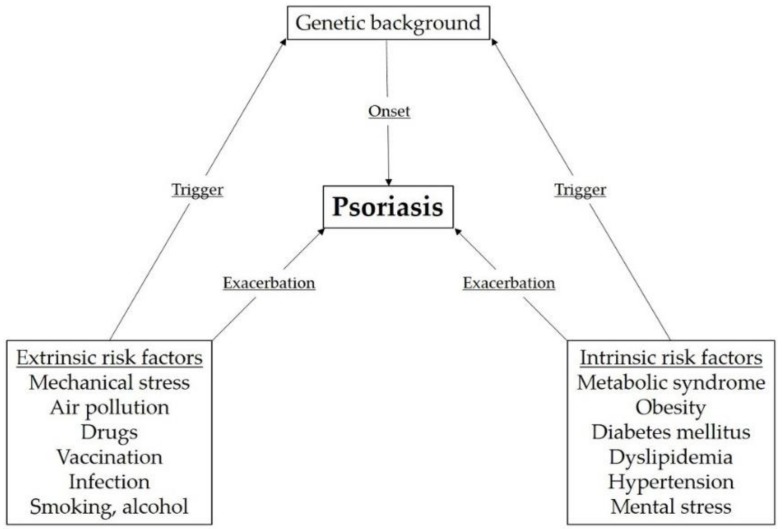
Psoriasis is an immune-mediated genetic skin disease. The underlying pathomechanisms involve complex interaction between the innate and adaptive immune system. T cells interact with dendritic cells, macrophages, and keratinocytes, which can be mediated by their secreted cytokines. In the past decade, biologics targeting tumor necrosis factor-α, interleukin (IL)-23, and IL-17 have been developed and approved for the treatment of psoriasis. These biologics have dramatically changed the treatment and management of psoriasis. In contrast, various triggering factors can elicit the disease in genetically predisposed individuals. Recent studies suggest that the exacerbation of psoriasis can lead to systemic inflammation and cardiovascular comorbidity. In addition, psoriasis may be associated with other auto-inflammatory and auto-immune diseases. In this review, we summarize the risk factors, which can be divided into two groups (namely, extrinsic and intrinsic risk factors), responsible for the onset and exacerbation of psoriasis in order to facilitate its prevention.
银屑病是一种免疫介导的遗传性皮肤疾病。其潜在的发病机制涉及先天免疫和适应性免疫系统之间的复杂相互作用。T 细胞与树突状细胞、巨噬细胞和角质形成细胞相互作用,这些作用可以通过它们分泌的细胞因子来介导。在过去的十年中,针对肿瘤坏死因子-α、白细胞介素(IL)-23 和 IL-17 的生物制剂已被开发并批准用于治疗银屑病。这些生物制剂极大地改变了银屑病的治疗和管理方式。相比之下,各种触发因素可导致遗传易感个体发病。最近的研究表明,银屑病的恶化可导致全身炎症和心血管合并症。此外,银屑病可能与其他自身炎症性和自身免疫性疾病相关。在这篇综述中,我们总结了导致银屑病发病和恶化的危险因素,可将其分为两组(即外在和内在危险因素),以促进其预防。