
群体管水母的操纵性能
Maneuvering Performance in the Colonial Siphonophore, .
作者信息
Sutherland Kelly R, Gemmell Brad J, Colin Sean P, Costello John H
机构信息
Oregon Institute of Marine Biology, University of Oregon, Eugene, OR 97402, USA.
Department of Integrative Biology, University of South Florida, Tampa, FL 33620, USA.
出版信息
Biomimetics (Basel). 2019 Sep 5;4(3):62. doi: 10.3390/biomimetics4030062.
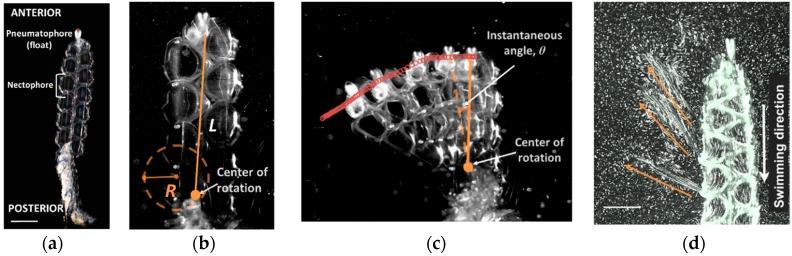
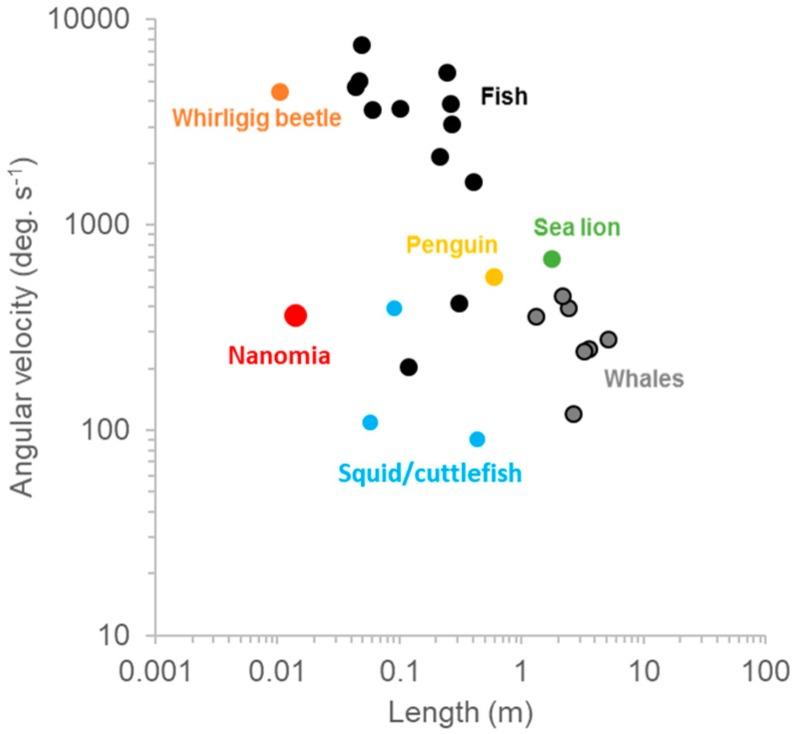
The colonial cnidarian, , is highly proficient at moving in three-dimensional space through forward swimming, reverse swimming and turning. We used high speed videography, particle tracking, and particle image velocimetry (PIV) with frame rates up to 6400 s to study the kinematics and fluid mechanics of during turning and reversing. achieved turns with high maneuverability (mean length-specific turning radius, R/L = 0.15 ± 0.10) and agility (mean angular velocity, ω = 104 ± 41 deg. s). The maximum angular velocity of , 215 deg. s, exceeded that of many vertebrates with more complex body forms and neurocircuitry. Through the combination of rapid nectophore contraction and velum modulation, generated high speed, narrow jets (maximum = 1063 ± 176 mm s; 295 nectophore lengths s) and thrust vectoring, which enabled high speed reverse swimming (maximum = 134 ± 28 mm s; 37 nectophore lengths s) that matched previously reported forward swimming speeds. A 1:1 ratio of forward to reverse swimming speed has not been recorded in other swimming organisms. Taken together, the colonial architecture, simple neurocircuitry, and tightly controlled pulsed jets by allow for a diverse repertoire of movements. Considering the further advantages of scalability and redundancy in colonies, is a model system for informing underwater propulsion and navigation of complex environments.
群体刺胞动物 在三维空间中通过向前游动、向后游动和转向等方式具有很高的移动能力。我们使用高速摄像、粒子跟踪和帧速率高达6400帧/秒的粒子图像测速技术(PIV)来研究 在转向和倒车时的运动学和流体力学。 实现了高机动性的转向(平均体长比转向半径,R/L = 0.15 ± 0.10)和敏捷性(平均角速度,ω = 104 ± 41度/秒)。 的最大角速度为215度/秒,超过了许多身体形态和神经回路更复杂的脊椎动物。通过快速的泳钟收缩和膜的调节相结合, 产生了高速、狭窄的射流(最大值 = 1063 ± 176毫米/秒;295个泳钟体长/秒)和推力矢量,这使得高速向后游动(最大值 = 134 ± 28毫米/秒;37个泳钟体长/秒)成为可能,其速度与先前报道的向前游动速度相匹配。在其他游泳生物中尚未记录到向前和向后游动速度的1:1比例。综合来看, 的群体结构、简单的神经回路以及对脉冲射流的严格控制允许其进行多样的运动。考虑到群体中可扩展性和冗余性的进一步优势, 是一个用于为复杂环境中的水下推进和导航提供信息的模型系统。



 Zotero 插件