Rosemary Bryant AO Research Centre, School of Nursing and Midwifery and UniSA Cancer Research Institute, University of South Australia, Adelaide, Australia.
The Netherlands Comprehensive Cancer Organization, Utrecht, the Netherlands.
J Cancer Surviv. 2019 Dec;13(6):829-839. doi: 10.1007/s11764-019-00793-7. Epub 2019 Sep 6.
Attrition and subsequent missing data pose a challenge in longitudinal research in oncology. This study examined factors associated with attrition in the PROFILES registry, and its impact on observed health-related quality of life (HRQOL) estimates.
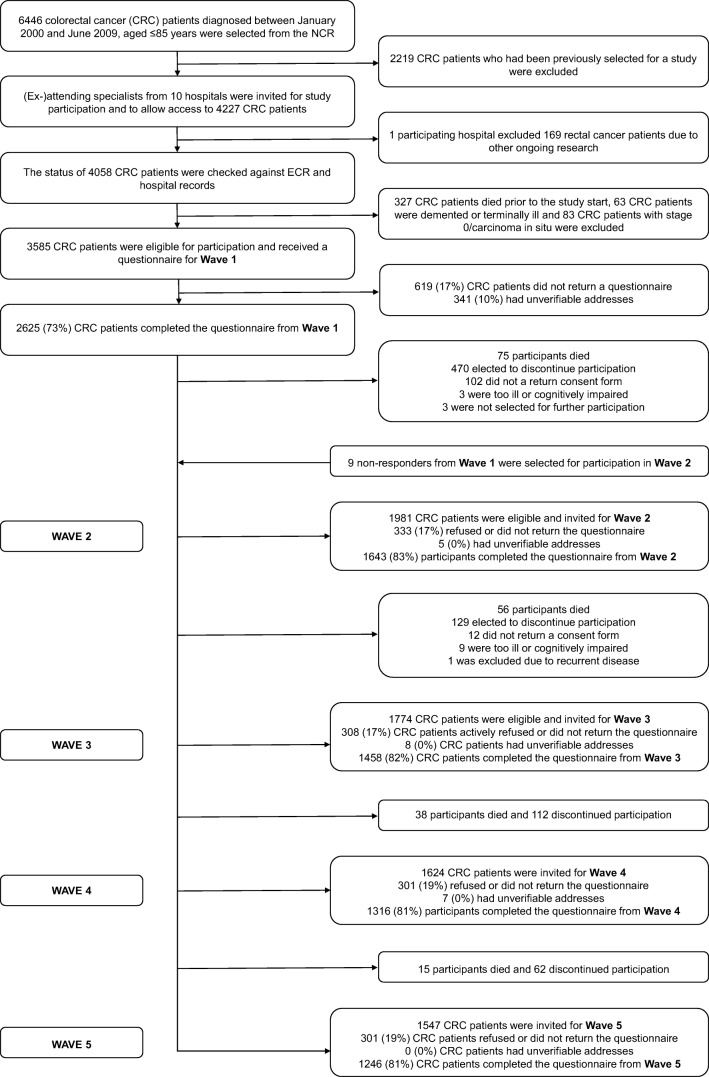
Sociodemographic, clinical, and HRQOL data were collected annually from a cohort of 2625 colorectal cancer survivors between 2010 and 2015. Participant characteristics according to time of dropout were compared using analysis of variance and chi-square tests. Predictors of attrition were examined in logistic regression analysis. Multilevel linear mixed models were constructed to investigate associations between attrition and HRQOL over time.
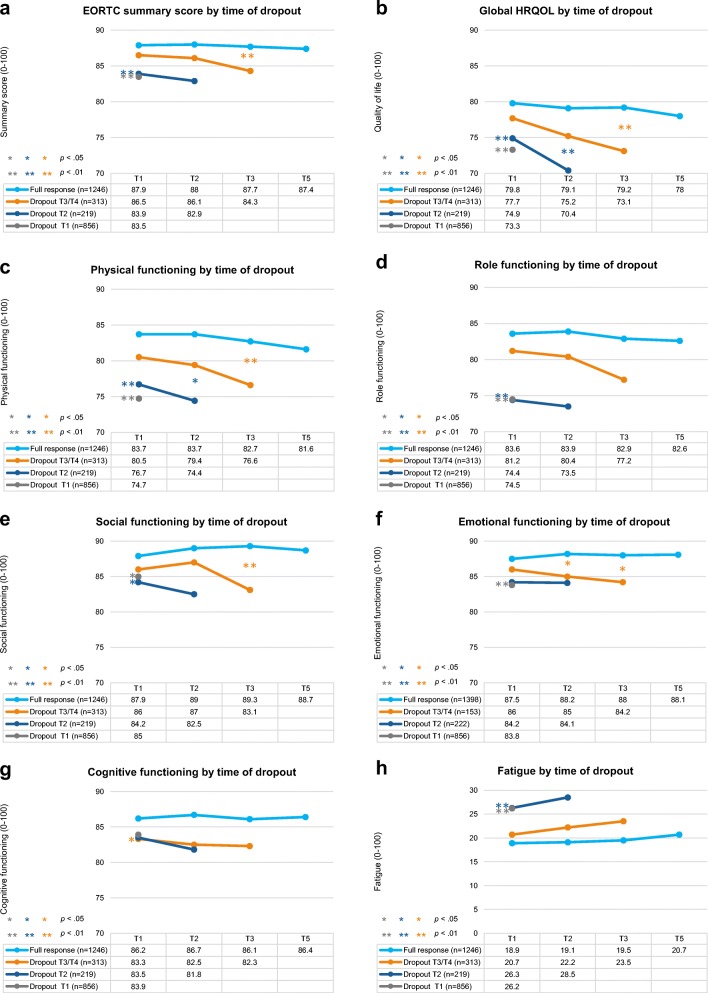
Participants who dropped out were more likely to be female (OR = 1.23, CI = 1.02-1.47), older (OR = 1.20, CI = 1.09-1.33), less educated (OR = 1.64, CI = 1.30-2.11), and to have depressive symptoms (OR = 1.84, CI = 1.39-2.44) than full responders, and less likely to have high socioeconomic status (OR = 0.74, CI = 0.61-0.94). Participants who dropped out earlier reported significantly worse HRQOL, functioning, and psychosocial symptoms, which declined at a steeper rate over time, than full responders.
Cancer survivors' HRQOL may be overestimated in longitudinal research due to attrition of the most unwell participants.
Cancer survivors with the poorest health are at risk of dropping out of PROFILES and possibly withdrawing from other activities. Optimizing participation in PROFILES-a potential mechanism for providing information and access to support-is an avenue for keeping this group engaged.
在肿瘤学的纵向研究中,流失和随后的数据缺失是一个挑战。本研究旨在探讨 PROFILES 注册研究中流失的相关因素及其对观察到的健康相关生活质量(HRQOL)评估的影响。
2010 年至 2015 年间,每年从 2625 名结直肠癌幸存者的队列中收集社会人口统计学、临床和 HRQOL 数据。使用方差分析和卡方检验比较根据退出时间的参与者特征。使用逻辑回归分析检验流失的预测因素。构建多层次线性混合模型,以调查随时间流失与 HRQOL 之间的关联。
与完全应答者相比,退出的参与者更可能是女性(OR=1.23,CI=1.02-1.47)、年龄较大(OR=1.20,CI=1.09-1.33)、受教育程度较低(OR=1.64,CI=1.30-2.11)和抑郁症状(OR=1.84,CI=1.39-2.44),而不太可能具有高社会经济地位(OR=0.74,CI=0.61-0.94)。较早退出的参与者报告的 HRQOL、功能和心理社会症状明显较差,且随时间的推移下降速度更快,而完全应答者则不是。
由于最不适的参与者流失,癌症幸存者的 HRQOL 在纵向研究中可能被高估。
健康状况最差的癌症幸存者有退出 PROFILES 并可能退出其他活动的风险。优化 PROFILES 的参与度-提供信息和获得支持的潜在机制-是让这一群体参与进来的一种途径。