Weidenbusch Marc, Lenzer Benedikt, Sailer Maximilian, Strobel Christian, Kunisch Raphael, Kiesewetter Jan, Fischer Martin R, Zottmann Jan M
Institute for Medical Education, University Hospital of LMU Munich, Munich, Germany.
Department of Internal Medicine IV, University Hospital of LMU Munich, Munich, Germany.
BMJ Open. 2019 Sep 6;9(9):e025973. doi: 10.1136/bmjopen-2018-025973.
Fostering clinical reasoning is a mainstay of medical education. Based on the clinicopathological conferences, we propose a case-based peer teaching approach called clinical case discussions (CCDs) to promote the respective skills in medical students. This study compares the effectiveness of different CCD formats with varying degrees of social interaction in fostering clinical reasoning.
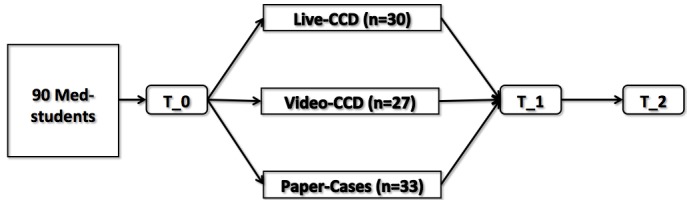
DESIGN, SETTING, PARTICIPANTS: A single-centre randomised controlled trial with a parallel design was conducted at a German university. Study participants (N=106) were stratified and tested regarding their clinical reasoning skills right after CCD participation and 2 weeks later.
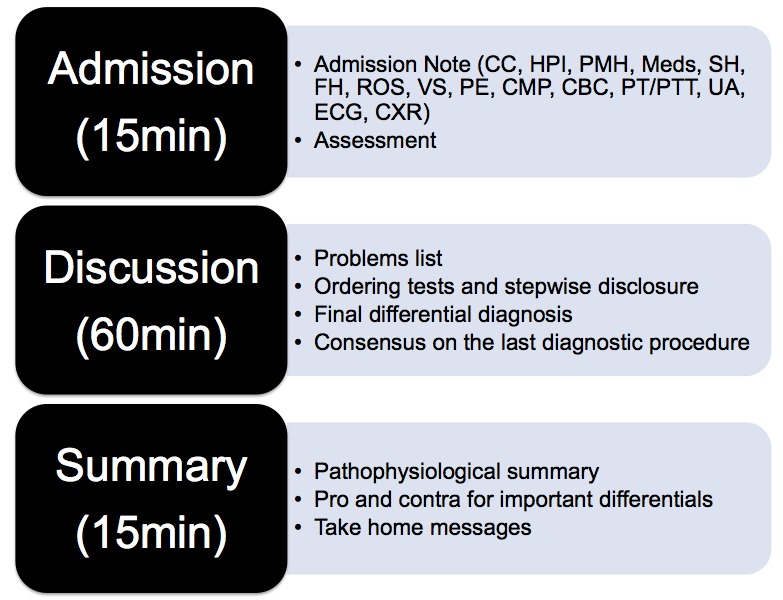
Participants worked within a live discussion group (Live-CCD), a group watching recordings of the live discussions (Video-CCD) or a group working with printed cases (Paper-Cases). The presentation of case information followed an admission-discussion-summary sequence.
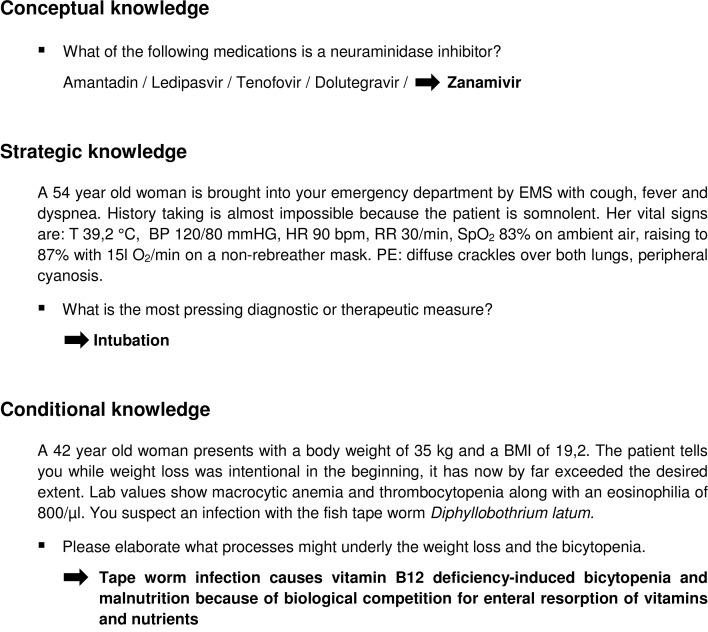
Clinical reasoning skills were measured with a knowledge application test addressing the students' conceptual, strategic and conditional knowledge. Additionally, subjective learning outcomes were assessed.
With respect to learning outcomes, the Live-CCD group displayed the best results, followed by Video-CCD and Paper-Cases, F(2,87)=27.07, p<0.001, partial η=0.384. No difference was found between Live-CCD and Video-CCD groups in the delayed post-test; however, both outperformed the Paper-Cases group, F(2,87)=30.91, p<0.001, partial η=0.415. Regarding subjective learning outcomes, the Live-CCD received significantly better ratings than the other formats, F(2,85)=13.16, p<0.001, partial η=0.236.
This study demonstrates that the CCD approach is an effective and sustainable clinical reasoning teaching resource for medical students. Subjective learning outcomes underline the importance of learner (inter)activity in the acquisition of clinical reasoning skills in the context of case-based learning. Higher efficacy of more interactive formats can be attributed to positive effects of collaborative learning. Future research should investigate how the Live-CCD format can further be improved and how video-based CCDs can be enhanced through instructional support.
培养临床推理能力是医学教育的核心内容。基于临床病理讨论会,我们提出了一种名为临床病例讨论(CCD)的基于案例的同伴教学方法,以提升医学生的相关技能。本研究比较了不同社交互动程度的CCD形式在培养临床推理能力方面的有效性。
设计、地点、参与者:在一所德国大学进行了一项采用平行设计的单中心随机对照试验。研究参与者(N = 106)在参与CCD后及2周后进行分层,并就其临床推理技能进行测试。
参与者分别在现场讨论组(现场CCD)、观看现场讨论录像的组(视频CCD)或处理纸质病例的组(纸质病例组)中开展学习。病例信息的呈现遵循入院-讨论-总结的顺序。
通过一项知识应用测试来衡量临床推理技能,该测试涉及学生的概念性、策略性和条件性知识。此外,还评估了主观学习成果。
在学习成果方面,现场CCD组表现最佳,其次是视频CCD组和纸质病例组,F(2,87)=27.07,p<0.001,偏η=0.384。在延迟后测中,现场CCD组和视频CCD组之间未发现差异;然而,两者均优于纸质病例组,F(2,87)=30.91,p<0.001,偏η=0.415。在主观学习成果方面,现场CCD组的评分显著高于其他形式,F(2,85)=13.16,p<0.001,偏η=0.236。
本研究表明,CCD方法是一种对医学生有效的、可持续的临床推理教学资源。主观学习成果强调了学习者(互动)活动在基于案例学习背景下获取临床推理技能中的重要性。更多互动形式的更高成效可归因于合作学习的积极作用。未来研究应探讨如何进一步改进现场CCD形式,以及如何通过教学支持来增强基于视频的CCD。