Nicola Murray Centre for Ovarian Cancer Research, Cancer Research UK Edinburgh Centre, MRC Institute of Genetics and Molecular Medicine, University of Edinburgh, UK.
Nicola Murray Centre for Ovarian Cancer Research, Cancer Research UK Edinburgh Centre, MRC Institute of Genetics and Molecular Medicine, University of Edinburgh, UK.
Gynecol Oncol. 2019 Nov;155(2):318-323. doi: 10.1016/j.ygyno.2019.09.001. Epub 2019 Sep 5.
Numerous studies have investigated the association between hormone receptor expression and clinical outcome in ovarian carcinoma (OC); however, these have largely focussed on serous OCs, with few studies reporting specifically on endometrioid OCs (EnOC). Where analyses have been stratified by histotype, expression has been assessed using the percentage of positive tumor cells, without accounting for nuclear expression intensity.
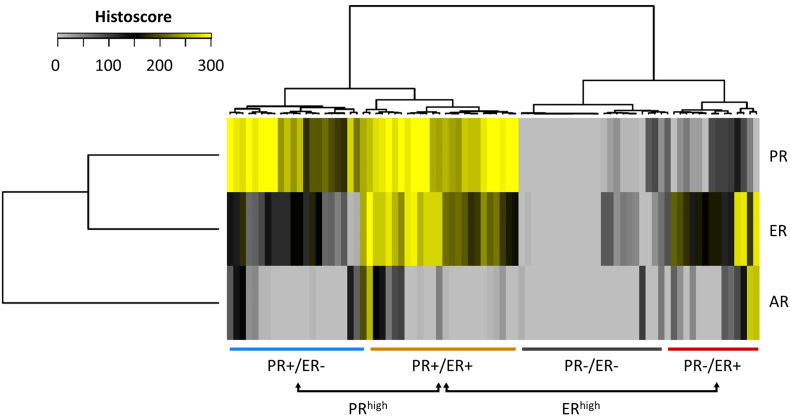
Here we assess the expression levels of progesterone receptor (PR), estrogen receptor alpha (ER) and androgen receptor (AR) using histoscore - a nuclear scoring method incorporating both proportion of positive cells and the intensity of nuclear staining - across a cohort of 107 WT1 negative EnOCs.
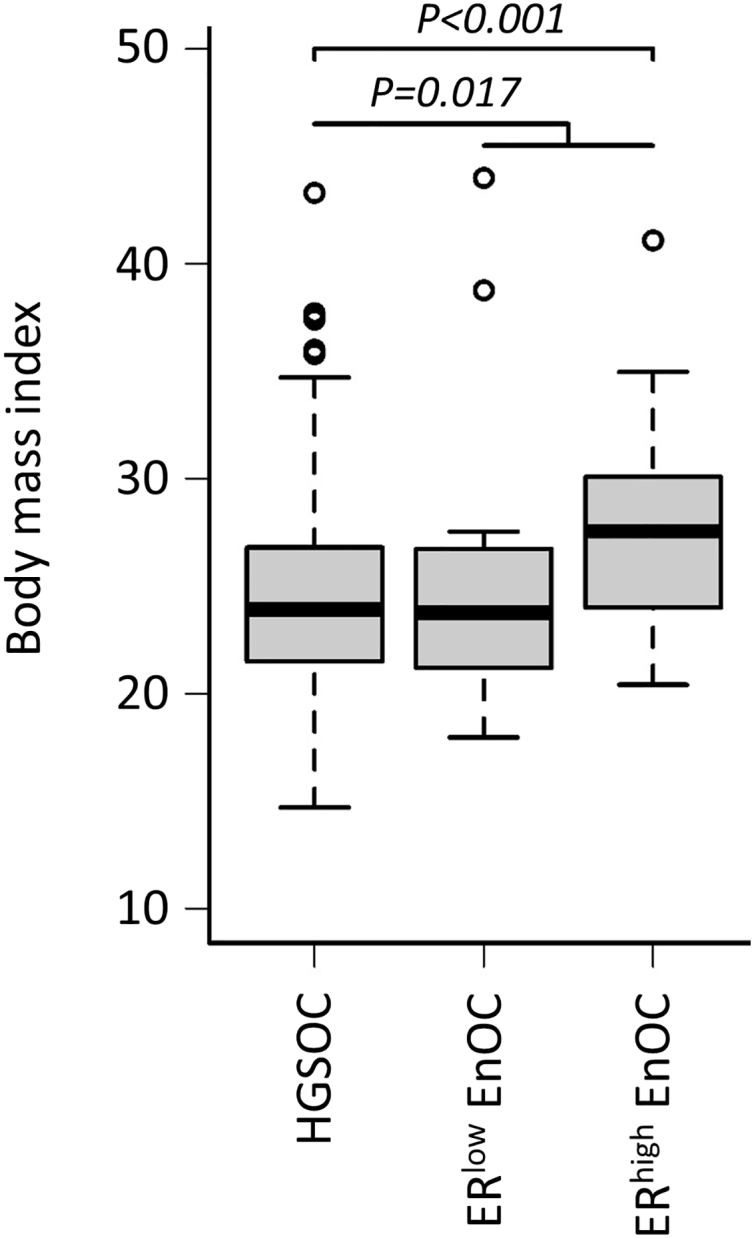
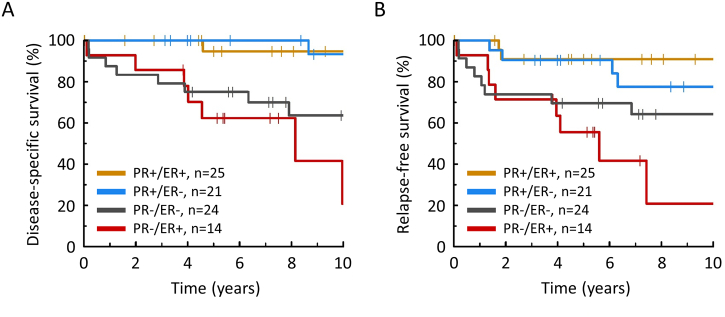
Hierarchical clustering by PR, ER and AR histoscores identified four EnOC subgroups (PR+/ER+, PR+/ER-, PR-/ER+ and PR-/ER-). EnOC patients in the PR+/ER+ and PR+/ER- groups displayed favorable outcome (multivariable HR for disease-specific survival 0.05 [0.01-0.35] and 0.05 [0.00-0.51]) compared to the PR-/ER+ group. Ten-year survival for stage II PR and PR cases was 94.1% and 42.4%. ER EnOC patients (PR+/ER+, PR-/ER+) had higher body mass index compared to ER cases (P = 0.015) and high grade serous OC patients (P < 0.001).
These data demonstrate that endometrioid OC cases with high PR expression display markedly favorable outcome. Stage II EnOCs with high PR expression represent potential candidates for de-escalation of first-line therapy. Future work should seek to characterise the sensitivity of PR and ER positive EnOCs to endocrine therapy.
大量研究调查了激素受体表达与卵巢癌(OC)临床结局的关系;然而,这些研究主要集中在浆液性 OC 上,很少有研究专门报告子宫内膜样 OC(EnOC)。在按组织类型分层的分析中,使用阳性肿瘤细胞的百分比评估表达,而不考虑核表达强度。
在这里,我们使用组织评分(一种包含阳性细胞比例和核染色强度的核评分方法)评估了 107 例 WT1 阴性 EnOC 中孕激素受体(PR)、雌激素受体 alpha(ER)和雄激素受体(AR)的表达水平。
PR、ER 和 AR 组织评分的层次聚类确定了 4 个 EnOC 亚组(PR+/ER+、PR+/ER-、PR-/ER+和 PR-/ER-)。与 PR-/ER+组相比,PR+/ER+和 PR+/ER-组的 EnOC 患者预后良好(疾病特异性生存的多变量 HR 分别为 0.05 [0.01-0.35] 和 0.05 [0.00-0.51])。Ⅱ期 PR 和 PR 病例的 10 年生存率分别为 94.1%和 42.4%。与 ER 病例(PR+/ER+、PR-/ER+)相比,ER EnOC 患者(PR+/ER+、PR-/ER+)的体重指数更高(P=0.015),且比高级别浆液性 OC 患者更高(P<0.001)。
这些数据表明,高 PR 表达的子宫内膜样 OC 病例具有明显的良好预后。高 PR 表达的Ⅱ期 EnOC 可能是一线治疗降级的潜在候选者。未来的研究应致力于描述 PR 和 ER 阳性 EnOC 对内分泌治疗的敏感性。