Lau Esther Tl, Tan Shirin H, Antwertinger Yasmin J, Hall Tony, Nissen Lisa M
School of Clinical Sciences, Queensland University of Technology, Brisbane, QLD, Australia.
School of Pharmacy, University of Queensland, Brisbane, QLD, Australia.
J Pain Res. 2019 Aug 5;12:2441-2455. doi: 10.2147/JPR.S199017. eCollection 2019.
People living with persistent pain in Australia often cannot access adequate care to manage their pain. Therefore, as the most accessible healthcare professionals, community pharmacists have an important role to play in helping to improve patient outcomes. Hence, it is important to investigate patient needs and expectations in terms of counseling interactions with pharmacists, along with pharmacists' approach to counseling interactions with these patients.
The nature of patient-pharmacist counseling interactions was explored with seven patients (one focus group), and 10 practicing pharmacists (two focus groups, three semi-structured interviews). The themes identified informed the development of an online survey that was advertised online to patients and pharmacists across Australia.
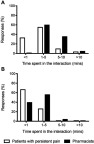
A total of 95 patients and 208 pharmacists completed the survey. Overall, more than half of patients (77/95) were satisfied with the care provided by their pharmacist, but only a third (71/205) of pharmacists were satisfied with the care they provided to patients. The majority of patients (67/94) reported that pharmacists provided good information about medications. This aligned with pharmacists' responses, as most reported focusing on medication side effects (118/188) and instructions for taking pain medication (93/183) during patient interactions. However, when asked about empathy and rapport from pharmacists, only half to two-thirds (48-61/95) of patients expressed positive views. Overall, half of the patients (39/75) wanted a caring, empathetic, respectful, and private conversation with the pharmacist, and nearly half (40/89) perceived the pharmacist's role as providing (new) information on alternative pharmacological and non-pharmacological therapies, including general advice on pain management.
There was a disparity in the nature of the interaction and information that patients wanted from pharmacists, compared to what was provided by pharmacists. Training and education may help pharmacists to better engage in patient-centered care when interacting with people living with persistent pain, thereby improving health outcomes for these patients.
在澳大利亚,患有持续性疼痛的人往往无法获得足够的疼痛管理护理。因此,作为最易接触到的医疗保健专业人员,社区药剂师在帮助改善患者治疗效果方面可发挥重要作用。因此,调查患者在与药剂师咨询互动方面的需求和期望,以及药剂师与这些患者进行咨询互动的方式非常重要。
通过与7名患者(一个焦点小组)和10名执业药剂师(两个焦点小组、三次半结构化访谈)探讨患者与药剂师咨询互动的性质。确定的主题为一项在线调查的开展提供了信息,该调查在澳大利亚各地向患者和药剂师进行了线上宣传。
共有95名患者和208名药剂师完成了调查。总体而言,超过一半的患者(77/95)对药剂师提供的护理感到满意,但只有三分之一(71/205)的药剂师对他们为患者提供的护理感到满意。大多数患者(67/94)报告称药剂师提供了有关药物的良好信息。这与药剂师的回答一致,因为大多数药剂师报告在与患者互动时关注药物副作用(118/188)和服用止痛药的说明(93/183)。然而,当被问及药剂师的同理心和融洽关系时,只有一半到三分之二(48 - 61/95)的患者表达了积极看法。总体而言,一半的患者(39/75)希望与药剂师进行体贴、有同理心、尊重且私密的交谈,近一半(40/89)的患者认为药剂师的角色是提供关于替代药物和非药物疗法的(新)信息,包括疼痛管理的一般建议。
与药剂师提供的内容相比,患者希望从药剂师那里获得的互动性质和信息存在差异。培训和教育可能有助于药剂师在与患有持续性疼痛的人互动时更好地参与以患者为中心的护理,从而改善这些患者的健康状况。