Byrum Stephanie D, Washam Charity L, Tackett Alan J, Garcia-Rill Edgar, Bisagno Veronica, Urbano Francisco J
Center for Translational Pediatric Research, Arkansas Children's Research Institute, Little Rock, AR, USA.
Center for Translational Neuroscience, University of Arkansas for Medical Sciences, Little Rock, AR, USA.
Heliyon. 2019 Aug 28;5(8):e02265. doi: 10.1016/j.heliyon.2019.e02265. eCollection 2019 Aug.
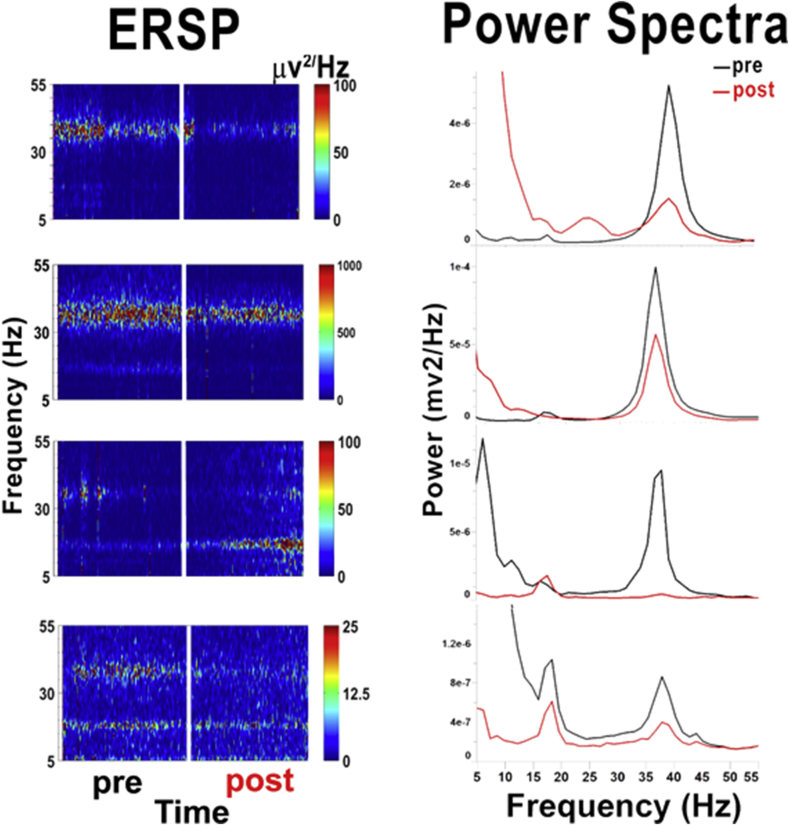
Gamma oscillations serve complex processes, and the first stage of their generation is the reticular activating system (RAS), which mediates the gamma-activity states of waking and paradoxical sleep. We studied whether the pedunculopontine nucleus (PPN), part of the RAS in which every cell manifests intrinsic gamma oscillations, undergoes changes resulting in distinctive protein expression.
We previously found that a histone deacetylation inhibitor, trichostatin A (TSA), acutely (30 min) blocked these oscillations. We developed a proteomic method for sampling stimulated and unstimulated PPN and determining protein expression in 1 mm punches of tissue from brain slices subjected to various treatments.
We compared brain slices exposed for 30 min to TSA (unstimulated), to the cholinergic agonist carbachol (CAR), known to induce PPN gamma oscillations, or exposed to both TSA + CAR.Comparison with existing methods: Label-free proteomics provides an unbiased and sensitive method to detect protein changes in the PPN. Our approach is superior to antibody-based methods that can lack specificity and can only be done for known targets. Proteomics methods like these have been leveraged to study molecular pathways in numerous systems and disease states.
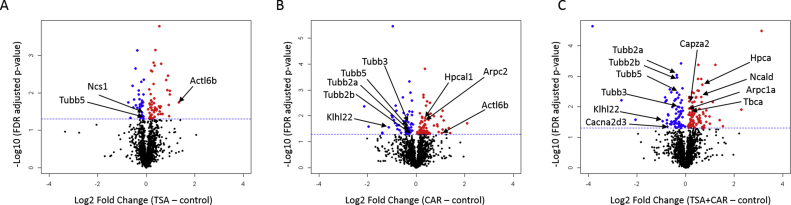
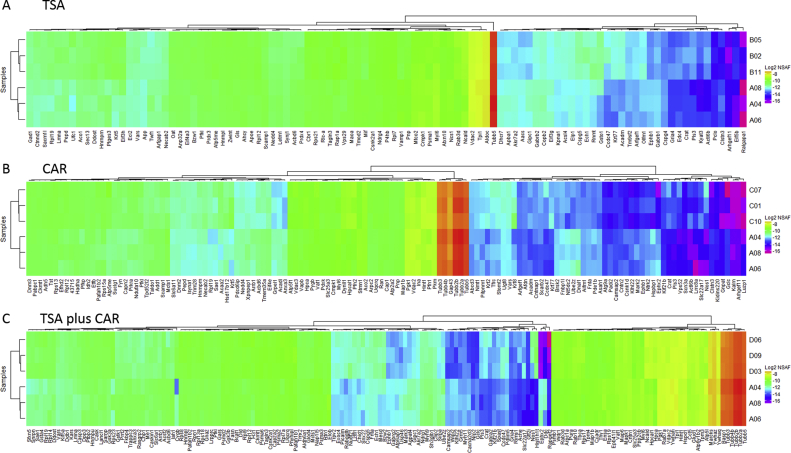
Significant protein changes were seen in two functions essential to the physiology of the PPN: cytoskeletal and intracellular [Ca] regulation proteins. TSA decreased, while CAR increased, and TSA + CAR had intermediate effects, on expression of these proteins. These results support the feasibility of the methods developed for determining proteomic changes in small samples of tissue participating in the most complex of brain processes.
γ振荡参与复杂的生理过程,其产生的第一阶段是网状激活系统(RAS),该系统介导清醒和异相睡眠的γ活动状态。我们研究了脑桥脚核(PPN),即RAS的一部分,其中每个细胞都表现出内在的γ振荡,是否会发生变化从而导致独特的蛋白质表达。
我们之前发现一种组蛋白去乙酰化抑制剂曲古抑菌素A(TSA)能急性(30分钟)阻断这些振荡。我们开发了一种蛋白质组学方法,用于对受刺激和未受刺激的PPN进行采样,并确定来自经各种处理的脑片1毫米组织块中的蛋白质表达。
我们将暴露于TSA 30分钟(未受刺激)、胆碱能激动剂卡巴胆碱(CAR,已知可诱导PPN的γ振荡)或同时暴露于TSA + CAR的脑片进行了比较。与现有方法的比较:无标记蛋白质组学为检测PPN中的蛋白质变化提供了一种无偏差且灵敏的方法。我们的方法优于基于抗体的方法,后者可能缺乏特异性且只能针对已知靶点进行检测。像这样的蛋白质组学方法已被用于研究众多系统和疾病状态下的分子途径。
在PPN生理学的两个重要功能中观察到了显著的蛋白质变化:细胞骨架和细胞内[Ca]调节蛋白。TSA降低了这些蛋白质的表达,而CAR增加了其表达,TSA + CAR则产生了中间效应。这些结果支持了所开发方法用于确定参与最复杂脑过程的小组织样本中蛋白质组变化的可行性。