Behavioural Science Institute, Radboud University, Nijmegen, The Netherlands.
Department of Psychiatry, Amsterdam UMC, University of Amsterdam, Amsterdam, The Netherlands.
Eur J Neurosci. 2020 Mar;51(6):1491-1503. doi: 10.1111/ejn.14574. Epub 2019 Oct 3.
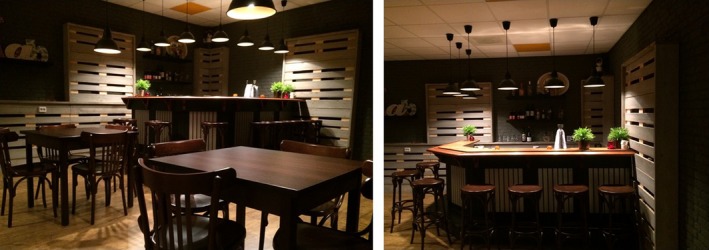
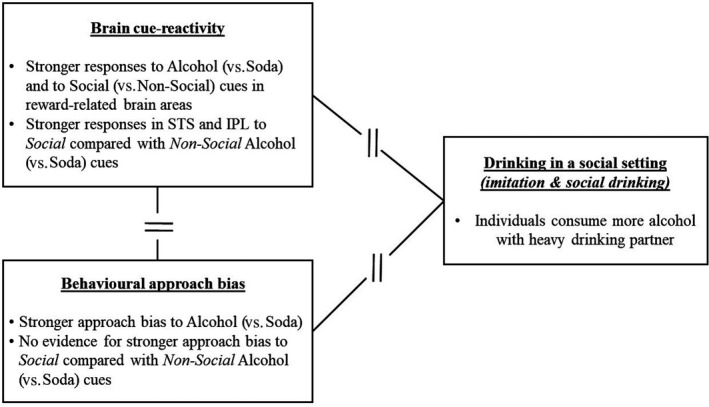
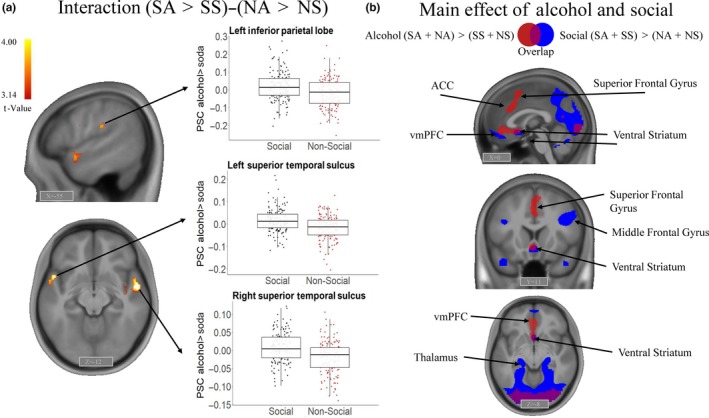
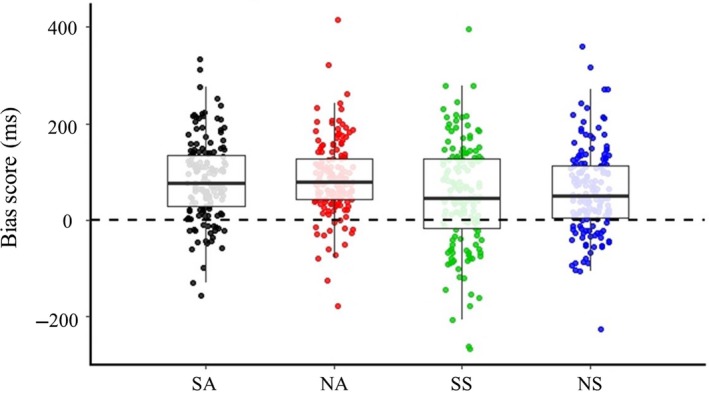
Alcohol is mainly consumed in social settings, in which people often adapt their drinking behaviour to that of others, also called imitation of drinking. Yet, it remains unclear what drives this drinking in a social setting. In this study, we expected to see stronger brain and behavioural responses to social compared to non-social alcohol cues, and these responses to be associated with drinking in a social setting. The sample consisted of 153 beer-drinking males, aged 18-25 years. Brain responses to social alcohol cues were measured during an alcohol cue-exposure task performed in an fMRI scanner. Behavioural responses to social alcohol cues were measured using a stimulus-response compatibility task, providing an index of approach bias towards these cues. Drinking in a social setting was measured in a laboratory mimicking a bar environment. Specific brain responses to social alcohol cues were observed in the bilateral superior temporal sulcus and the left inferior parietal lobe. There was no approach bias towards social alcohol cues specifically; however, we did find an approach bias towards alcohol (versus soda) cues in general. Brain responses and approach bias towards social alcohol cues were unrelated and not associated with actual drinking. Thus, we found no support for a relation between drinking in a social setting on the one hand, and brain cue-reactivity or behavioural approach biases to social alcohol cues on the other hand. This suggests that, in contrast to our hypothesis, drinking in a social setting may not be driven by brain or behavioural responses to social alcohol cues.
酒精主要在社交环境中消费,在这种环境中,人们经常模仿他人的饮酒行为,也称为饮酒模仿。然而,目前尚不清楚是什么驱动了这种社交环境下的饮酒行为。在这项研究中,我们预计会看到与非社交酒精线索相比,社交酒精线索会引起更强的大脑和行为反应,并且这些反应与社交环境下的饮酒有关。该样本由 153 名年龄在 18 至 25 岁之间的男性啤酒饮用者组成。在 fMRI 扫描仪中进行酒精线索暴露任务期间,测量了大脑对社交酒精线索的反应。使用刺激-反应相容性任务测量了对社交酒精线索的行为反应,提供了对这些线索的接近偏向指数。在模拟酒吧环境的实验室中测量了社交环境下的饮酒情况。观察到双侧颞上回和左顶下小叶对社交酒精线索的特定大脑反应。没有针对社交酒精线索的特定接近偏见;然而,我们确实发现了对一般酒精(与苏打水相比)线索的接近偏见。大脑对社交酒精线索的反应和接近偏见与实际饮酒无关。因此,我们没有发现社交环境下饮酒与大脑对社交酒精线索的反应或行为接近偏见之间存在关系的支持。这表明,与我们的假设相反,社交环境下的饮酒行为可能不是由大脑或对社交酒精线索的行为接近偏见驱动的。