Computational Psychiatry Research, Department of Psychiatry, Psychotherapy, and Psychosomatics, University of Zurich, CH-8032 Zurich, Switzerland,
Wellcome Centre for Human Neuroimaging and Max Planck/UCL Centre for Computational Psychiatry and Ageing Research, University College London, London WC1N 3BG United Kingdom.
J Neurosci. 2019 Oct 23;39(43):8517-8526. doi: 10.1523/JNEUROSCI.0412-19.2019. Epub 2019 Sep 9.
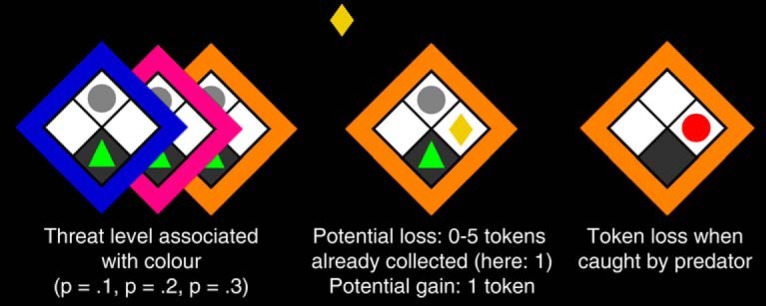
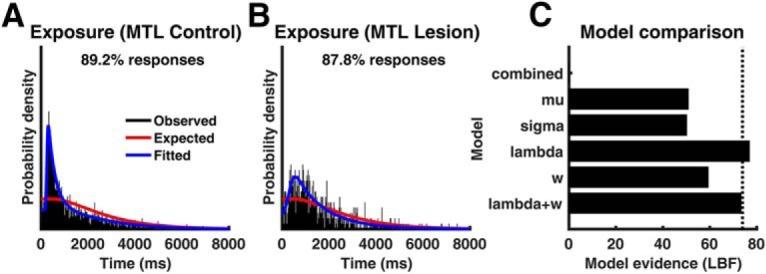
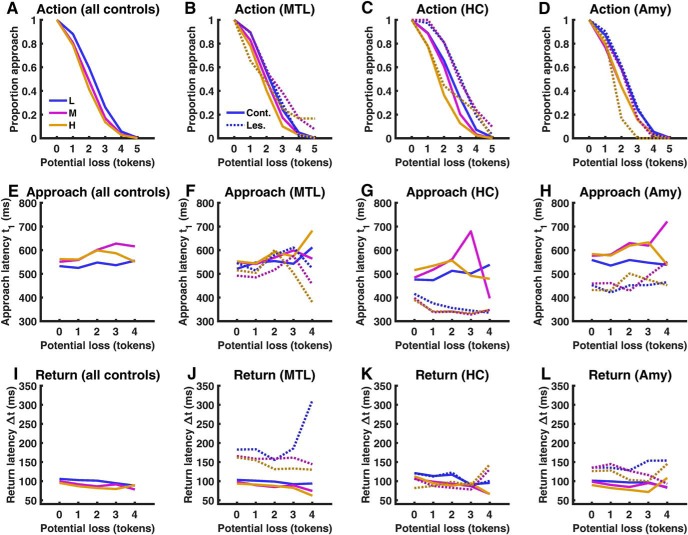
Anxiety comprises a suite of behaviors to deal with potential threat and is often modeled in approach-avoidance conflict tasks. Collectively, these tests constitute a predominant preclinical model of anxiety disorder. A body of evidence suggests that both ventral hippocampus and amygdala lesions impair anxiety-like behavior, but the relative contribution of these two structures is unclear. A possible reason is that approach-avoidance conflict tasks involve a series of decisions and actions, which may be controlled by distinct neural mechanisms that are difficult to disentangle from behavioral readouts. Here, we capitalize on a human approach-avoidance conflict test, implemented as computer game, that separately measures several action components. We investigate three patients of both sexes with unspecific unilateral medial temporal lobe (MTL) damage, one male with selective bilateral hippocampal (HC), and one female with selective bilateral amygdala lesions, and compare them to matched controls. MTL and selective HC lesions, but not selective amygdala lesions, increased approach decision when possible loss was high. In contrast, MTL and selective amygdala lesions, but not selective HC lesions, increased return latency. Additionally, selective HC and selective amygdala lesions reduced approach latency. In a task targeted at revealing subjective assumptions about the structure of the computer game, MTL and selective HC lesions impacted on reaction time generation but not on the subjective task structure. We conclude that deciding to approach reward under threat relies on hippocampus but not amygdala, whereas vigor of returning to safety depends on amygdala but not on hippocampus. Approach-avoidance conflict tests are widely investigated in rodents, and increasingly in humans, to understand the neural basis of anxiety-like behavior. However, the contribution of the most relevant brain regions, ventral hippocampus and amygdala, is incompletely understood. We use a human computerized test that separates different action components and find that hippocampus, but not amygdala, lesions impair approach decisions, whereas amygdala, but not hippocampus, lesions impair the vigor of return to safety.
焦虑包括一系列应对潜在威胁的行为,通常在趋近-回避冲突任务中进行建模。这些测试共同构成了焦虑障碍的主要临床前模型。有大量证据表明,腹侧海马体和杏仁核损伤都会损害类似焦虑的行为,但这两个结构的相对贡献尚不清楚。一个可能的原因是,趋近-回避冲突任务涉及一系列决策和行动,这些决策和行动可能受到难以从行为结果中分离出来的不同神经机制的控制。在这里,我们利用一种作为计算机游戏实施的人类趋近-回避冲突测试,该测试分别测量了几个动作成分。我们研究了三名男女患者,他们均患有非特异性单侧内侧颞叶(MTL)损伤,一名男性患者双侧海马体(HC)选择性损伤,一名女性患者双侧杏仁核选择性损伤,并将他们与匹配的对照组进行比较。MTL 和选择性 HC 损伤,但不是选择性杏仁核损伤,当可能的损失较高时,会增加趋近决策。相比之下,MTL 和选择性杏仁核损伤,但不是选择性 HC 损伤,会增加返回潜伏期。此外,选择性 HC 和选择性杏仁核损伤会降低趋近潜伏期。在一项旨在揭示对计算机游戏结构的主观假设的任务中,MTL 和选择性 HC 损伤影响反应时间生成,但不影响主观任务结构。我们得出结论,在受到威胁时决定趋近奖励取决于海马体,但不取决于杏仁核,而返回安全的活力取决于杏仁核,但不取决于海马体。趋近-回避冲突测试在啮齿动物中得到广泛研究,并且越来越多地在人类中进行,以了解类似焦虑行为的神经基础。然而,最相关的大脑区域——腹侧海马体和杏仁核的贡献尚不完全清楚。我们使用一种分离不同动作成分的人类计算机测试,发现海马体而不是杏仁核损伤会损害趋近决策,而杏仁核而不是海马体损伤会损害返回安全的活力。