CREAF, 08193, Cerdanyola del Vallès, Spain.
Department of Biology, Washington University in Saint Louis, St. Louis, MO, 63130, USA.
Nat Commun. 2019 Sep 9;10(1):4077. doi: 10.1038/s41467-019-11943-x.
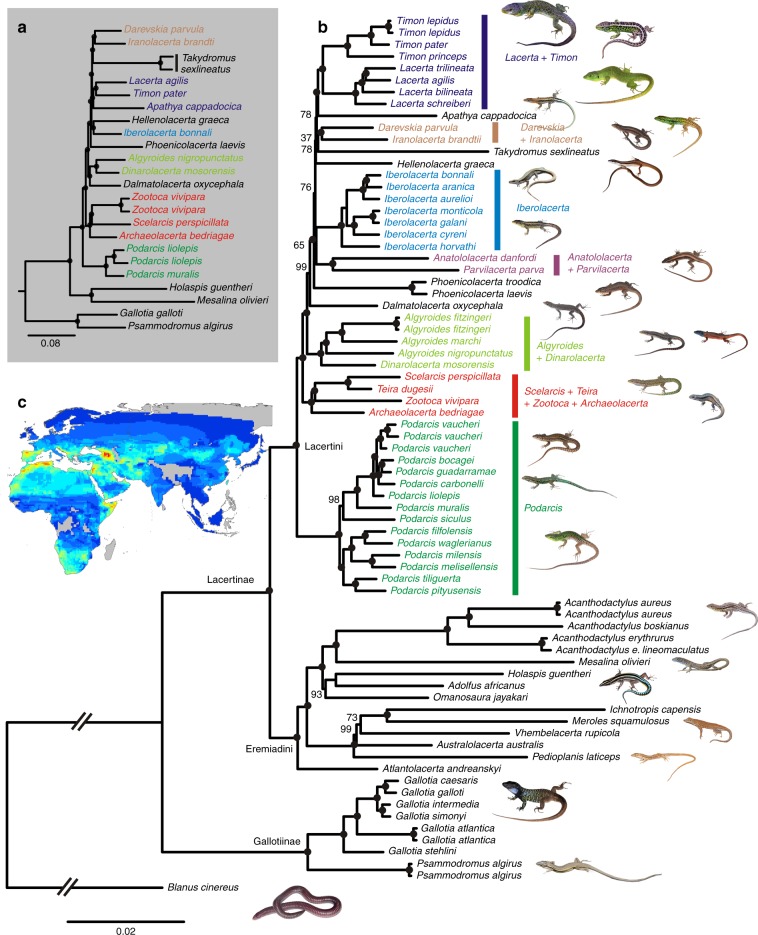
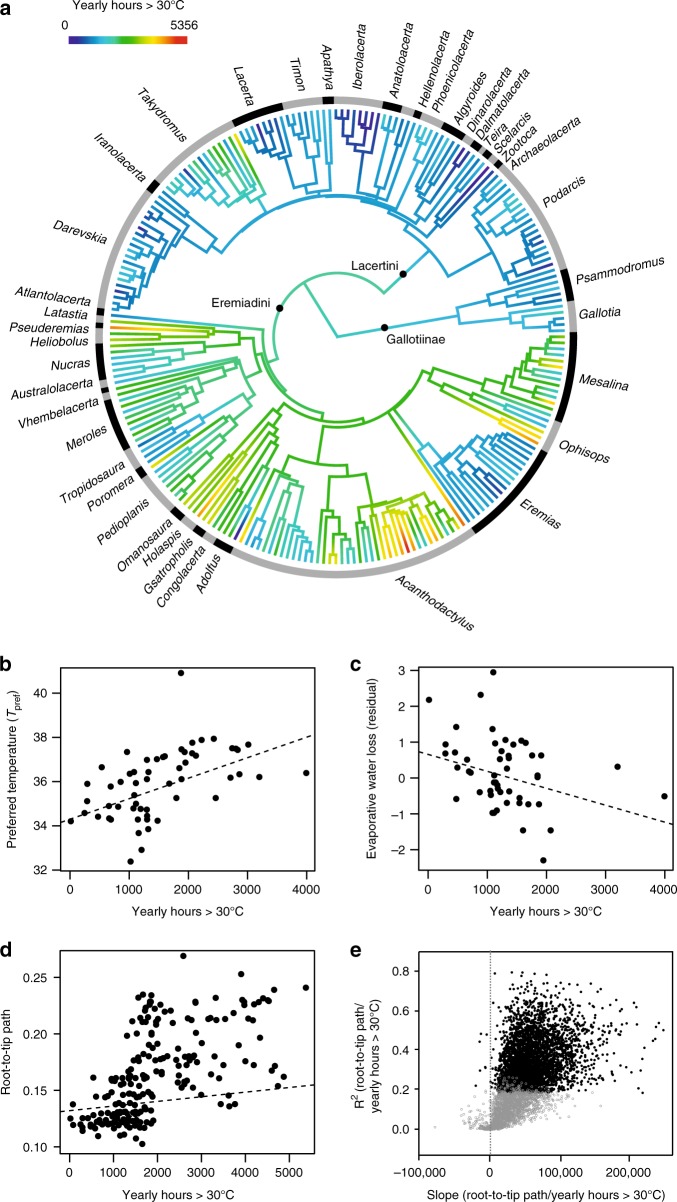
Climatic conditions changing over time and space shape the evolution of organisms at multiple levels, including temperate lizards in the family Lacertidae. Here we reconstruct a dated phylogenetic tree of 262 lacertid species based on a supermatrix relying on novel phylogenomic datasets and fossil calibrations. Diversification of lacertids was accompanied by an increasing disparity among occupied bioclimatic niches, especially in the last 10 Ma, during a period of progressive global cooling. Temperate species also underwent a genome-wide slowdown in molecular substitution rates compared to tropical and desert-adapted lacertids. Evaporative water loss and preferred temperature are correlated with bioclimatic parameters, indicating physiological adaptations to climate. Tropical, but also some populations of cool-adapted species experience maximum temperatures close to their preferred temperatures. We hypothesize these species-specific physiological preferences may constitute a handicap to prevail under rapid global warming, and contribute to explaining local lizard extinctions in cool and humid climates.
随着时间和空间的气候变化,塑造了生物体在多个层次上的进化,包括蜥蜴科的温带蜥蜴。在这里,我们基于一个超级矩阵,结合新的系统发育基因组数据集和化石校准,重建了 262 种蜥蜴的有时间分辨率的系统发育树。蜥蜴科的多样化伴随着其占据的生物气候生态位之间的差异不断增加,尤其是在过去的 1000 万年中,这是一个全球逐渐变冷的时期。与热带和沙漠适应的蜥蜴相比,温带物种的分子替代率也经历了全基因组的减缓。蒸发失水和适宜温度与生物气候参数相关,表明对气候的生理适应。热带地区,甚至一些适应凉爽气候的物种的种群,其最高温度接近其适宜温度。我们假设这些物种特异性的生理偏好可能构成在快速全球变暖下生存的障碍,并有助于解释在凉爽和潮湿气候下的当地蜥蜴灭绝。