Integrative Toxicology, Institute of Environmental Medicine, Karolinska Institutet, Stockholm, Sweden.
Department of Philosophy and History, Royal Institute of Technology, Stockholm, Sweden.
Ann Work Expo Health. 2019 Nov 13;63(9):1004-1012. doi: 10.1093/annweh/wxz069.
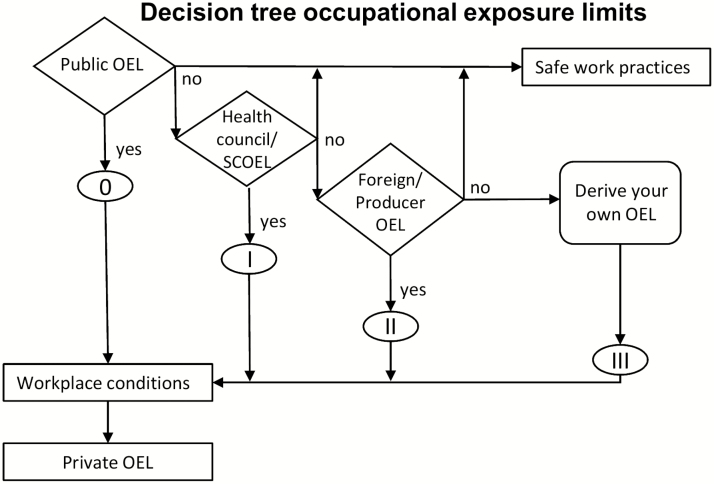
The Netherlands' system for occupational exposure limits (OELs) encompasses two kinds of OELs: public and private. Public OELs are set by the government. Private OELs are derived by industry and cover all substances without a public OEL. In parallel, the regulation concerning the Registration, Evaluation, Authorisation and Restriction of Chemicals (REACH) has introduced an exposure guidance value similar to the OEL, namely the Derived No-Effect Level (DNEL) for workers' inhalation exposure. This study aimed to investigate issues encountered by occupational health professionals regarding private OELs, and how they perceive the DNELs for workers in relation to private OELs. Towards this aim, we sent out a web-based questionnaire to the members of the Dutch professional organization for occupational hygienists (Nederlandse Vereniging voor Arbeidshygiëne [NVVA], n = 513) and to members of the Dutch professional organization for safety engineers (NVVK, n = 2916). Response rates were 27% (n = 139) and 7% (n = 198), respectively. More occupational hygienists (59%) than safety engineers (17%) reported to derive private OELs themselves. Our respondents reported several challenges with the derivation of private OELs. Fifty-one percent of the occupational hygienists and 20% of the safety engineers stated to see a role of REACH Registrants' worker DNELs as private OELs. However, more than half of our respondents were undecided or unfamiliar with worker DNELs. In addition, stated opinions on where worker DNELs fit in the hierarchy of private OELs varied considerably. To conclude, both these professional groups derive private OELs and stated that they need more guidance for this. Furthermore, there is a lack of clarity whether worker DNELs may qualify as private OELs, and where they would fit in the hierarchy of private OELs.
荷兰的职业接触限值(OEL)系统包括两种 OEL:公共和私人。公共 OEL 由政府设定。私人 OEL 由行业制定,涵盖所有没有公共 OEL 的物质。与此同时,关于化学品注册、评估、授权和限制的法规(REACH)引入了一种类似于 OEL 的暴露指导值,即工人吸入暴露的衍生无效应水平(DNEL)。本研究旨在调查职业健康专业人员在私人 OEL 方面遇到的问题,以及他们如何看待工人的 DNEL 与私人 OEL 的关系。为此,我们向荷兰职业卫生学家专业组织(Nederlandse Vereniging voor Arbeidshygiëne [NVVA],n=513)和荷兰安全工程师专业组织(Nederlandse Vereniging voor Veiligheidskunde [NVVK],n=2916)的成员发送了一份基于网络的问卷。回复率分别为 27%(n=139)和 7%(n=198)。更多的职业卫生学家(59%)比安全工程师(17%)报告自己制定私人 OEL。我们的受访者报告了在制定私人 OEL 方面遇到的几个挑战。51%的职业卫生学家和 20%的安全工程师表示,REACH 注册人工人的 DNEL 可以作为私人 OEL。然而,超过一半的受访者对此持不确定或不熟悉的态度。此外,关于工人 DNEL 在私人 OEL 等级制度中的位置的观点也存在很大差异。总之,这两个专业群体都制定了私人 OEL,并表示他们为此需要更多的指导。此外,对于工人的 DNEL 是否可以作为私人 OEL,以及它们在私人 OEL 等级制度中的位置,还存在很大的不确定性。