Department of Biosciences, Università degli Studi di Milano, via Celoria 26, 20133 Milan, Italy.
Department of Molecular and Translational Medicine, cFRU lab, Università degli Studi di Brescia, viale Europa 11, 25123 Brescia, Italy.
Cardiovasc Res. 2020 May 1;116(6):1147-1160. doi: 10.1093/cvr/cvz217.
Atrial fibrillation (AF) is the most common type of cardiac arrhythmias, whose incidence is likely to increase with the aging of the population. It is considered a progressive condition, frequently observed as a complication of other cardiovascular disorders. However, recent genetic studies revealed the presence of several mutations and variants linked to AF, findings that define AF as a multifactorial disease. Due to the complex genetics and paucity of models, molecular mechanisms underlying the initiation of AF are still poorly understood. Here we investigate the pathophysiological mechanisms of a familial form of AF, with particular attention to the identification of putative triggering cellular mechanisms, using patient's derived cardiomyocytes (CMs) differentiated from induced pluripotent stem cells (iPSCs).
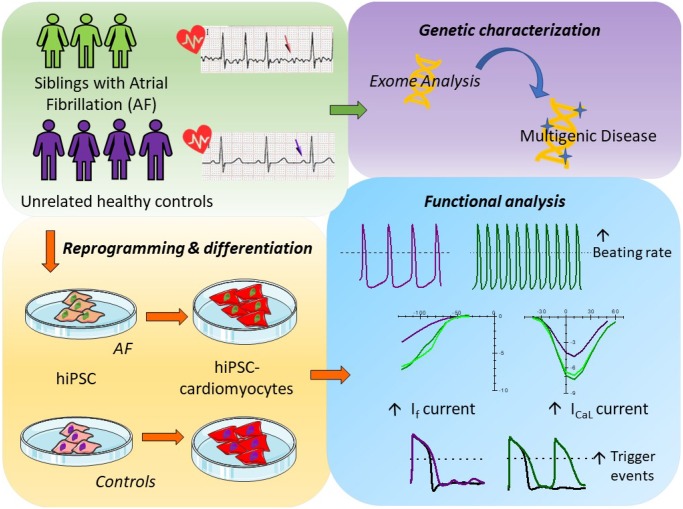
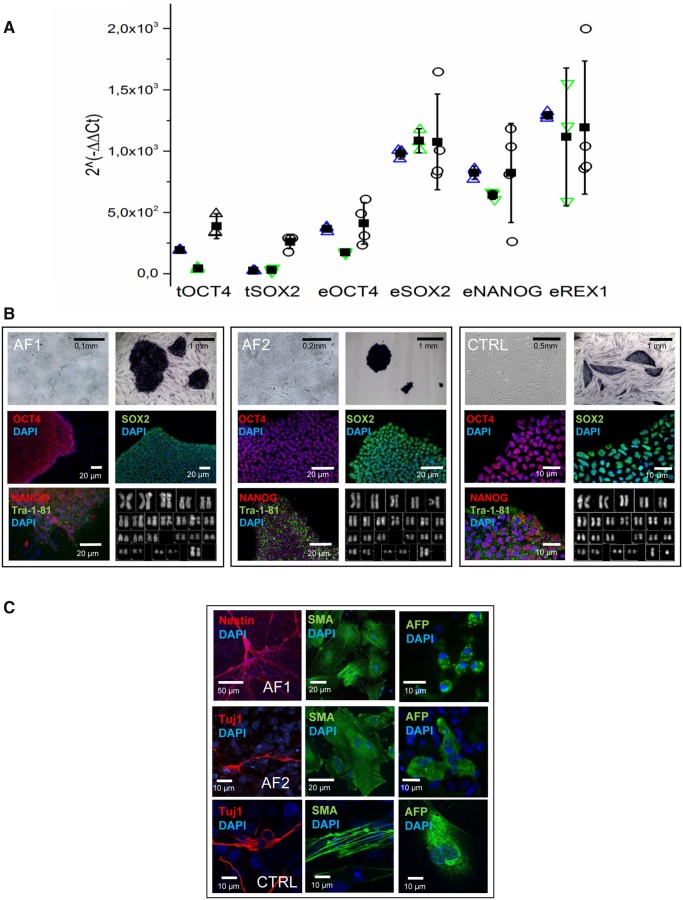
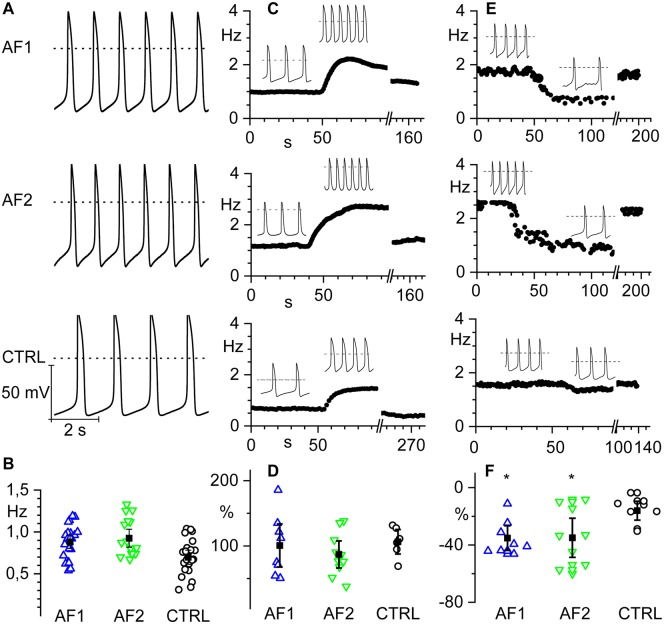
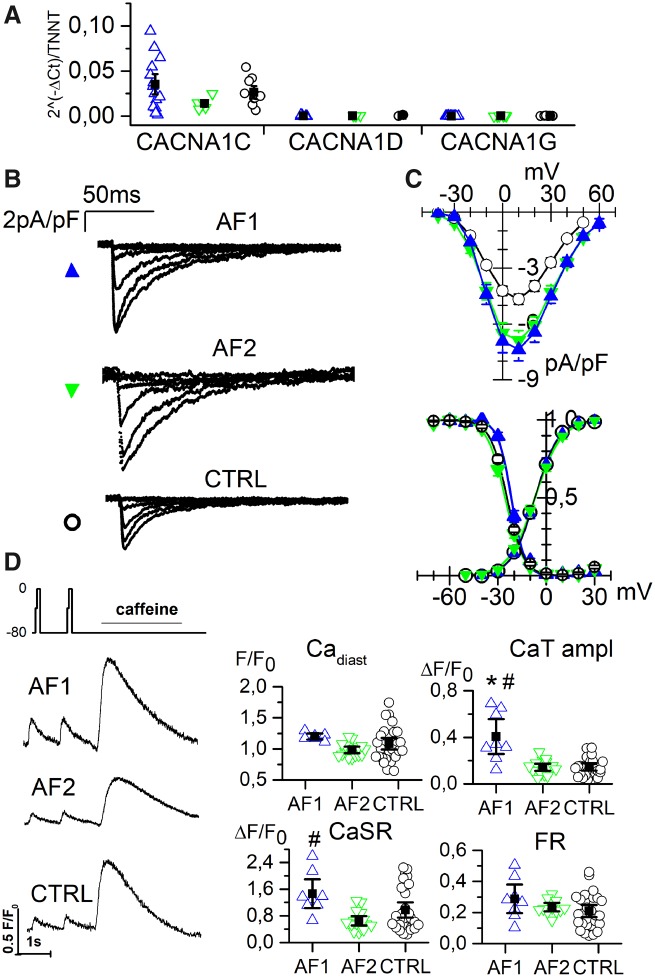
Here we report the clinical case of three siblings with untreatable persistent AF whose whole-exome sequence analysis revealed several mutated genes. To understand the pathophysiology of this multifactorial form of AF we generated three iPSC clones from two of these patients and differentiated these cells towards the cardiac lineage. Electrophysiological characterization of patient-derived CMs (AF-CMs) revealed that they have higher beating rates compared to control (CTRL)-CMs. The analysis showed an increased contribution of the If and ICaL currents. No differences were observed in the repolarizing current IKr and in the sarcoplasmic reticulum calcium handling. Paced AF-CMs presented significantly prolonged action potentials and, under stressful conditions, generated both delayed after-depolarizations of bigger amplitude and more ectopic beats than CTRL cells.
Our results demonstrate that the common genetic background of the patients induces functional alterations of If and ICaL currents leading to a cardiac substrate more prone to develop arrhythmias under demanding conditions. To our knowledge this is the first report that, using patient-derived CMs differentiated from iPSC, suggests a plausible cellular mechanism underlying this complex familial form of AF.
心房颤动(AF)是最常见的心律失常类型,其发病率随着人口老龄化可能会增加。它被认为是一种进行性疾病,常作为其他心血管疾病的并发症出现。然而,最近的遗传研究揭示了几种与 AF 相关的突变和变体,这些发现将 AF 定义为一种多因素疾病。由于复杂的遗传学和缺乏模型,AF 起始的分子机制仍知之甚少。在这里,我们研究了一种家族性 AF 的病理生理机制,特别关注从诱导多能干细胞(iPSCs)分化而来的患者来源的心肌细胞(CMs)中潜在触发细胞机制的鉴定。
在这里,我们报告了三例无法治疗的持续性 AF 患者的临床病例,他们的全外显子组序列分析显示了几个突变基因。为了了解这种多因素 AF 的病理生理学,我们从其中两名患者中生成了三个 iPSC 克隆,并将这些细胞分化为心脏谱系。对患者来源的 CM(AF-CMs)的电生理特性进行了分析,结果显示它们的搏动率高于对照(CTRL)-CMs。分析显示 If 和 ICaL 电流的贡献增加。在复极化电流 IKr 和肌浆网钙处理方面没有差异。起搏的 AF-CMs 的动作电位明显延长,在应激条件下,与 CTRL 细胞相比,产生的延迟后除极幅度更大,异位搏动更多。
我们的结果表明,患者的共同遗传背景导致 If 和 ICaL 电流的功能改变,从而使心脏基质在要求苛刻的条件下更容易发生心律失常。据我们所知,这是首次使用源自 iPSC 的患者来源的 CM 报告的,提示了这种复杂家族性 AF 的一种合理的细胞机制。