Institute for Lung Health, Leicester NIHR Biomedical Research Centre, University of Leicester, Leicester, UK.
GSK Respiratory Therapeutic Area Unit, Stevenage, UK.
Allergy. 2020 Feb;75(2):370-380. doi: 10.1111/all.14016. Epub 2019 Sep 10.
Whether the clinical or pathophysiologic significance of the "treatable trait" high blood eosinophil count in COPD is the same as for asthma remains controversial. We sought to determine the relationship between the blood eosinophil count, clinical characteristics and gene expression from bronchial brushings in COPD and asthma.
Subjects were recruited into a COPD (emphysema versus airway disease [EvA]) or asthma cohort (Unbiased BIOmarkers in PREDiction of respiratory disease outcomes, U-BIOPRED). We determined gene expression using RNAseq in EvA (n = 283) and Affymetrix microarrays in U-BIOPRED (n = 85). We ran linear regression analysis of the bronchial brushings transcriptional signal versus blood eosinophil counts as well as differential expression using a blood eosinophil > 200 cells/μL as a cut-off. The false discovery rate was controlled at 1% (with continuous values) and 5% (with dichotomized values).
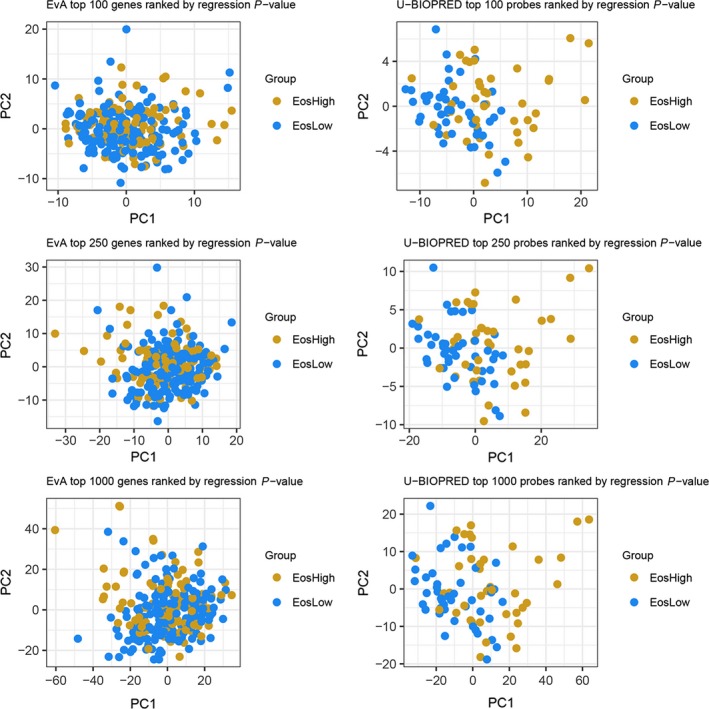
There were no differences in age, gender, lung function, exercise capacity and quantitative computed tomography between eosinophilic versus noneosinophilic COPD cases. Total serum IgE was increased in eosinophilic asthma and COPD. In EvA, there were 12 genes with a statistically significant positive association with the linear blood eosinophil count, whereas in U-BIOPRED, 1197 genes showed significant associations (266 positive and 931 negative). The transcriptome showed little overlap between genes and pathways associated with blood eosinophil counts in asthma versus COPD. Only CST1 was common to eosinophilic asthma and COPD and was replicated in independent cohorts.
Despite shared "treatable traits" between asthma and COPD, the molecular mechanisms underlying these clinical entities are predominately different.
在 COPD 中,“可治疗特征”高血嗜酸性粒细胞计数的临床或病理生理意义是否与哮喘相同仍存在争议。我们旨在确定 COPD 和哮喘患者血液嗜酸性粒细胞计数、临床特征和支气管刷取物基因表达之间的关系。
我们将受试者纳入 COPD(肺气肿与气道疾病[EvA])或哮喘队列(无偏生物标志物在预测呼吸疾病结局中的应用,U-BIOPRED)。我们使用 RNAseq 确定了 EvA 中的基因表达(n=283),并使用 Affymetrix 微阵列确定了 U-BIOPRED 中的基因表达(n=85)。我们对支气管刷取物转录信号与血液嗜酸性粒细胞计数进行了线性回归分析,并使用血液嗜酸性粒细胞计数>200 个细胞/μL 作为截断值进行了差异表达分析。采用 False Discovery Rate(FDR)控制在 1%(连续值)和 5%(二分类值)。
嗜酸性粒细胞性与非嗜酸性粒细胞性 COPD 病例在年龄、性别、肺功能、运动能力和定量计算机断层扫描方面无差异。总血清 IgE 在嗜酸性粒细胞性哮喘和 COPD 中增加。在 EvA 中,有 12 个基因与血液嗜酸性粒细胞计数呈统计学上的正相关,而在 U-BIOPRED 中,有 1197 个基因显示出显著相关性(266 个阳性和 931 个阴性)。哮喘和 COPD 中与血液嗜酸性粒细胞计数相关的基因和途径的转录组之间几乎没有重叠。只有 CST1 是嗜酸性粒细胞性哮喘和 COPD 的共同特征,并且在独立队列中得到了复制。
尽管哮喘和 COPD 之间存在共同的“可治疗特征”,但这些临床实体的分子机制主要不同。