Prefeitura Municipal de Campo Grande. Secretaria Municipal de Saúde. Campo Grande, MS, Brasil.
Fundação Oswaldo Cruz de Mato Grosso do Sul. Campo Grande, MS, Brasil.
Rev Saude Publica. 2019 Sep 9;53:71. doi: 10.11606/S1518-8787.2019053000362.
To describe the epidemiological aspects of HIV infection and AIDS among indigenous peoples of the state of Mato Grosso do Sul, Brazil.
This is a descriptive epidemiological study on the occurrence and distribution of HIV infection and AIDS in the indigenous population assisted by the Distrito Sanitário Especial Indígena (Indigenous Special Health District) Mato Grosso do Sul between 2001 and 2014, based on three secondary databases. Annual rates of HIV and AIDS detection and prevalence were calculated, considering case distribution according to village, Health Base Pole and sociodemographic variables. Accumulated rates of detection, mortality and case fatality were calculated by ethnic group and for the Health Base Pole with the highest number of cases.
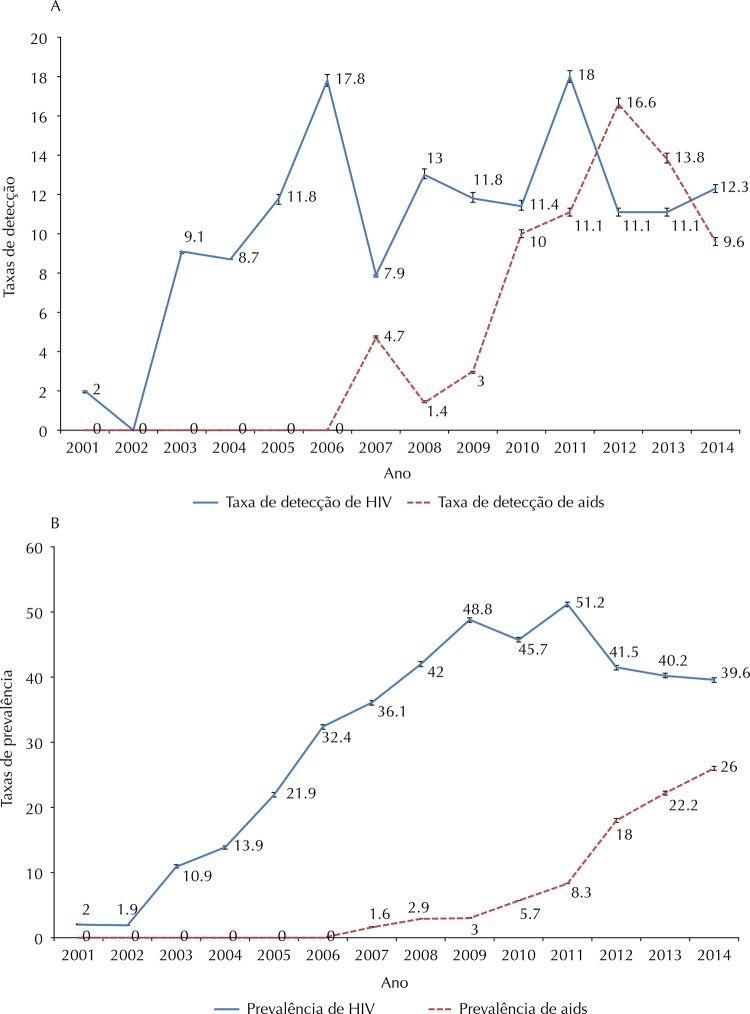
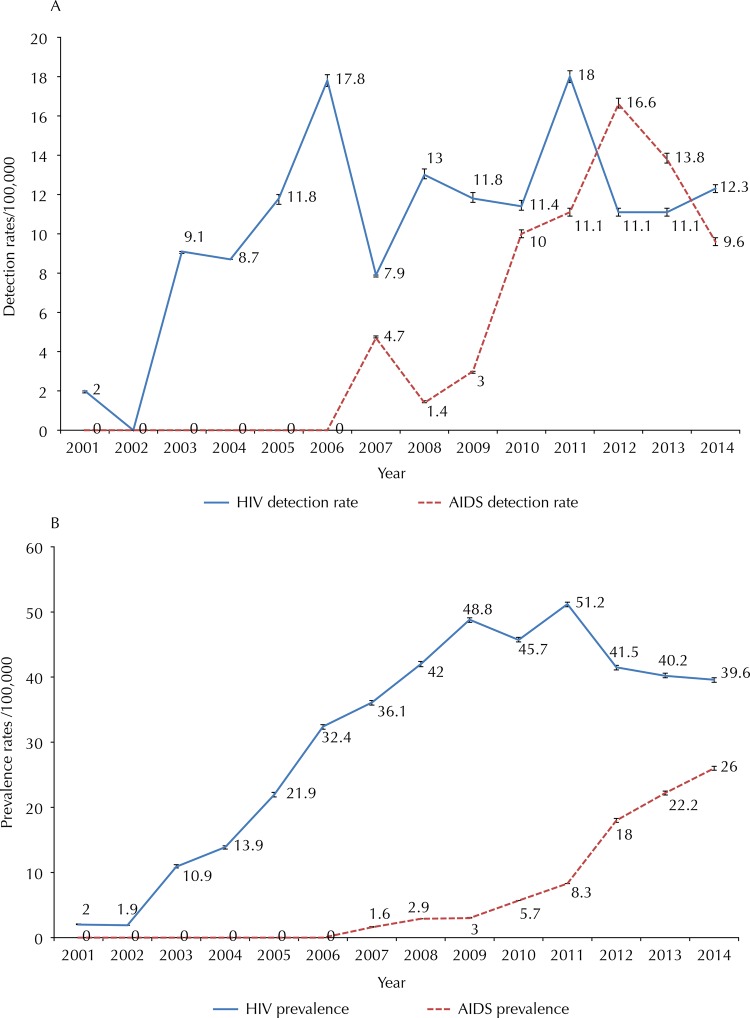
The HIV detection rate fluctuated between 0.0 and 18.0/100 thousand people in the study period. For AIDS, there was no notification before 2007, but in 2012 its rate reached 16.6/100 thousand. HIV prevalence grew between 2001 and 2011, and it continuously grew for AIDS starting from 2007. The highest HIV detection rates occurred among Guarani peoples (167.1/100 thousand) and for AIDS, among the Kaiowá peoples (79.3/100 thousand); mortality and fatality rates were higher among the Kaiowá. Regarding the Dourados Health Base Pole, the AIDS detection rate increased, and the mortality and fatality rates decreased.
HIV infection and AIDS have been increasing among indigenous peoples, with distribution of the disease mainly in the Health Base Poles of the southern region of the state, where greater economic and social vulnerability are also observed. The endemic character of HIV and AIDS can become epidemic in some years given the existence of cases in other villages in the state. Its occurrence among the Guarani and Kaiowá populations indicates the need for expanded diagnosis, access to treatment and prevention measures.
描述巴西马托格罗索州土著人民中艾滋病毒感染和艾滋病的流行情况。
这是一项关于 2001 年至 2014 年期间马托格罗索州印第安人特别卫生区(Indigenous Special Health District)协助下,在土著人口中艾滋病毒感染和艾滋病发生和分布情况的描述性流行病学研究,该研究基于三个二级数据库。根据村落、卫生基础极点和社会人口统计学变量,计算了艾滋病毒和艾滋病的年检测率和流行率。根据种族和病例最多的卫生基础极点,计算了艾滋病毒检测、死亡率和病死率的累积率。
研究期间,艾滋病毒检测率在 0.0 至 18.0/10 万之间波动。在 2007 年之前,没有艾滋病的通知,但在 2012 年,其发病率达到了 16.6/10 万。艾滋病毒的流行率在 2001 年至 2011 年之间增长,而从 2007 年开始,艾滋病的流行率持续增长。在瓜拉尼人(Guarani peoples)中,艾滋病毒检测率最高(167.1/10 万),在 Kaiowá 人(Kaiowá peoples)中,艾滋病的检测率最高(79.3/10 万);死亡率和病死率在 Kaiowá 人中更高。就 Dourados 卫生基础极点而言,艾滋病的检测率有所增加,而死亡率和病死率则有所下降。
艾滋病毒感染和艾滋病在土著人民中不断增加,疾病的分布主要集中在该州南部地区的卫生基础极点,这些地区还存在更大的经济和社会脆弱性。鉴于该州其他村庄存在病例,艾滋病毒和艾滋病的地方性特征可能在某些年份成为流行。瓜拉尼人和 Kaiowá 人感染艾滋病毒和艾滋病表明,需要扩大诊断、获得治疗和预防措施。