Univ Rennes, CHU Rennes, Inserm, EHESP, IRSET (Institut de Recherche en Santé Environnement et Travail) - UMR_S 1085, Rennes, France.
Service de Parasitologie-Mycologie, CHU Toulouse, Toulouse, France.
PLoS Negl Trop Dis. 2019 Sep 11;13(9):e0007711. doi: 10.1371/journal.pntd.0007711. eCollection 2019 Sep.
The diagnosis of schistosomiasis currently relies on microscopic detection of schistosome eggs in stool or urine samples and serological assays. The poor sensitivity of standard microscopic procedures performed in routine laboratories, makes molecular detection methods of increasing interest. The aim of the study was to evaluate two in-house real-time Schistosoma PCRs, targeting respectively S. mansoni [Sm] and S. haematobium [Sh] in excreta, biopsies and sera as potential tools to diagnose active infections and to monitor treatment efficacy.
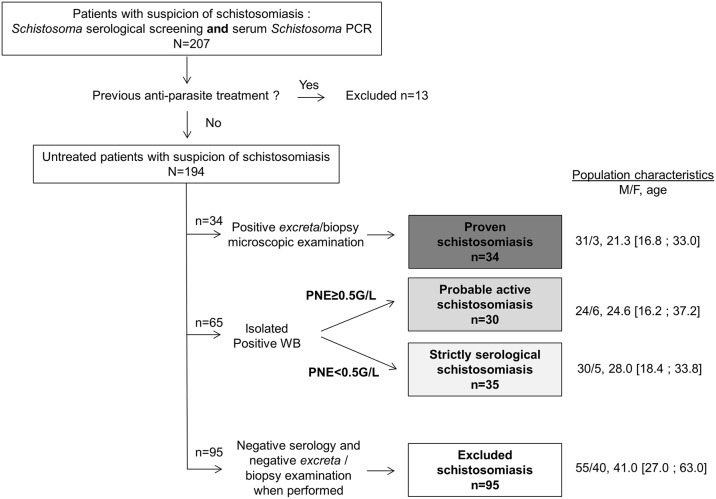
Schistosoma PCRs were performed on 412 samples (124 urine, 86 stools, 8 biopsies, 194 sera) from patients with suspected schistosomiasis, before anti-parasitic treatment. Results were compared to microscopic examination and serological assays (enzyme-linked immunosorbent assay (ELISA), indirect haemagglutination (HA) and Western Blot (WB) assay).
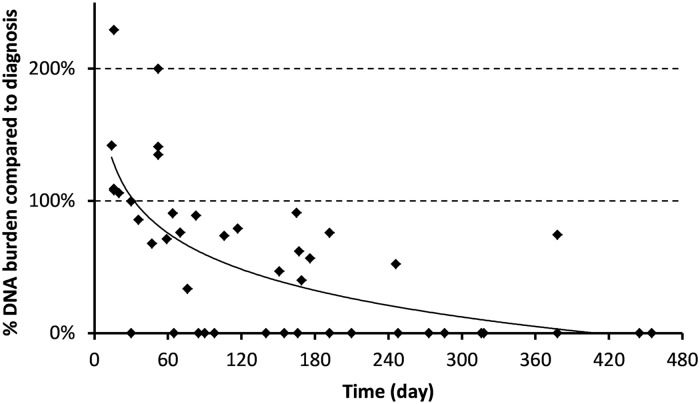
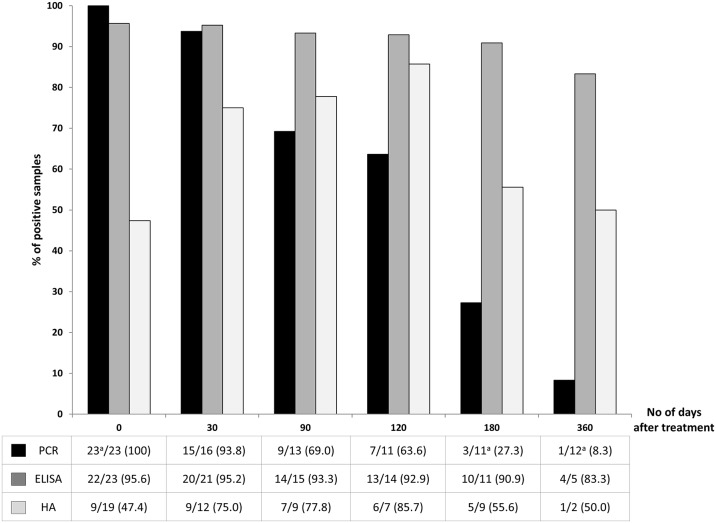
Compared to microscopy, PCRs significantly increased the sensitivity of diagnosis, from 4% to 10.5% and from 33.7% to 48.8%, for Sh in urine and Sm in stools, respectively. The overall sensitivity of PCR on serum samples was 72.7% and reached 94.1% in patients with positive excreta (microscopy). The specificity of serum PCR was 98.9%. After treatment, serum PCR positivity rates slowly declined from 93.8% at day 30 to 8.3% at day 360, whereas antibody detection remained positive after 1 year.
Schistosoma PCRs clearly outperform standard microscopy on stools and urine and could be part of reference methods combined with WB-based serology, which remains a gold standard for initial diagnosis. When serological assays are positive and microscopy is negative, serum PCRs provide species information to guide further clinical exploration. Biomarkers such as DNA and antibodies are of limited relevance for early treatment monitoring but serum PCR could be useful when performed at least 1 year after treatment to help confirm a cured infection.
目前,血吸虫病的诊断依赖于粪便或尿液样本中血吸虫卵的显微镜检测和血清学检测。在常规实验室中进行的标准显微镜检测方法的敏感性较差,因此越来越多的人对分子检测方法感兴趣。本研究旨在评估两种针对粪便、活检和血清中的曼氏血吸虫 [Sm] 和埃及血吸虫 [Sh] 的内部实时 Schistosoma PCR 方法,作为诊断活动性感染和监测治疗效果的潜在工具。
对 412 例疑似血吸虫病患者的 124 份尿液、86 份粪便、8 份活检和 194 份血清样本进行了 Schistosoma PCR 检测。结果与显微镜检查和血清学检测(酶联免疫吸附试验 (ELISA)、间接血凝 (HA) 和 Western Blot (WB) 检测)进行了比较。
与显微镜检查相比,PCR 显著提高了诊断的敏感性,尿液中 Sh 的敏感性从 4%增加到 10.5%,粪便中 Sm 的敏感性从 33.7%增加到 48.8%。血清样本的总体 PCR 敏感性为 72.7%,在粪便阳性的患者中达到 94.1%。血清 PCR 的特异性为 98.9%。治疗后,血清 PCR 阳性率从第 30 天的 93.8%缓慢下降到第 360 天的 8.3%,而抗体检测在 1 年后仍为阳性。
Schistosoma PCR 在粪便和尿液检测方面明显优于标准显微镜检查,可作为结合 WB 血清学的参考方法的一部分,后者仍然是初始诊断的金标准。当血清学检测呈阳性而显微镜检查呈阴性时,血清 PCR 可提供物种信息,以指导进一步的临床探索。DNA 和抗体等生物标志物对早期治疗监测的相关性有限,但在治疗后至少 1 年进行血清 PCR 可能有助于确认治愈的感染。