Department of Medical and Health Sciences, Linkoping University, Linköping, Sweden.
PLoS One. 2019 Sep 12;14(9):e0219911. doi: 10.1371/journal.pone.0219911. eCollection 2019.
Individuals with functional impairments or chronic diseases are often in need of assistance in their daily lives. For these individuals it is essential to find novel, cost-effective solutions to meet their needs. Service dogs are dogs that are specially trained to assist individuals with functional impairments and may be able to improve these individuals' quality of life at a reasonable cost, i.e. be cost effective. Cost-effectiveness analyses are used to illustrate the cost of an intervention in relation to its effects and provide important input to decision-makers when setting priorities.
The aim of this study is to assess the cost effectiveness of a certified physical service dog and a diabetes alert dog compared to a regular companion dog.
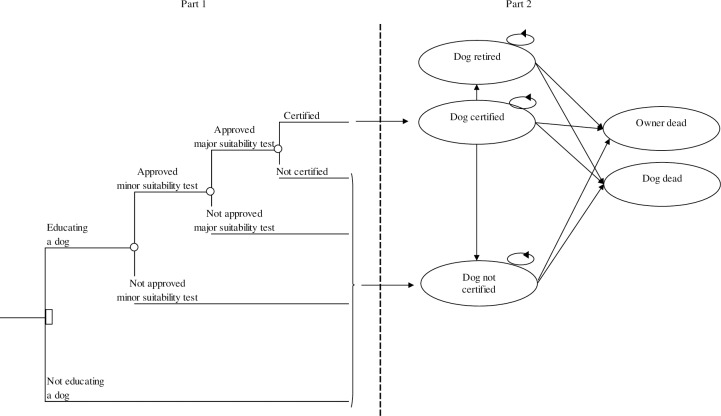
Costs, life years and quality-adjusted life years were estimated over a 10-year time horizon using a decision-analytic model built upon evidence from the"service and hearing dog project". The primary outcome was the incremental cost-effectiveness ratio expressed as cost per gained quality-adjusted life year. The analysis was conducted from a societal perspective. Costs and effects were discounted with 3% per annum and reported in USD.
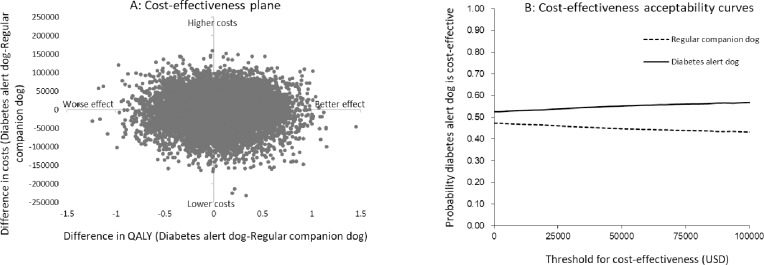
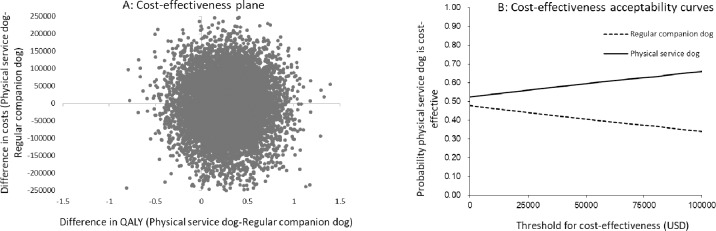
Compared to a regular companion dog, a physical service dog is cost saving [-6,000 USD] and gives the dog owner more quality-adjusted life years [0.28]. The diabetes alert dog is also cost effective in comparison with a regular companion dog [-4,500 USD, 0.06 QALYs].
This study indicates that a certified service dog is cost saving in comparison with a regular companion dog for individuals with functional impairments or chronic diseases. The uncertainty of the analysis implies that further studies are needed in order to confirm these results. Nevertheless, physical service dogs and diabetes alert dogs show potential to be a valuable support and decision analytic models are useful tools to provide this information.
有功能障碍或慢性疾病的个体在日常生活中通常需要帮助。对于这些个体来说,找到新颖、具有成本效益的解决方案来满足他们的需求至关重要。服务犬是经过专门训练以帮助有功能障碍的个体的犬类,并且可能以合理的成本提高这些个体的生活质量,即具有成本效益。成本效益分析用于说明干预措施的成本与其效果的关系,并在决策者确定优先事项时提供重要的投入。
本研究旨在评估经过认证的物理服务犬和糖尿病警示犬与常规伴侣犬相比的成本效益。
使用基于“服务和听力犬项目”证据构建的决策分析模型,在 10 年时间内估算成本、生命年和质量调整生命年。主要结果是增量成本效益比,表示为每获得一个质量调整生命年的成本。分析从社会角度进行。成本和效果按每年 3%贴现,并以美元报告。
与常规伴侣犬相比,物理服务犬具有成本效益[节省 6000 美元],并为犬主人提供更多的质量调整生命年[0.28 年]。与常规伴侣犬相比,糖尿病警示犬也具有成本效益[-4500 美元,0.06 QALYs]。
本研究表明,对于有功能障碍或慢性疾病的个体,经过认证的服务犬与常规伴侣犬相比具有成本效益。分析的不确定性意味着需要进一步研究以确认这些结果。然而,物理服务犬和糖尿病警示犬具有成为有价值支持的潜力,决策分析模型是提供这些信息的有用工具。