Department of Surgery, McMaster University, Hamilton, Ontario, Canada.
Research and High-Performance Computing Support, McMaster University, Hamilton, Ontario, Canada.
PLoS One. 2019 Sep 12;14(9):e0222276. doi: 10.1371/journal.pone.0222276. eCollection 2019.
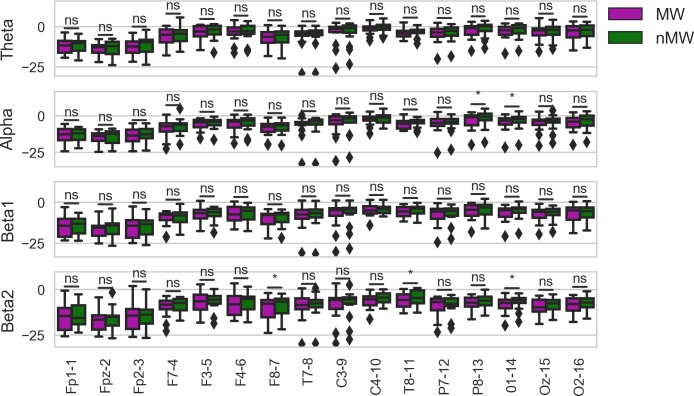
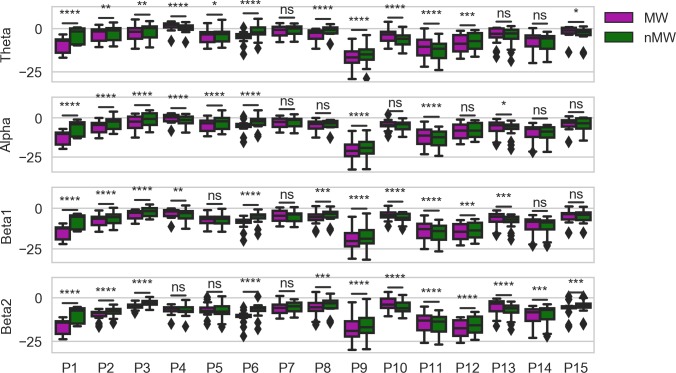
The ability to detect mind wandering as it occurs is an important step towards improving our understanding of this phenomenon and studying its effects on learning and performance. Current detection methods typically rely on observable behaviour in laboratory settings, which do not capture the underlying neural processes and may not translate well into real-world settings. We address both of these issues by recording electroencephalography (EEG) simultaneously from 15 participants during live lectures on research in orthopedic surgery. We performed traditional group-level analysis and found neural correlates of mind wandering during live lectures that are similar to those found in some laboratory studies, including a decrease in occipitoparietal alpha power and frontal, temporal, and occipital beta power. However, individual-level analysis of these same data revealed that patterns of brain activity associated with mind wandering were more broadly distributed and highly individualized than revealed in the group-level analysis.
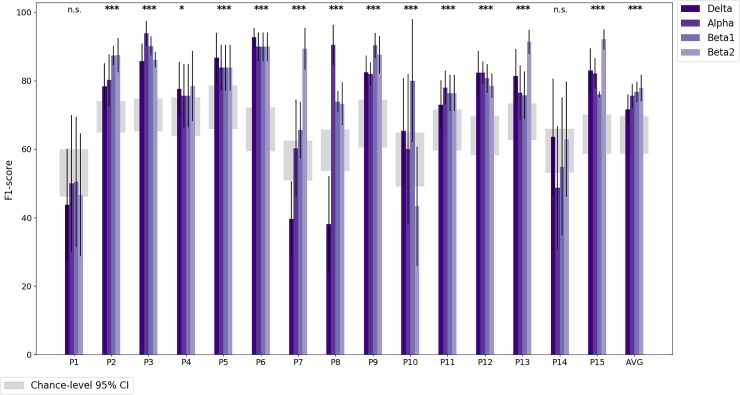
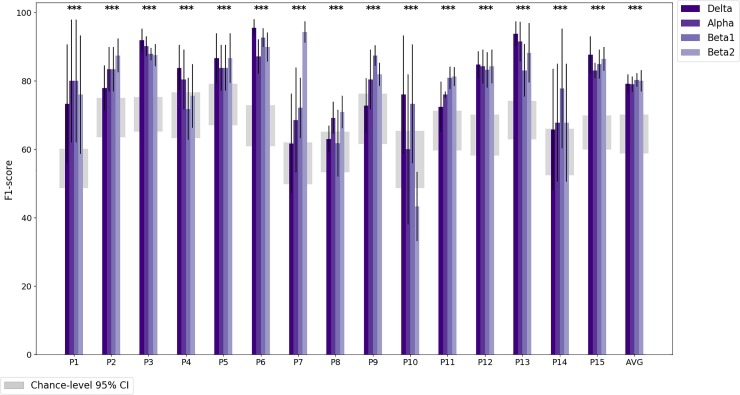
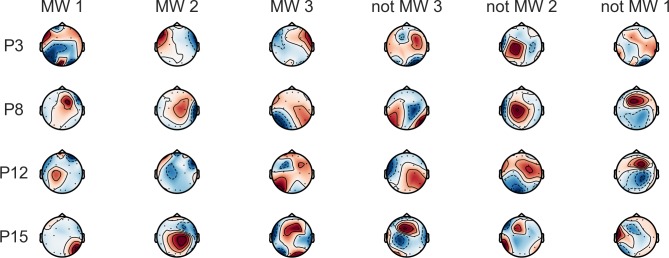
To apply these findings to mind wandering detection, we used a data-driven method known as common spatial patterns to discover scalp topologies for each individual that reflects their differences in brain activity when mind wandering versus attending to lectures. This approach avoids reliance on known neural correlates primarily established through group-level statistics. Using this method for individual-level machine learning of mind wandering from EEG, we were able to achieve an average detection accuracy of 80-83%.
Modelling mind wandering at the individual level may reveal important details about its neural correlates that are not reflected when using traditional observational and statistical methods. Using machine learning techniques for this purpose can provide new insight into the varieties of neural activity involved in mind wandering, while also enabling real-time detection of mind wandering in naturalistic settings.
能够在其发生时检测到思维漫游是提高我们对这种现象的理解并研究其对学习和表现的影响的重要步骤。当前的检测方法通常依赖于实验室环境中的可观察行为,这些行为无法捕捉到潜在的神经过程,并且可能无法很好地转化为现实世界的环境。我们通过在骨科研究的现场讲座中同时从 15 名参与者记录脑电图 (EEG) 来解决这两个问题。我们进行了传统的组级分析,并在现场讲座中发现了与一些实验室研究相似的思维漫游神经相关,包括枕顶 alpha 功率降低和额、颞、枕部 beta 功率增加。然而,对这些相同数据的个体水平分析表明,与思维漫游相关的大脑活动模式比组级分析中揭示的更为广泛和高度个体化。
为了将这些发现应用于思维漫游检测,我们使用了一种称为共同空间模式的数据驱动方法,为每个人发现头皮拓扑结构,反映他们在思维漫游与听讲座时大脑活动的差异。这种方法避免了依赖主要通过组级统计数据确定的已知神经相关。使用这种方法对 EEG 进行个体水平的思维漫游机器学习,我们能够实现平均检测准确率 80-83%。
在个体水平上对思维漫游进行建模可能会揭示其神经相关的重要细节,而这些细节在使用传统的观察和统计方法时是无法反映的。为此目的使用机器学习技术可以为思维漫游所涉及的各种神经活动提供新的见解,同时还能够在自然环境中实时检测思维漫游。