Temerty Centre for Therapeutic Brain Intervention at the Centre for Addiction and Mental Health, Toronto, ON, Canada.
Institute for Health Policy Management and Evaluation, University of Toronto, Toronto, ON, Canada.
PLoS One. 2019 Sep 12;14(9):e0222546. doi: 10.1371/journal.pone.0222546. eCollection 2019.
Repetitive transcranial magnetic stimulation (rTMS) is an evidence-based treatment for depression that is increasingly implemented in healthcare systems across the world. A new form of rTMS called intermittent theta burst stimulation (iTBS) can be delivered in 3 min and has demonstrated comparable effectiveness to the conventional 37.5 min 10Hz rTMS protocol in patients with depression.
To compare the direct treatment costs per course and per remission for iTBS compared to 10Hz rTMS treatment in depression.
We conducted a cost analysis from a healthcare system perspective using patient-level data from a large randomized non-inferiority trial (THREE-D). Depressed adults 18 to 65 received either 10Hz rTMS or iTBS treatment. Treatment costs were calculated using direct healthcare costs associated with equipment, coils, physician assessments and technician time over the course of treatment. Cost per remission was estimated using the proportion of patients achieving remission following treatment. Deterministic sensitivity analyses and non-parametric bootstrapping was used to estimate uncertainty.
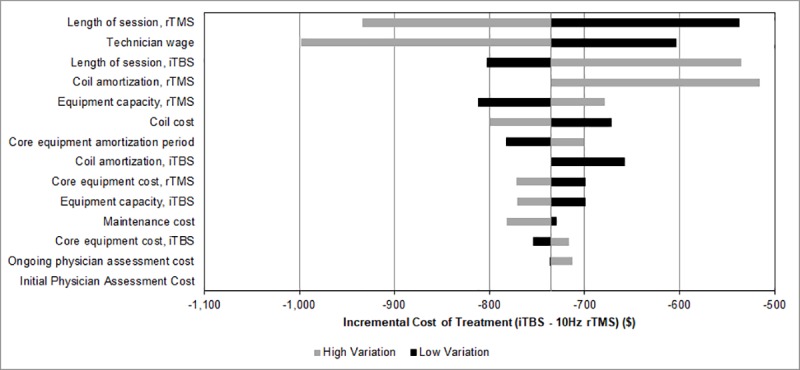
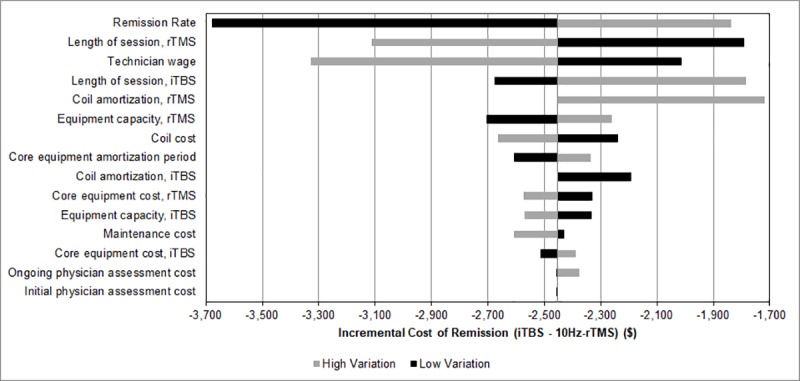
From a healthcare system perspective, the average cost per patient was USD$1,108 (SD 166) for a course of iTBS and $1,844 (SD 304) for 10Hz rTMS, with an incremental net savings of $735 (95% CI 688 to 783). The average cost per remission was $3,695 (SD 552) for iTBS and $6,146 (SD 1,015) for 10Hz rTMS, with an average incremental net savings of $2,451 (95% CI 2,293 to 2,610).
The shorter session durations and treatment capacity increase associated with 3 min iTBS translate into significant cost-savings per patient and per remission when compared to 10Hz rTMS.
重复经颅磁刺激(rTMS)是一种有循证医学证据的抑郁症治疗方法,在世界范围内的医疗系统中得到了越来越多的应用。一种新的 rTMS 形式,即间歇性 theta 爆发刺激(iTBS),可以在 3 分钟内完成,并且在抑郁症患者中已经证明与传统的 10Hz rTMS 方案具有相当的疗效。
比较 iTBS 与 10Hz rTMS 治疗抑郁症的每疗程和每缓解的直接治疗成本。
我们从医疗保健系统的角度进行了成本分析,使用了来自一项大型随机非劣效性试验(THREE-D)的患者水平数据。18 至 65 岁的抑郁症成年人接受了 10Hz rTMS 或 iTBS 治疗。治疗成本是根据治疗过程中与设备、线圈、医生评估和技术人员时间相关的直接医疗成本计算的。使用治疗后达到缓解的患者比例来估计每缓解的成本。使用确定性敏感性分析和非参数引导法来估计不确定性。
从医疗保健系统的角度来看,iTBS 一个疗程的平均每位患者成本为 1108 美元(SD 166),而 10Hz rTMS 为 1844 美元(SD 304),增量净节省 735 美元(95%CI 688 美元至 783 美元)。iTBS 每缓解的平均成本为 3695 美元(SD 552),而 10Hz rTMS 为 6146 美元(SD 1015),平均增量净节省 2451 美元(95%CI 2293 美元至 2610 美元)。
与 10Hz rTMS 相比,3 分钟 iTBS 的较短治疗时间和增加的治疗能力,每疗程和每缓解的成本都显著降低。