IMAG, CNRS, Montpellier University, Montpellier University Hospital, Montpellier, France.
Apard groupe Adène, Montpellier, France.
Respir Res. 2019 Sep 12;20(1):209. doi: 10.1186/s12931-019-1150-7.
Whereas telemedicine usage is growing, the only clinical algorithm for Continuous Positive Airway Pressure (CPAP) adherence management is that stipulated by the 2013 American Thoracic Society (ATS). The capacity of the latter to predict non-adherence in long-term CPAP-treated patients has not been validated.
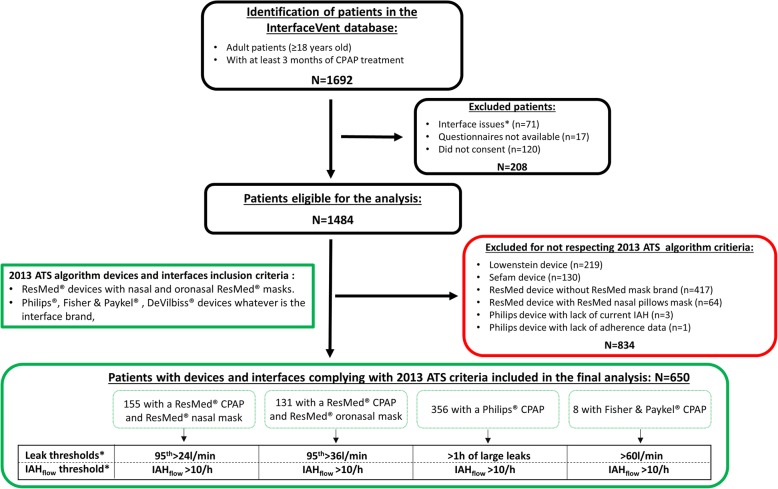
Patients from the prospective real-life InterfaceVent study (NCT03013283, study conducted in an adult cohort undergoing at least 3 months of CPAP) and eligible for ATS algorithm usage were analysed. The residual device Apnea-Hypopnea-Index (AHI) and High Large Leak (HLL) thresholds proposed in the ATS algorithm were evaluated for predicting adherence (i.e. AHI > 10/h, HLLs 95th > 24 L/min for ResMed® devices and ResMed® nasal mask, HLLs 95th > 36 l/min for ResMed® devices and ResMed® oronasal masks, HLLs > 1 h for Philips® devices and HHLs > 60 l/min for Fisher & Paykel® devices). Adherence was defined according to the 2013 ATS algorithm (i.e. CPAP use > 4 h/j for at least 70% of days).
650/1484 patients eligible for ATS algorithm usage were analysed (15.38% non-adherent, 74% male with a median (IQ) age of 68 (61-77) years, a body mass index of 30.8 (27.7-34.5) kg/m, an initial AHI of 39 (31-55) events/h, and CPAP-treatment-duration of 5.1 (2.2-7.8) years). Logistic regression analysis demonstrated no significant relationship between the ATS proposed AHI or HLL thresholds and non-adherence. Complementary ROC curve analysis failed to determine satisfactory AHI and HLL thresholds.
When managing non-adherence in long-term CPAP-treated patients, our data do not validate absolute AHI or HLL thresholds in general.
The INTERFACE-VENT study is registered on ClinicalTrials.gov (Identifier: study ( NCT03013283 ).
尽管远程医疗的使用正在增加,但唯一用于持续气道正压通气(CPAP)依从性管理的临床算法是 2013 年美国胸科学会(ATS)规定的算法。后者预测长期 CPAP 治疗患者不依从的能力尚未得到验证。
对前瞻性真实世界 InterfaceVent 研究(NCT03013283,在接受至少 3 个月 CPAP 治疗的成年患者队列中进行的研究)中符合 ATS 算法使用条件的患者进行了分析。评估了 ATS 算法中提出的设备残留呼吸暂停-低通气指数(AHI)和高大量泄漏(HLL)阈值,以预测依从性(即 AHI>10/h,ResMed®设备和 ResMed®鼻罩的 HLLs 95th>24L/min,ResMed®设备和 ResMed®口鼻罩的 HLLs 95th>36l/min,飞利浦®设备的 HLLs>1 小时,Fisher & Paykel®设备的 HHLs>60l/min)。根据 2013 年 ATS 算法(即 CPAP 使用>4 小时/天,至少 70%的天数)定义依从性。
分析了符合 ATS 算法使用条件的 650/1484 名患者(15.38%不依从,74%为男性,中位(IQR)年龄为 68(61-77)岁,体重指数为 30.8(27.7-34.5)kg/m,初始 AHI 为 39(31-55)事件/h,CPAP 治疗持续时间为 5.1(2.2-7.8)年)。Logistic 回归分析显示,ATS 提出的 AHI 或 HLL 阈值与不依从之间没有显著关系。补充 ROC 曲线分析未能确定令人满意的 AHI 和 HLL 阈值。
在管理长期 CPAP 治疗患者的不依从性时,我们的数据不能普遍验证绝对 AHI 或 HLL 阈值。
INTERFACE-VENT 研究在 ClinicalTrials.gov 上注册(标识符:study(NCT03013283))。