Bakker Aafke, Janssen Lindy, Noordam Cees
Amalia Children's Hospital, Department of Pediatrics, Radboud University Medical Center, Nijmegen, Netherlands.
JMIR Pediatr Parent. 2018 Dec 13;1(2):e10. doi: 10.2196/pediatrics.9576.
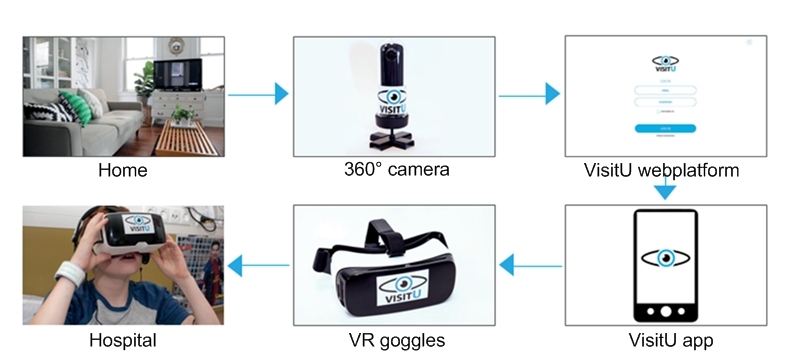
Being separated from home and relatives is a major stressor for children and adolescents when hospitalized. Children long for a manner to be distracted, pleasured, and socially connected during hospitalization. Different technological devices have been applied in health care to answer those needs. Both virtual reality (VR) and videoconferencing have proven their value in hospital wards and pediatrics. VisitU combines these 2 technologies innovatively. VisitU is a recently launched VR product enabling users to be virtually at home during hospitalization.
This study aims to explore the experiences of hospitalized patients with the VR intervention of VisitU in addition to standard care.
Over a 3-month period, a purposive sample of 10 patients hospitalized in the Radboudumc Amalia Children's Hospital was included in this qualitative study. Semistructured interviews were performed, one before and one after the use of the VR device. Patients were asked open-ended questions concerning their experiences with VisitU on practical, cognitive, emotional, and social domains. The interviews were audiorecorded and transcribed verbatim. Atlas.ti was used to support the qualitative analysis. Furthermore, the inductive thematic analysis was done according to the 6-step procedure described by Braun and Clarke.
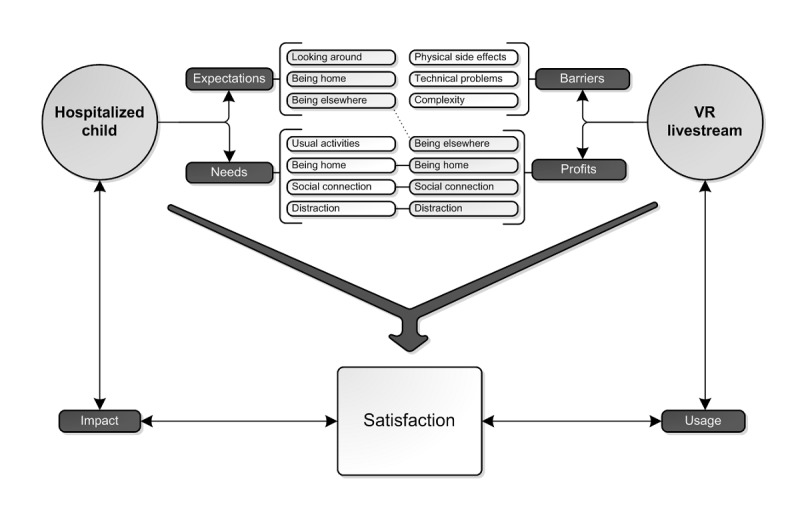
The following 6 main themes were the result of the qualitative analysis: "Being hospitalized," "Expectations of VisitU," "VisitU in use," "VisitU, the benefits," "The impact of VisitU," and "Barriers when using VisitU." The way VisitU was used by patients varied. The main benefits of VisitU were being somewhere else, being at home, and facilitating social connection. Limitations were experienced on the technical abilities, physical side effects, and complexity of use. Despite that, patients were positive about VisitU and unanimous in the view that they would like to use it again and advise other patients to use it.
This study shows the positive experiences of pediatric patients with VR live streaming. VisitU brings together the needs of patients and possibilities of VR and videoconferencing; it offers patients a way out of the hospital. Nevertheless, practical and technical obstacles must be overcome and side effects are an area of further research.
住院期间与家人分离对儿童和青少年来说是一个主要的压力源。孩子们渴望在住院期间有某种方式来分散注意力、获得愉悦并保持社交联系。不同的技术设备已被应用于医疗保健领域以满足这些需求。虚拟现实(VR)和视频会议在医院病房和儿科领域都已证明了它们的价值。VisitU创新性地结合了这两种技术。VisitU是一款最近推出的VR产品,能让用户在住院期间身临其境地感受在家中的氛围。
本研究旨在探讨住院患者在接受标准护理之外,使用VisitU进行VR干预的体验。
在3个月的时间里,本定性研究纳入了拉德堡德大学医学中心阿玛利亚儿童医院的10名住院患者作为有目的抽样。进行了半结构化访谈,在使用VR设备之前和之后各进行一次。向患者询问了关于他们在实际、认知、情感和社交领域使用VisitU的体验的开放式问题。访谈进行了录音并逐字转录。使用Atlas.ti软件辅助定性分析。此外,根据布劳恩和克拉克描述的6步程序进行归纳主题分析。
定性分析得出以下6个主要主题:“住院”“对VisitU的期望”“使用中的VisitU”“VisitU的益处”“VisitU的影响”以及“使用VisitU时的障碍”。患者使用VisitU的方式各不相同。VisitU的主要益处是让人感觉身处别处、仿佛在家中以及促进社交联系。在技术能力、身体副作用和使用复杂性方面存在一些限制。尽管如此,患者对VisitU持积极态度,一致认为他们愿意再次使用并建议其他患者使用。
本研究展示了儿科患者对VR直播的积极体验。VisitU将患者的需求与VR和视频会议的可能性结合在一起;它为患者提供了一种走出医院的方式。然而,必须克服实际和技术障碍,副作用是需要进一步研究的领域。