Cyberpsychology Research Group, Faculty of Medicine and Health, The University of Sydney, Sydney, Australia.
Faculty of Business, Justice, and Behavioural Sciences, Charles Sturt University, Bathurst, Australia.
J Med Internet Res. 2021 Jun 28;23(6):e24967. doi: 10.2196/24967.
Given the high level of interest and increasing familiarity with virtual reality among adolescents, there is great potential to use virtual reality to address adolescents' unique health care delivery needs while in hospital. While there have been reviews on the use of virtual reality for specific health conditions and procedures, none to date have reviewed the full scope of virtual reality hospital interventions for adolescents who are often combined with children as a homogenous group, despite the fact that adolescents experience virtual environments different from children.
The aim of this review was to systematically identify available evidence regarding the use of virtual reality interventions for adolescent patients in hospital settings to evaluate effectiveness, suitability, and safety and identify opportunities for future research.
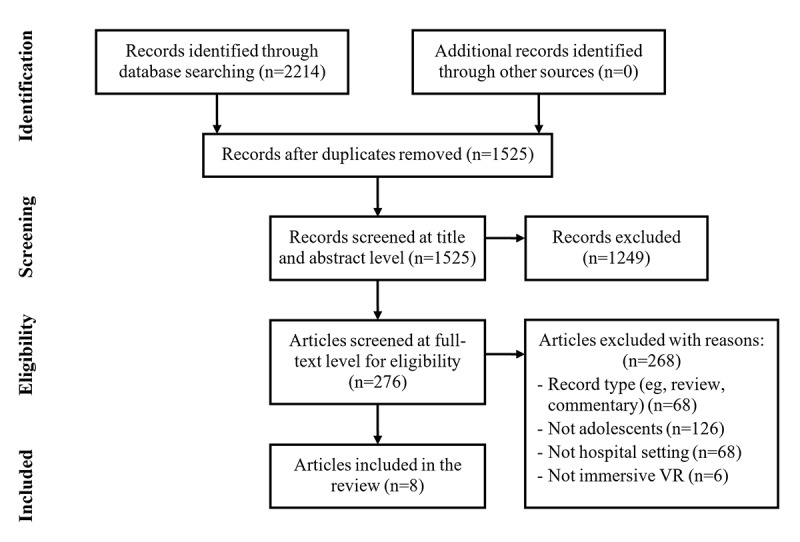
PubMed, PsycINFO, Medline, and Scopus databases were searched using keywords and phrases. Retrieved abstracts (n=1525) were double screened, yielding 276 articles for full-text screening. Of these, 8 articles met inclusion criteria. Data were extracted to a standardized coding sheet, and a narrative synthesis was performed due to the heterogeneity of the studies.
Four RCTs and 4 single-case reports were identified for inclusion, all of which aimed to reduce pain or anxiety. The scenarios targeted were burn pain, venipuncture, chemotherapy, preoperative anxiety, and palliative care. Three out of 4 RCTs found significant reductions in pain or anxiety outcomes measures when using virtual reality compared to standard care or other distraction techniques; however, only 1 study combined self-reported experiences of pain or anxiety with any physiological measures. Single-case reports relied primarily upon qualitative feedback, with patients reporting reduced pain or anxiety and a preference for virtual reality to no virtual reality.
Virtual reality can provide a safe and engaging way to reduce pain and anxiety in adolescents while in hospital, particularly when virtual reality software is highly immersive and specifically designed for therapeutic purposes. As VR becomes more accessible and affordable for use in hospitals, larger and more diverse studies that capitalize on adolescents' interest in and aptitude for virtual reality, and on the full range of capabilities of this emerging technology, are needed to build on these promising results.
PROSPERO International Prospective Register of Systematic Reviews CRD42020198760; https://www.crd.york.ac.uk/prospero/display_record.php?ID=CRD42020198760.
鉴于青少年对虚拟现实的浓厚兴趣和日益熟悉,利用虚拟现实来满足青少年在医院的独特医疗服务需求具有巨大潜力。虽然已经有针对特定健康状况和程序的虚拟现实使用的综述,但迄今为止,还没有针对经常与儿童作为同质群体一起接受治疗的青少年的虚拟现实医院干预措施进行全面综述,尽管青少年体验的虚拟环境与儿童不同。
本综述的目的是系统地确定有关虚拟现实干预措施在医院环境中用于青少年患者的现有证据,以评估有效性、适用性和安全性,并确定未来研究的机会。
使用关键词和短语在 PubMed、PsycINFO、Medline 和 Scopus 数据库中进行检索。对检索到的摘要(n=1525)进行双次筛选,得到 276 篇全文筛选文章。其中,8 篇文章符合纳入标准。将数据提取到标准化编码表中,并由于研究的异质性,进行了叙述性综合。
确定了 4 项 RCT 和 4 项单病例报告纳入研究,所有研究均旨在减轻疼痛或焦虑。针对的场景是烧伤疼痛、静脉穿刺、化疗、术前焦虑和姑息治疗。4 项 RCT 中有 3 项发现与标准护理或其他分散注意力技术相比,使用虚拟现实可显著降低疼痛或焦虑的结果测量值;然而,只有 1 项研究将疼痛或焦虑的自我报告体验与任何生理测量值结合起来。单病例报告主要依赖于定性反馈,患者报告疼痛或焦虑减轻,并更喜欢虚拟现实而不是没有虚拟现实。
虚拟现实可以为青少年在医院时提供一种安全且吸引人的减轻疼痛和焦虑的方法,特别是当虚拟现实软件具有高度沉浸式且专为治疗目的而设计时。随着虚拟现实在医院中变得更容易获得和更经济实惠,需要进行更大规模和更多样化的研究,利用青少年对虚拟现实的兴趣和适应能力,以及这种新兴技术的全部功能,在这些有希望的结果的基础上再接再厉。
PROSPERO 国际前瞻性系统评价注册中心 CRD42020198760;https://www.crd.york.ac.uk/prospero/display_record.php?ID=CRD42020198760。