Morrato Elaine H, Hamer Mika K, Sills Marion, Kwan Bethany, Schilling Lisa M
Department of Health Systems, Management and Policy, Colorado School of Public Health, University of Colorado Anschutz Medical Campus, US.
Adult and Child Consortium for Health Outcomes Research and Delivery Science (ACCORDS), University of Colorado Anschutz Medical Campus, US.
EGEMS (Wash DC). 2019 Aug 29;7(1):48. doi: 10.5334/egems.295.
Sustaining electronic health data networks and maximizing return on federal investment in their development is essential for achieving national data insight goals for transforming health care. However, crossing the business model chasm from grant funding to self-sustaining viability is challenging.
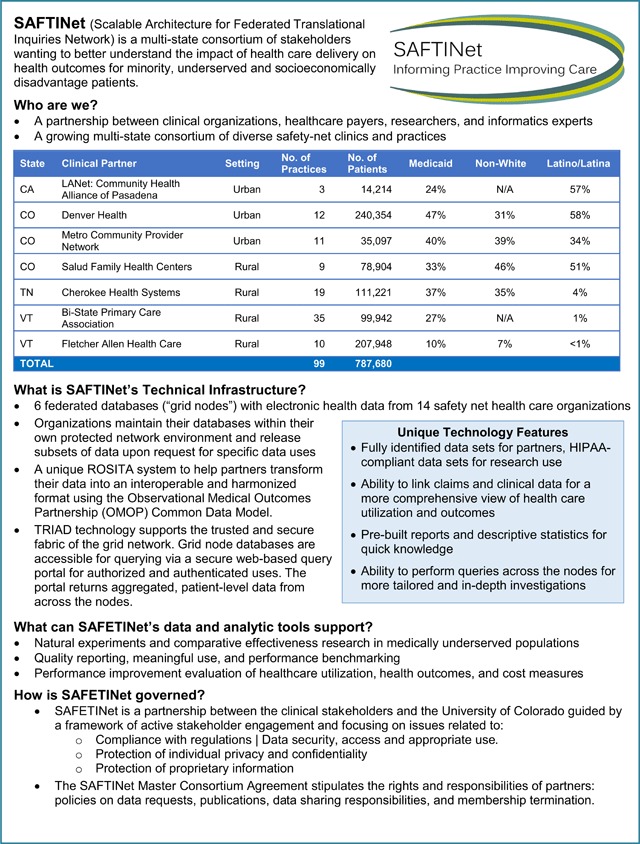
This paper presents lessons learned in seeking the sustainability of the Scalable Architecture for Federated Translational Inquiries Network (SAFTINet), and electronic health data network involving over 50 primary care practices in three states. SAFTINet was developed with funding from the Agency for Healthcare Research and Quality to create a multi-state network for comparative effectiveness research (CER) involving safety-net patients.
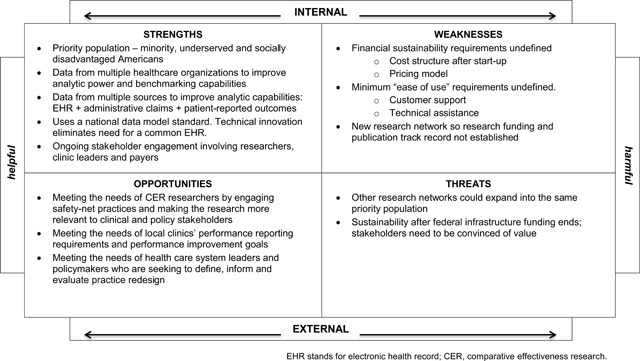
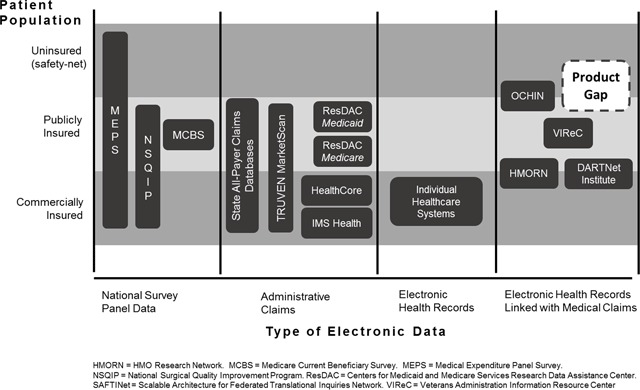
Three analyses were performed: (1) a product gap analysis of alternative data sources; (2) a Strengths-Weaknesses-Opportunities-Threat (SWOT) analysis of SAFTINet in the context of competing alternatives; and (3) a customer discovery process involving approximately 150 SAFTINet stakeholders to identify SAFTINet's sustaining value proposition for health services researchers, clinical data partners, and policy makers.
The results of this business model analysis informed SAFTINet's sustainability strategy. The fundamental high-level product needs were similar between the three primary customer segments: credible data, efficient and easy to use, and relevance to their daily work or 'jobs to be done'. However, how these benefits needed to be minimally demonstrated varied by customer such that different supporting evidence was required.
The SAFTINet experience illustrates that commercialization-readiness and business model methods can be used to identify multi-sided value propositions for sustaining electronic health data networks and their data capabilities as drivers of health care transformation.
维持电子健康数据网络并最大化联邦政府在其发展方面的投资回报,对于实现国家数据洞察目标以转变医疗保健至关重要。然而,从赠款资金跨越到自我维持的可行性的商业模式鸿沟具有挑战性。
本文介绍了在寻求联邦转化性查询网络(SAFTINet)可扩展架构的可持续性方面所吸取的经验教训,SAFTINet是一个涉及三个州50多个初级保健机构的电子健康数据网络。SAFTINet是在医疗保健研究与质量局的资助下开发的,旨在创建一个涉及安全网患者的多州比较效果研究(CER)网络。
进行了三项分析:(1)替代数据源的产品差距分析;(2)在竞争替代方案背景下对SAFTINet的优势-劣势-机会-威胁(SWOT)分析;(3)一个涉及约150名SAFTINet利益相关者的客户发现过程,以确定SAFTINet对健康服务研究人员、临床数据合作伙伴和政策制定者的可持续价值主张。
该商业模式分析的结果为SAFTINet的可持续性战略提供了信息。三个主要客户群体的基本高层次产品需求相似:可靠的数据、高效且易于使用,以及与他们的日常工作或“待办事项”相关。然而,这些好处需要以何种最低限度的方式展示因客户而异,因此需要不同的支持证据。
SAFTINet的经验表明,商业化准备和商业模式方法可用于确定多方面的价值主张,以维持电子健康数据网络及其数据能力,作为医疗保健转型的驱动力。