
利用霍夫迈斯特效应定制聚合物囊泡形状。
Tailoring Polymersome Shape Using the Hofmeister Effect.
机构信息
Radboud University , Institute for Molecules and Materials , Heyendaalseweg 135 , 6525 AJ , Nijmegen , The Netherlands.
出版信息
Biomacromolecules. 2020 Jan 13;21(1):89-94. doi: 10.1021/acs.biomac.9b00924. Epub 2019 Oct 11.
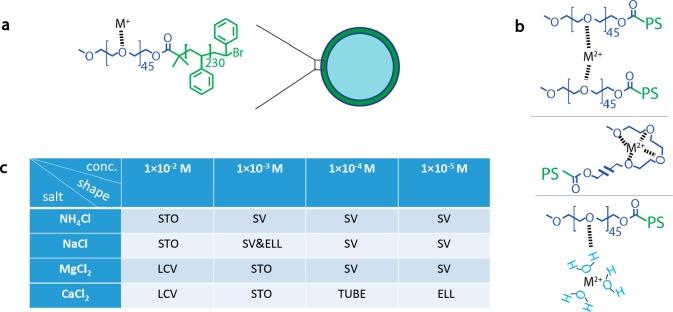
Reshaping polymersomes remains a challenge for both size and shape control, methodology development, and mechanism understanding, which hindered their application in nanomedicine and nanomachine. Unlike liposome, polymersomes are capable of maintaining their shape due to their rigid and glassy membrane. Here we use the Hofmeister effect to guide the shape control of polymersome by tuning the ion type and concentration. Multiple morphologies such as ellipsoid, tube, disc, stomatocytes, and large compound vesicles are found. These results give evidence of demonstrating that the shape changes are not only induced by osmotic pressure, but also by the interaction with the polymersome membranes. Additionally, this methodology provides a general tool to tailor the shape of polymersome into various morphologies.
重塑聚合物囊泡在大小和形状控制、方法学开发以及机制理解方面仍然是一个挑战,这阻碍了它们在纳米医学和纳米机器中的应用。与脂质体不同,聚合物囊泡由于其刚性和玻璃状膜而能够保持其形状。在这里,我们利用Hofmeister 效应通过调节离子类型和浓度来指导聚合物囊泡的形状控制。发现了多种形态,如椭圆体、管、盘、畸形红细胞和大复合囊泡。这些结果为证明形状变化不仅是由渗透压引起的,也是由与聚合物囊泡膜的相互作用引起的提供了证据。此外,该方法为将聚合物囊泡的形状定制成各种形态提供了一种通用工具。


 Zotero 插件