Clinical Center on TB Control, Beijing Chest Hospital, Capital Medical University/Beijing Tuberculosis & Thoracic Tumor Research Institute, Beijing 101149, China.
National Clinical Laboratory on Tuberculosis, Beijing Chest Hospital, Capital Medical University/Beijing Tuberculosis & Thoracic Tumor Research Institute, Beijing 101149, China.
Biomed Res Int. 2019 Aug 20;2019:9310917. doi: 10.1155/2019/9310917. eCollection 2019.
A national tuberculosis- (TB-) designated hospital survey was conducted in 2015 to identify significant changes since 2009 in implementation of TB-testing services within hospitals of various types and administrative levels in various regions in China.
In 2015, all TB-designated hospitals were required to complete questionnaires designed by the National Clinical Center for TB. Community hospitals also completed simplified questionnaires as part of the study.
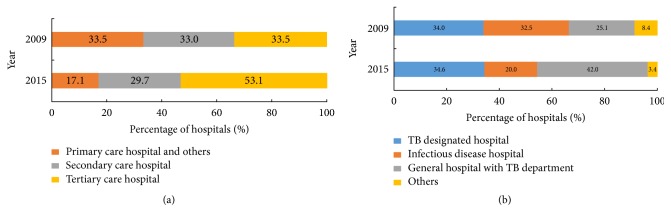
Overall, in 2015 there were 1685 TB-designated hospitals in China, consisting of 1335 (79.2%) county-level hospitals and 350 (20.8%) hospitals at the prefecture level and above. The percentage of counties with TB-designated hospitals in the western region (57.4%) was significantly lower than corresponding percentages for eastern and middle regions (70.3% and 96.5, respectively). Based on data recorded on hospital surveys in both 2009 and 2015, significant differences were noted between years in proportions of general hospitals with TB wards and of specialized infectious disease hospitals ( < 0.01). Of 1256 county-level laboratories conducting smear microscopy, only 979 (79%) performed external quality control evaluations of test results in 2015. For prefecture-level hospitals, 70% (234/334), 76% (155/203), and 67% (66/98) of hospitals obtained external quality control validations of smear microscopy, phenotypic DST, and molecular test results, respectively.
Although China's health reform efforts have resulted in improved TB patient access to quality health care, more attention should be paid to balancing the distribution of medical facilities across different regions. In addition, laboratory capabilities and quality control systems should be strengthened to ensure delivery of high-quality laboratory services by TB-designated hospitals throughout China.
2015 年进行了一次全国结核病(TB)定点医院调查,以确定自 2009 年以来,中国不同地区、不同类型和行政级别的医院实施结核病检测服务方面的显著变化。
2015 年,所有结核病定点医院都必须完成国家临床结核病中心设计的问卷。社区医院也作为研究的一部分完成了简化问卷。
总体而言,2015 年中国共有 1685 家结核病定点医院,其中包括 1335 家(79.2%)县级医院和 350 家(20.8%)地市级以上医院。西部地区(57.4%)有结核病定点医院的县的比例明显低于东部和中部地区(分别为 70.3%和 96.5%)。根据 2009 年和 2015 年医院调查记录的数据,综合医院设立结核病病房和专门传染病医院的比例在这两年间存在显著差异(<0.01)。在 1256 家开展涂片显微镜检查的县级实验室中,2015 年只有 979 家(79%)进行了检验结果的外部质量控制评估。在地市级医院中,70%(234/334)、76%(155/203)和 67%(66/98)的医院分别获得了涂片显微镜检查、表型药敏试验和分子试验结果的外部质量控制验证。
尽管中国的卫生改革努力使结核病患者能够获得更好的医疗服务,但仍需更加关注平衡不同地区的医疗设施分布。此外,应加强实验室能力和质量控制系统,以确保全国结核病定点医院提供高质量的实验室服务。