Santos Ana P, Castro Clara, Antunes Luís, Henrique Rui, Cardoso M Helena, Monteiro Mariana P
Department of Endocrinology, Portuguese Oncology Institute of Porto (IPO Porto), 4200-072 Porto, Portugal.
Clinical Research Unit, Research Center of IPO Porto (CI-IPOP), Portuguese Oncology Institute of Porto (IPO Porto), 4200-072 Porto, Portugal.
J Clin Med. 2019 Sep 17;8(9):1479. doi: 10.3390/jcm8091479.
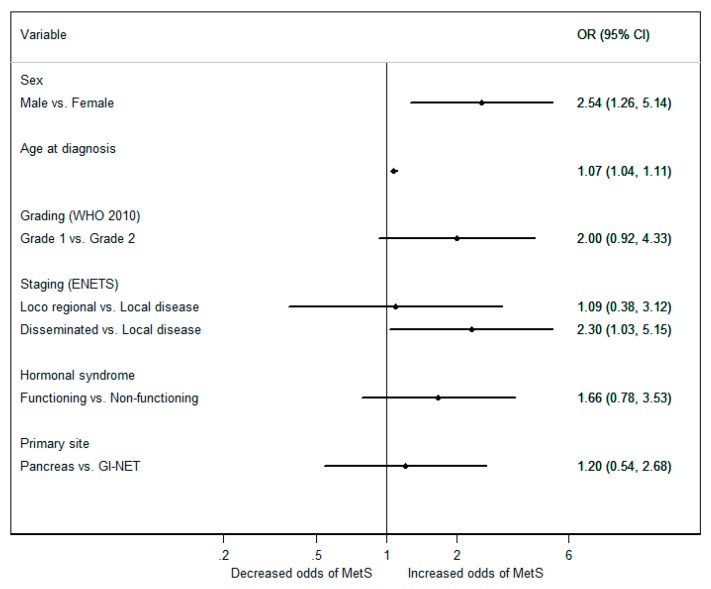
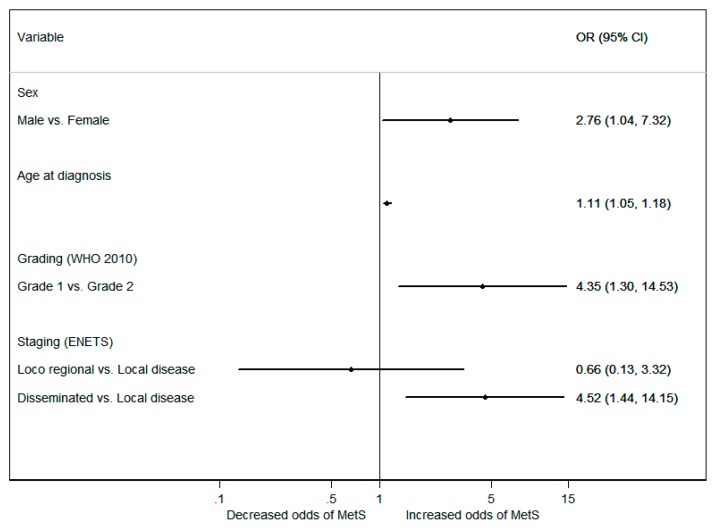
The association of well-differentiated gastro-entero-pancreatic neuroendocrine tumors (WD GEP-NETs) with metabolic syndrome (MetS), abdominal obesity, and fasting glucose abnormalities was recently described. The aim of this study was to evaluate whether the presence of MetS or any MetS individual component was also influenced by GEP-NET characteristics at diagnosis. A cohort of patients with WD GEP-NETs ( = 134), classified according to primary tumor location (gastrointestinal or pancreatic), pathological grading (G1 (Ki67 ≤ 2%) and G2 (>3 ≤ 20%) (WHO 2010), disease extension (localized, loco-regional, and metastatic), and presence of hormonal secretion syndrome (functioning/non-functioning), was evaluated for the presence of MetS criteria. After adjustment for age and gender, the odds of having MetS was significantly higher for patients with WD GEP-NET grade G1 (OR 4.35 95%CI 1.30-14.53) and disseminated disease (OR 4.52 95%CI 1.44-14.15). GEP-NET primary tumor location or secretory syndrome did not influence the risk for MetS. None of the tumor characteristics evaluated were associated with body mass index, fasting plasma glucose category, or any of the individual MetS components. Patients with GEP-NET and MetS depicted a higher risk of presenting a lower tumor grade and disseminated disease. The positive association between MetS and GEP-NET characteristics further highlights the potential link between the two conditions.
最近有研究描述了高分化胃肠胰神经内分泌肿瘤(WD GEP-NETs)与代谢综合征(MetS)、腹型肥胖和空腹血糖异常之间的关联。本研究的目的是评估在诊断时,MetS的存在或任何MetS的个体组成部分是否也受GEP-NET特征的影响。对一组WD GEP-NET患者(n = 134)进行了评估,这些患者根据原发性肿瘤位置(胃肠道或胰腺)、病理分级(G1(Ki67≤2%)和G2(>3≤20%)(WHO 2010))、疾病分期(局限性、局部区域和转移性)以及激素分泌综合征的存在情况(功能性/非功能性)进行分类,以确定是否存在MetS标准。在对年龄和性别进行调整后,WD GEP-NET G1级患者患MetS的几率显著更高(OR 4.35,95%CI 1.30 - 14.53),播散性疾病患者也是如此(OR 4.52,95%CI 1.44 - 14.15)。GEP-NET原发性肿瘤位置或分泌综合征不影响患MetS的风险。所评估的肿瘤特征均与体重指数、空腹血糖类别或任何个体MetS组成部分无关。患有GEP-NET和MetS的患者出现较低肿瘤分级和播散性疾病的风险更高。MetS与GEP-NET特征之间的正相关进一步凸显了这两种情况之间的潜在联系。