Khammanee Thunchanok, Sawangjaroen Nongyao, Buncherd Hansuk, Tun Aung Win, Thanapongpichat Supinya
Department of Microbiology, Faculty of Science, Prince of Songkla University, Hat Yai, Songkhla, Thailand.
Faculty of Medical Technology, Prince of Songkla University, Hat Yai, Songkhla, Thailand.
Korean J Parasitol. 2019 Aug;57(4):369-377. doi: 10.3347/kjp.2019.57.4.369. Epub 2019 Aug 31.
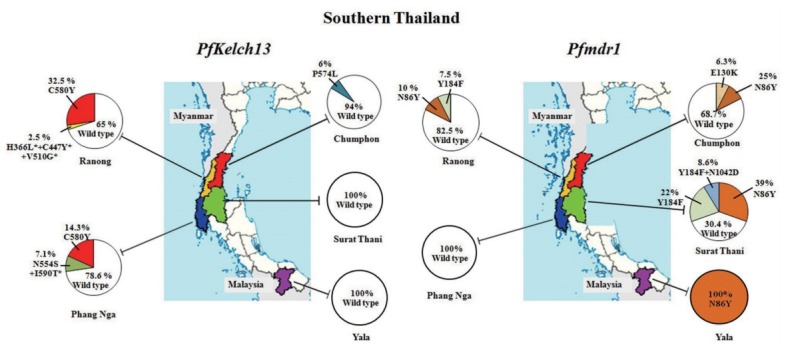
Artemisinin-based combination therapy (ACT) resistance is widespread throughout the Greater Mekong Subregion. This raises concern over the antimalarial treatment in Thailand since it shares borders with Cambodia, Laos, and Myanmar where high ACT failure rates were reported. It is crucial to have information about the spread of ACT resistance for efficient planning and treatment. This study was to identify the molecular markers for antimalarial drug resistance: Pfkelch13 and Pfmdr1 mutations from 5 provinces of southern Thailand, from 2012 to 2017, of which 2 provinces on the Thai- Myanmar border (Chumphon and Ranong), one on Thai-Malaysia border (Yala) and 2 from non-border provinces (Phang Nga and Surat Thani). The results showed that C580Y mutation of Pfkelch13 was found mainly in the province on the Thai-Myanmar border. No mutations in the PfKelch13 gene were found in Surat Thani and Yala. The Pfmdr1 gene isolated from the Thai-Malaysia border was a different pattern from those found in other areas (100% N86Y) whereas wild type strain was present in Phang Nga. Our study indicated that the molecular markers of artemisinin resistance were spread in the provinces bordering along the Thai-Myanmar, and the pattern of Pfmdr1 mutations from the areas along the international border of Thailand differed from those of the non-border provinces. The information of the molecular markers from this study highlighted the recent spread of artemisinin resistant parasites from the endemic area, and the data will be useful for optimizing antimalarial treatment based on regional differences.
以青蒿素为基础的联合疗法(ACT)耐药性在大湄公河次区域广泛存在。这引发了对泰国疟疾治疗的担忧,因为泰国与柬埔寨、老挝和缅甸接壤,而这些国家报告了较高的ACT治疗失败率。掌握ACT耐药性的传播信息对于有效规划和治疗至关重要。本研究旨在确定抗疟药物耐药性的分子标志物:2012年至2017年期间,对泰国南部5个省份的恶性疟原虫 Kelch13(Pfkelch13)和多药耐药基因1(Pfmdr1)突变进行检测,其中包括2个泰国与缅甸边境省份(春蓬和拉廊)、1个泰国与马来西亚边境省份(也拉)以及2个非边境省份(攀牙和素叻他尼)。结果显示,Pfkelch13的C580Y突变主要出现在泰国与缅甸边境省份。在素叻他尼和也拉未发现PfKelch13基因突变。从泰国与马来西亚边境分离出的Pfmdr1基因与其他地区的模式不同(100%为N86Y),而攀牙存在野生型菌株。我们的研究表明,青蒿素耐药性的分子标志物在泰国与缅甸接壤省份传播,泰国国际边境沿线地区的Pfmdr1突变模式与非边境省份不同。本研究的分子标志物信息突出了近期青蒿素耐药寄生虫在流行地区的传播情况,这些数据将有助于根据区域差异优化疟疾治疗。