Department of Clinical Neuroscience and Therapeutics, Hiroshima University Graduate School of Biomedical and Health Sciences.
Department of Neurology, Tokyo Women's Medical University School of Medicine.
J Atheroscler Thromb. 2020 May 1;27(5):449-460. doi: 10.5551/jat.50518. Epub 2019 Sep 18.
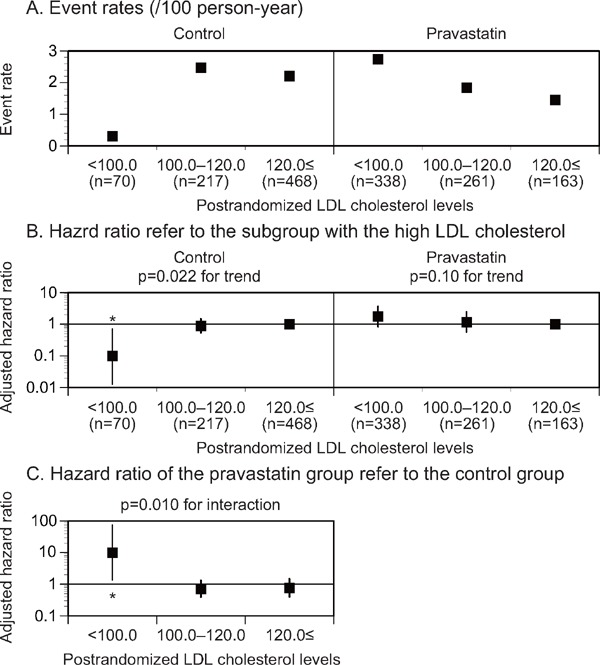
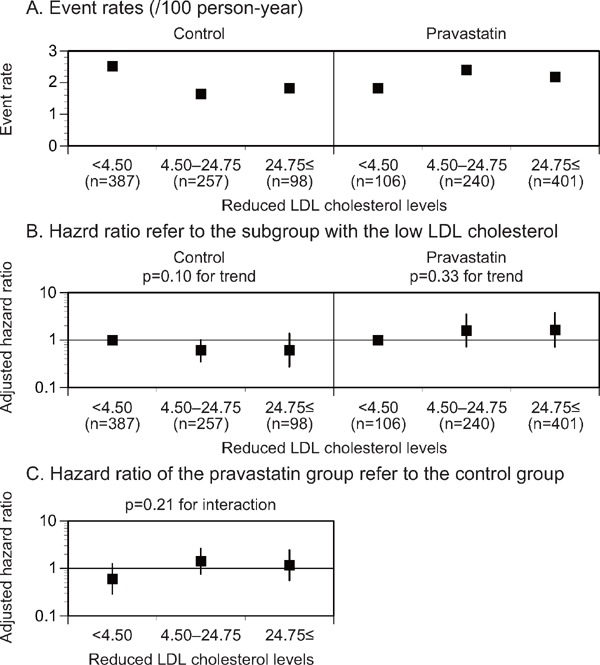
To understand the different influences of statins on the incidence rate of each stroke subtype in association with low-density lipoprotein (LDL) cholesterol levels, we performed a post hoc analysis on the data from the Japan Statin Treatment Against Recurrent Stroke (J-STARS) study.
Subjects (n=1,578) were divided into three groups according to their mean postrandomized LDL cholesterol level (<100, 100-120, and ≥ 120 mg/dL) until the last observation before the event or the end of follow-up. A Cox proportional hazard model for time to events was used for calculating adjusted hazard ratios, 95% confidence intervals, and the trend tests.
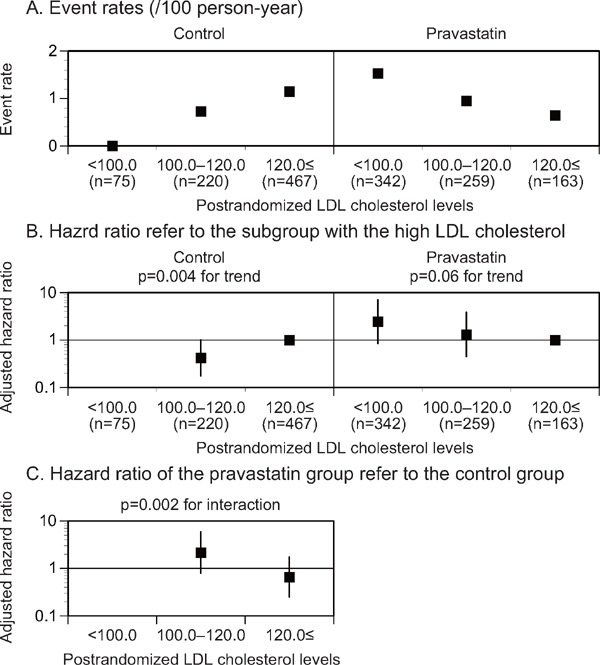
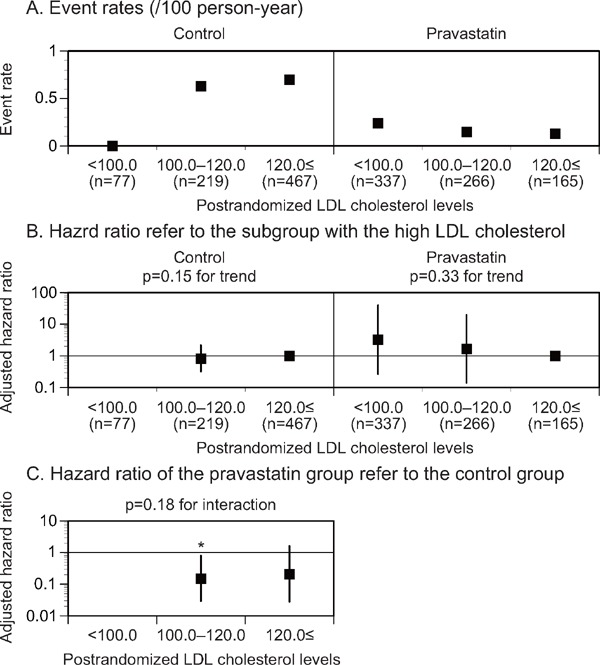
The event rates for atherothrombotic stroke did not decrease in accordance with the postrandomized LDL cholesterol level subgroups of either the control or the pravastatin group (p=0.15 and 0.33 for the trend, respectively). In the control group, however, no atherothrombotic stroke event was observed in the subgroup of the low postrandomized LDL cholesterol level (less than 100 mg/dL). The event rates for atherothrombotic stroke were lower in the middle postrandomized LDL cholesterol level subgroup (100-120 mg/dL) of the pravastatin group than that of the control group. The event rates for lacunar stroke decreased in the lower postrandomized LDL cholesterol level subgroup of the control group but not of the pravastatin group (p=0.004 and 0.06 for the trend, respectively).
Statins showed different influences on the risks of atherothromobotic and lacunar stroke according to postrandomized LDL cholesterol levels.
为了了解他汀类药物对各型卒中发生率的不同影响与低密度脂蛋白(LDL)胆固醇水平的关系,我们对日本他汀类药物防治复发性卒中研究(J-STARS)的数据进行了事后分析。
根据随机分组后 LDL 胆固醇水平的平均值(<100、100-120 和≥120mg/dL),将受试者(n=1578)分为三组,直至事件发生前的最后一次观察或随访结束。采用时间相关的 Cox 比例风险模型计算调整后的危险比、95%置信区间和趋势检验。
在对照组或普伐他汀组中,各 LDL 胆固醇水平亚组的动脉粥样硬化血栓性卒中发生率并未随随机分组后 LDL 胆固醇水平降低而降低(趋势检验 p=0.15 和 0.33)。然而,在对照组中,随机分组后 LDL 胆固醇水平较低(<100mg/dL)亚组未观察到动脉粥样硬化血栓性卒中事件。普伐他汀组中 LDL 胆固醇水平处于中间范围(100-120mg/dL)的亚组,动脉粥样硬化血栓性卒中的发生率低于对照组。对照组中,随机分组后 LDL 胆固醇水平较低的亚组腔隙性卒中发生率降低,但普伐他汀组无此趋势(趋势检验 p=0.004 和 0.06)。
他汀类药物对动脉粥样硬化血栓性和腔隙性卒中的风险有不同的影响,与随机分组后 LDL 胆固醇水平有关。