Du Ying, Gong Xiang-Dan, Fang Xin, Xing Fang, Xia Tian-Jiao, Gu Xiao-Ping
Department of Anesthesiology, Affiliated Drum Tower Hospital of Medical Department of Nanjing University, Nanjing, Jiangsu Province, China.
Jiangsu Key Laboratory of Molecular Medicine, Nanjing University, Nanjing, Jiangsu Province, China.
Neural Regen Res. 2020 Jan;15(1):96-102. doi: 10.4103/1673-5374.264468.
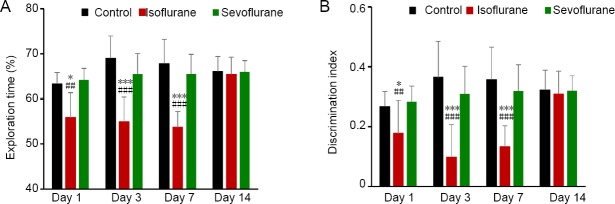
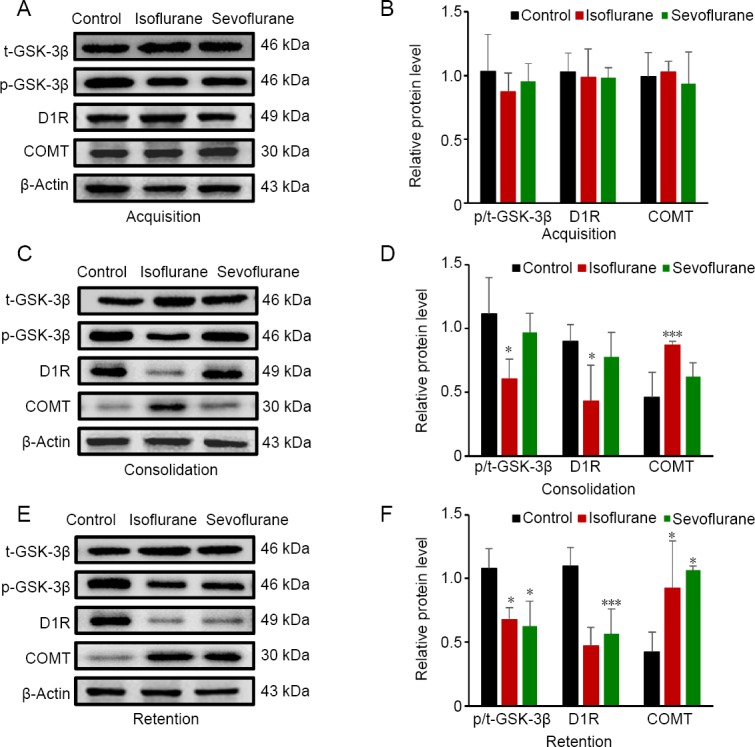
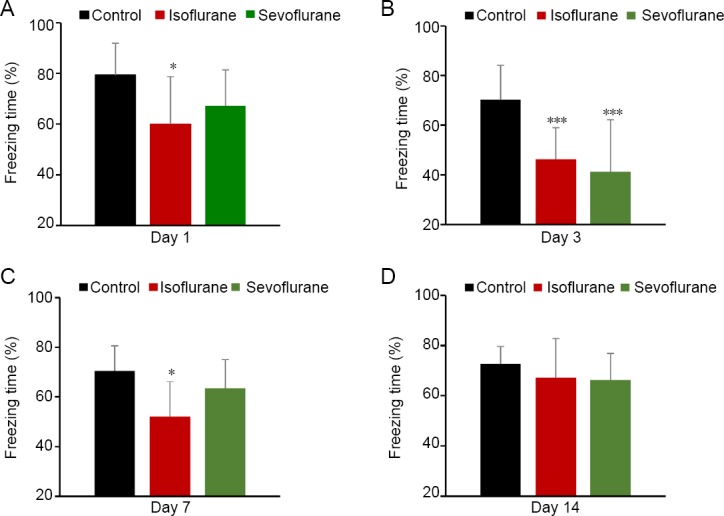
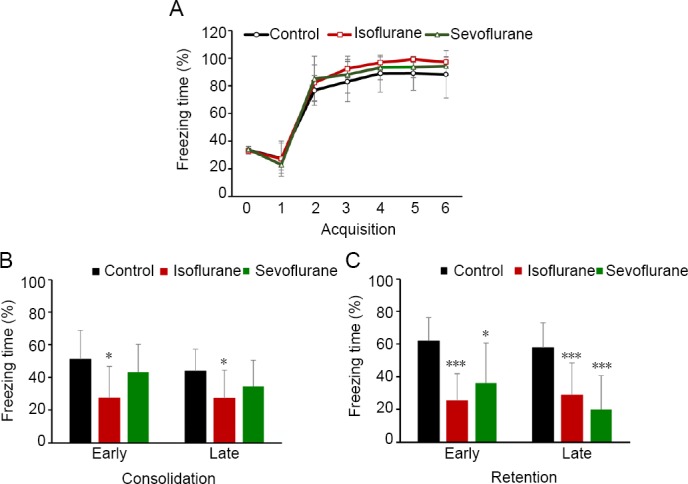
Isoflurane and sevoflurane are both inhalation anesthetics, but in clinical application, sevoflurane has been considered to be less suitable for long-term anesthesia because of its catabolic compounds and potential nephrotoxicity. Nevertheless, recent studies have shown that these two inhalation anesthetics are similar in hepatorenal toxicity, cost, and long-term anesthetic effect. Moreover, sevoflurane possibly has less cognitive impact on young mice. In this study, C57BL/6 mice aged 8-10 weeks were exposed to 1.2% isoflurane or 2.4% sevoflurane for 6 hours. Cognitive function and memory were examined in young mice using the novel object recognition, contextual fear conditioning, and cued-fear extinction tests. Western blot assay was performed to detect expression levels of D1 dopamine receptor, catechol-O-methyltransferase, phospho-glycogen synthase kinase-3β, and total glycogen synthase kinase-3β in the hippocampus. Our results show that impaired performance was not detected in mice exposed to sevoflurane during the novel object recognition test. Contextual memory impairment in the fear conditioning test was shorter in the sevoflurane group than the isoflurane group. Long-term sevoflurane exposure did not affect memory consolidation, while isoflurane led to memory consolidation and reduced retention. Downregulation of hippocampal D1 dopamine receptors and phosphorylated glycogen synthase kinase-3β/total glycogen synthase kinase-3β and upregulation of catechol-O-methyltransferase may be associated with differing memory performance after exposure to isoflurane or sevoflurane. These results confirm that sevoflurane has less effect on cognitive impairment than isoflurane, which may be related to expression of D1 dopamine receptors and catechol-O-methyltransferase and phosphorylation of glycogen synthase kinase-3β in the hippocampus. This study was approved by the Institutional Animal Care and Use Committee, Nanjing University, China on November 20, 2017 (approval No. 20171102).
异氟烷和七氟烷均为吸入性麻醉剂,但在临床应用中,由于七氟烷的分解产物及潜在肾毒性,其被认为不太适合用于长期麻醉。然而,近期研究表明,这两种吸入性麻醉剂在肝肾毒性、成本及长期麻醉效果方面相似。此外,七氟烷对幼鼠的认知影响可能较小。在本研究中,将8至10周龄的C57BL/6小鼠暴露于1.2%的异氟烷或2.4%的七氟烷中6小时。使用新物体识别、情境恐惧条件反射和线索恐惧消退试验检测幼鼠的认知功能和记忆。进行蛋白质免疫印迹分析以检测海马体中D1多巴胺受体、儿茶酚-O-甲基转移酶、磷酸化糖原合酶激酶-3β和总糖原合酶激酶-3β的表达水平。我们的结果显示,在新物体识别试验中,暴露于七氟烷的小鼠未检测到行为表现受损。在恐惧条件反射试验中,七氟烷组的情境记忆损伤比异氟烷组短。长期暴露于七氟烷不影响记忆巩固,而异氟烷则导致记忆巩固并降低记忆保持。海马体中D1多巴胺受体、磷酸化糖原合酶激酶-3β/总糖原合酶激酶-3β的下调以及儿茶酚-O-甲基转移酶的上调可能与暴露于异氟烷或七氟烷后的不同记忆表现有关。这些结果证实,七氟烷对认知损伤的影响比异氟烷小,这可能与海马体中D1多巴胺受体和儿茶酚-O-甲基转移酶的表达以及糖原合酶激酶-3β的磷酸化有关。本研究于2017年11月20日获得中国南京大学实验动物管理与使用委员会批准(批准号:20171102)。