Caulfield Sarah E, Davis Christine C, Byers Kristina F
Emory University Winship Cancer Institute, Atlanta, Georgia.
J Adv Pract Oncol. 2019 Mar;10(2):167-174. Epub 2019 Mar 1.
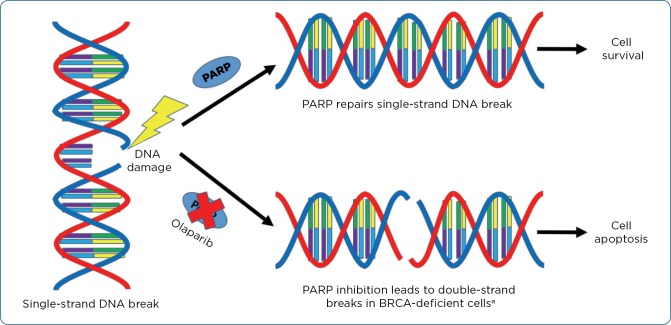
Breast cancer is the most frequently diagnosed cancer in women globally. Genetic mutations can increase the risk of developing breast cancer. Inherited germline mutations in and tumor suppressor genes (gm) account for 5% to 10% of breast cancer cases. The recent approval of olaparib, a poly (ADP-ribose) polymerase (PARP) inhibitor, in HER2-negative, metastatic breast cancer provides an additional treatment option for patients with a gm. Inhibition of PARP results in the trapping of the PARP-DNA complex at replication forks, causing single-strand breaks to become double-strand breaks (DSBs). PARP trapping and the accumulation of DSBs ultimately leads to cell apoptosis. Cells deficient in BRCA1/2 are particularly sensitive to the effects of PARP inhibition, as cells lacking these functional proteins are unable to repair DSBs, resulting in synthetic lethality. The phase III OlympiAD trial showed a progression-free survival benefit but no overall survival benefit, leading to the US Food and Drug Administration approval of olaparib. The purpose of this article is to describe current data regarding the use of olaparib in metastatic breast cancer, its role in the treatment of patients with a gm, and the clinical implications of its approval for oncology advanced practitioners.
乳腺癌是全球女性中最常被诊断出的癌症。基因突变会增加患乳腺癌的风险。乳腺癌病例中有5%至10%是由乳腺癌1号基因(BRCA1)和乳腺癌2号基因(BRCA2)等肿瘤抑制基因的遗传性种系突变引起的。聚(ADP-核糖)聚合酶(PARP)抑制剂奥拉帕利最近被批准用于治疗HER2阴性转移性乳腺癌,为携带种系突变的患者提供了另一种治疗选择。抑制PARP会导致PARP-DNA复合物在复制叉处被困住,使单链断裂变成双链断裂(DSB)。PARP被困住以及DSB的积累最终导致细胞凋亡。缺乏BRCA1/2的细胞对PARP抑制的影响特别敏感,因为缺乏这些功能蛋白的细胞无法修复DSB,从而导致合成致死。III期OlympiAD试验显示奥拉帕利有延长无进展生存期的益处,但没有总生存期的益处,这促使美国食品药品监督管理局批准了奥拉帕利。本文的目的是描述关于奥拉帕利在转移性乳腺癌中的应用的当前数据、其在携带种系突变患者治疗中的作用以及其获批对肿瘤学高级从业者的临床意义。