Chang Hae Ryung
Department of Life Science, Handong Global University, Pohang 37554, Republic of Korea.
Biomedicines. 2023 Sep 13;11(9):2527. doi: 10.3390/biomedicines11092527.
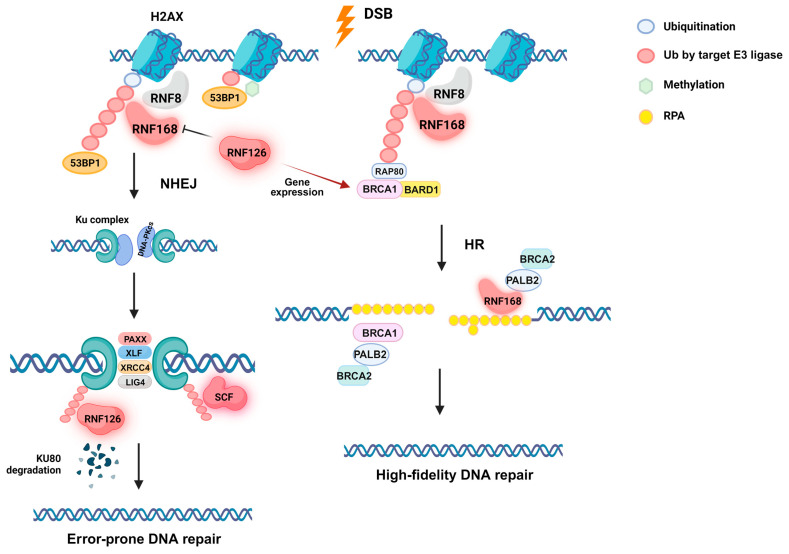
Ubiquitination is a post-translational modification (PTM) that is involved in proteolysis, protein-protein interaction, and signal transduction. Accumulation of mutations and genomic instability are characteristic of cancer cells, and dysfunction of the ubiquitin pathway can contribute to abnormal cell physiology. Because mutations can be critical for cells, DNA damage repair, cell cycle regulation, and apoptosis are pathways that are in close communication to maintain genomic integrity. Uncontrolled cell proliferation due to abnormal processes is a hallmark of cancer, and mutations, changes in expression levels, and other alterations of ubiquitination factors are often involved. Here, three E3 ubiquitin ligases will be reviewed in detail. RNF126, RNF168 and CUL1 are involved in DNA damage response (DDR), DNA double-strand break (DSB) repair, cell cycle regulation, and ultimately, cancer cell proliferation control. Their involvement in multiple cellular pathways makes them an attractive candidate for cancer-targeting therapy. Functional studies of these E3 ligases have increased over the years, and their significance in cancer is well reported. There are continuous efforts to develop drugs targeting the ubiquitin pathway for anticancer therapy, which opens up the possibility for these E3 ligases to be evaluated for their potential as a target protein for anticancer therapy.
泛素化是一种翻译后修饰(PTM),参与蛋白质水解、蛋白质-蛋白质相互作用和信号转导。突变积累和基因组不稳定是癌细胞的特征,泛素途径功能障碍可导致细胞生理异常。由于突变对细胞至关重要,DNA损伤修复、细胞周期调控和细胞凋亡是密切相关以维持基因组完整性的途径。异常过程导致的细胞增殖失控是癌症的标志,泛素化因子的突变、表达水平变化及其他改变常与之相关。在此,将详细综述三种E3泛素连接酶。RNF126、RNF168和CUL1参与DNA损伤反应(DDR)、DNA双链断裂(DSB)修复、细胞周期调控,并最终参与癌细胞增殖控制。它们参与多种细胞途径使其成为癌症靶向治疗的有吸引力的候选对象。多年来对这些E3连接酶的功能研究不断增加,其在癌症中的意义也有充分报道。人们不断努力开发针对泛素途径的抗癌治疗药物,这为评估这些E3连接酶作为抗癌治疗靶蛋白的潜力提供了可能性。