Department of General Surgery, Beijing Friendship Hospital, Capital Medical University & National Clinical Research Center for Digestive Diseases, No.95, Yong An Road, Xicheng District, Beijing, 100050, China.
School of Public Health, Peking University, Beijing, China.
BMC Cancer. 2023 Aug 29;23(1):807. doi: 10.1186/s12885-023-11328-w.
Breast cancer susceptibility gene (BRCA) mutation carriers are at an increased risk for breast, ovarian, prostate and pancreatic cancers. However, the role of BRCA is unclear in colorectal cancer; the results regarding the association between BRCA gene mutations and colorectal cancer risk are inconsistent and even controversial. This study aimed to investigate whether BRCA1 and BRCA2 gene mutations are associated with colorectal cancer risk.
In this systematic review, we searched PubMed/MEDLINE, Embase and Cochrane Library databases, adhering to PRISMA guidelines. Study quality was assessed using the Newcastle-Ottawa Scale (NOS). Unadjusted odds ratios (ORs) were used to estimate the probability of Breast Cancer Type 1 Susceptibility gene (BRCA1) and Breast Cancer Type 2 Susceptibility gene (BRCA2) mutations in colorectal cancer patients. The associations were evaluated using fixed effect models.
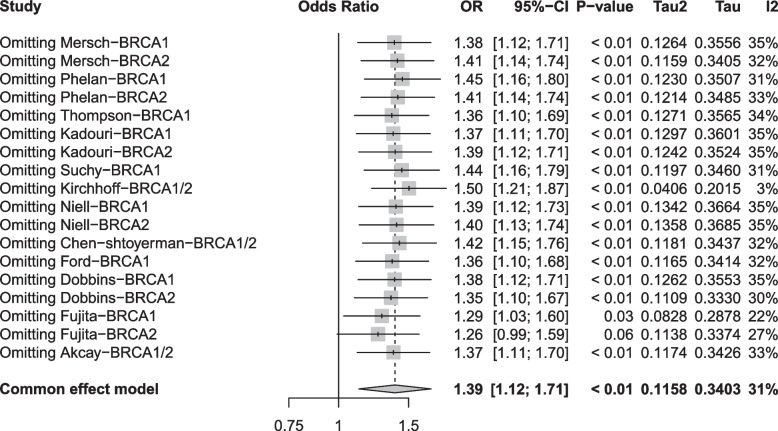
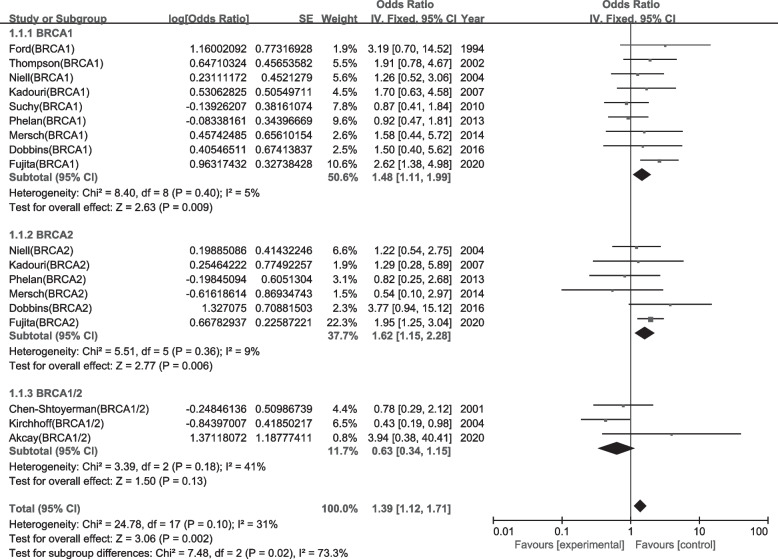
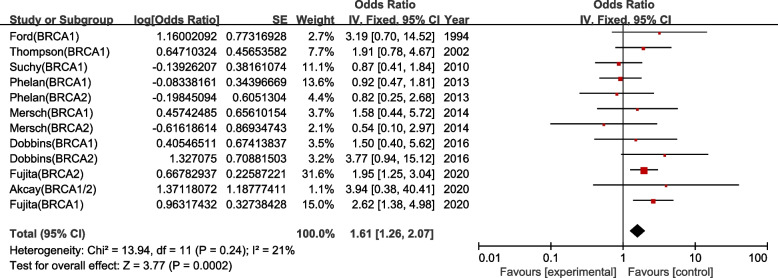
Fourteen studies were included in the systematic review. Twelve studies, including seven case-control and five cohort studies, were included in the meta-analysis. A significant increase in the frequency of BRCA1 and BRCA2 mutations was observed in patients with colorectal cancer [OR = 1.34, 95% confidence interval (CI) = 1.02-1.76, P = 0.04]. In subgroup analysis, colorectal cancer patients had an increased odds of BRCA1 (OR = 1.48, 95% CI = 1.10-2.01, P = 0.01) and BRCA2 (OR = 1.56, 95% CI = 1.06-2.30, P = 0.02) mutations.
BRCA genes are one of the genes that may increase the risk of developing colorectal cancer. Thus, BRCA genes could be potential candidates that may be included in the colorectal cancer genetic testing panel.
乳腺癌易感基因(BRCA)突变携带者患乳腺癌、卵巢癌、前列腺癌和胰腺癌的风险增加。然而,BRCA 在结直肠癌中的作用尚不清楚;BRCA 基因突变与结直肠癌风险之间的关联结果不一致,甚至有争议。本研究旨在探讨 BRCA1 和 BRCA2 基因突变是否与结直肠癌风险相关。
在这项系统评价中,我们按照 PRISMA 指南搜索了 PubMed/MEDLINE、Embase 和 Cochrane Library 数据库。使用纽卡斯尔-渥太华量表(NOS)评估研究质量。使用未调整的优势比(OR)来估计结直肠癌患者中乳腺癌 1 型易感基因(BRCA1)和乳腺癌 2 型易感基因(BRCA2)突变的概率。使用固定效应模型评估相关性。
系统评价共纳入 14 项研究。Meta 分析纳入了 12 项研究,包括 7 项病例对照研究和 5 项队列研究。结直肠癌患者中 BRCA1 和 BRCA2 突变的频率明显增加[OR=1.34,95%置信区间(CI)=1.02-1.76,P=0.04]。亚组分析显示,结直肠癌患者 BRCA1(OR=1.48,95%CI=1.10-2.01,P=0.01)和 BRCA2(OR=1.56,95%CI=1.06-2.30,P=0.02)突变的几率增加。
BRCA 基因是可能增加结直肠癌发病风险的基因之一。因此,BRCA 基因可能是可纳入结直肠癌遗传检测面板的潜在候选基因。