Department of Nutrition, Food Science and Physiology, School of Pharmacy and Nutrition, Universidad de Navarra, 31008 Pamplona, Spain.
Department of Geriatrics, Complejo Hospitalario de Navarra, Calle de Irunlarrea 3, 31008 Pamplona, Spain.
Nutrients. 2019 Sep 18;11(9):2243. doi: 10.3390/nu11092243.
Admitted bedridden older patients are at risk of the development of sarcopenia during hospital stay (incident sarcopenia). The objective of this study was to assess the factors associated with sarcopenia (incident and chronic) and its impact on mortality in older people with hip fracture.
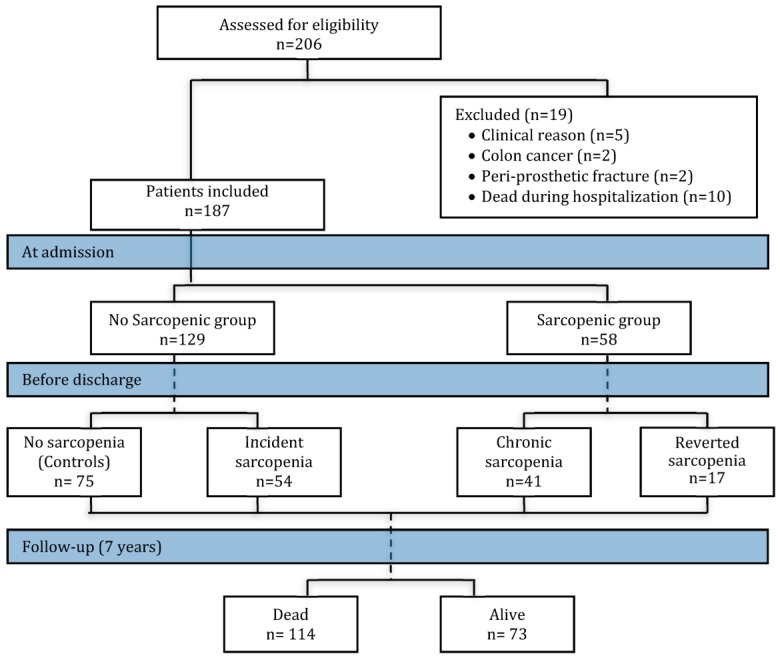
A multicenter, pragmatic, prospective observational study was designed. Older subjects with hip fracture admitted to two rehabilitation units were included. Sarcopenia was assessed at admission and at discharge according to the revised EWGSOP (European Working Group on Sarcopenia in Older People) consensus definition. The mortality was evaluated after 7 years of follow-up.
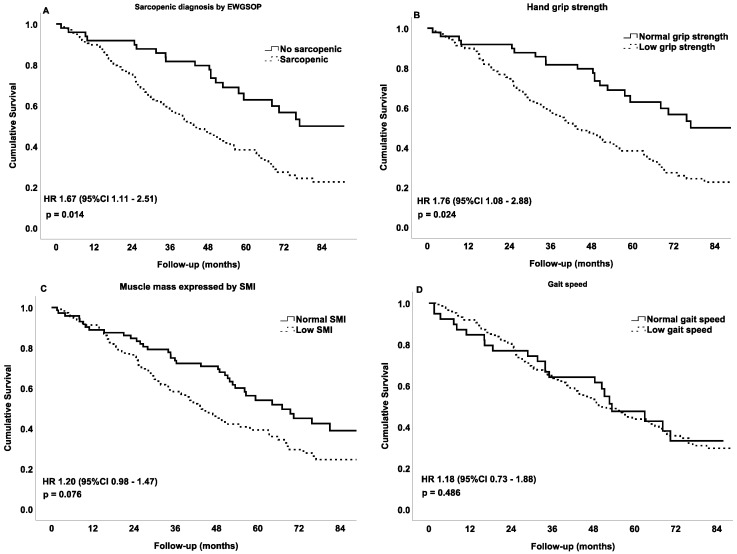
A total of 187 subjects (73.8% women) age 85.2 ± 6.3 years were included. Risk factors associated to incident and chronic sarcopenia were undernutrition (body mass index-BMI and Mini Nutritional Assessment-Short Form-MNA-SF), hand-grip strength and skeletal muscle index. During follow-up 114 patients died (60.5% sarcopenic vs. 39.5% non-sarcopenic, = 0.001). Cox regression analyses showed that factors associated to increased risk of mortality were sarcopenia (HR: 1.67, 95% CI 1.11-2.51) and low hand-grip strength (HR: 1.76, 95% CI 1.08-2.88).
Older patients with undernutrition have a higher risk of developing sarcopenia during hospital stay, and sarcopenic patients have almost two times more risk of mortality than non-sarcopenic patients during follow-up after hip fracture.
住院期间(新发肌少症),卧床的老年住院患者有发生肌少症的风险。本研究旨在评估与髋部骨折老年患者肌少症(新发和慢性)相关的因素及其对死亡率的影响。
设计了一项多中心、实用、前瞻性观察研究。纳入了入住两个康复病房的髋部骨折老年患者。根据修订后的 EWGSOP(欧洲老年人肌少症工作组)共识定义,在入院时和出院时评估肌少症。在 7 年的随访后评估死亡率。
共纳入 187 名(73.8%为女性)年龄为 85.2 ± 6.3 岁的患者。新发和慢性肌少症的危险因素包括营养不良(体重指数-BMI 和微型营养评估-简短表格-MNA-SF)、握力和骨骼肌指数。在随访期间,有 114 名患者死亡(60.5%肌少症患者比 39.5%非肌少症患者, = 0.001)。Cox 回归分析显示,与死亡率增加相关的因素包括肌少症(HR:1.67,95%CI 1.11-2.51)和握力低(HR:1.76,95%CI 1.08-2.88)。
营养不良的老年患者在住院期间发生肌少症的风险更高,而肌少症患者在髋部骨折后随访期间的死亡率是非肌少症患者的近两倍。