Kwon Da Hye, Lee Hyesook, Park Cheol, Hong Su-Hyun, Hong Sang Hoon, Kim Gi-Young, Cha Hee-Jae, Kim Suhkmann, Kim Heui-Soo, Hwang Hye-Jin, Choi Yung Hyun
Anti-Aging Research Center and Department of Biochemistry, College of Korean Medicine, Dong-eui University, Busan 47340, Korea.
Department of Molecular Biology, College of Natural Sciences, Dong-eui University, Busan 47340, Korea.
Antioxidants (Basel). 2019 Sep 18;8(9):413. doi: 10.3390/antiox8090413.
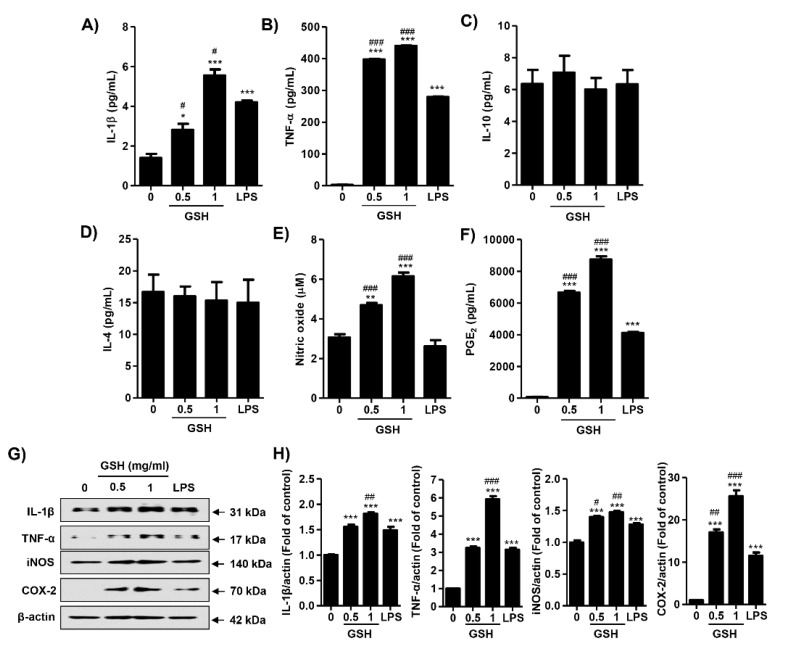
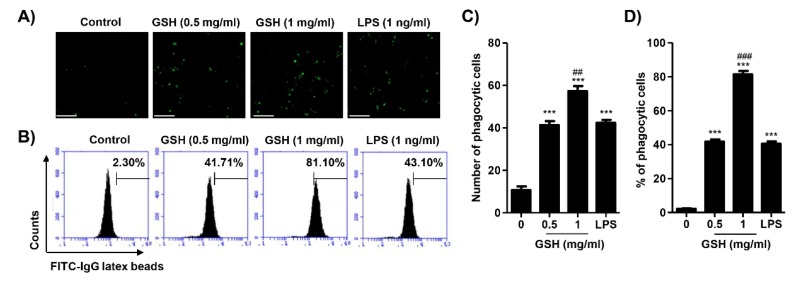
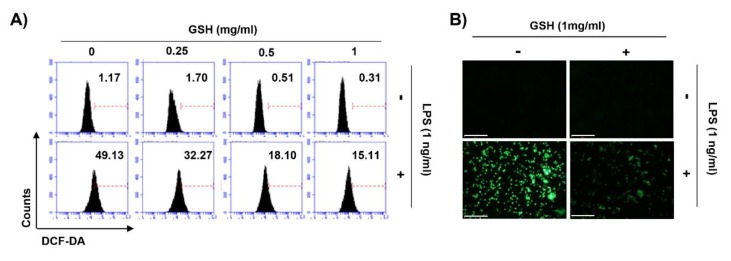
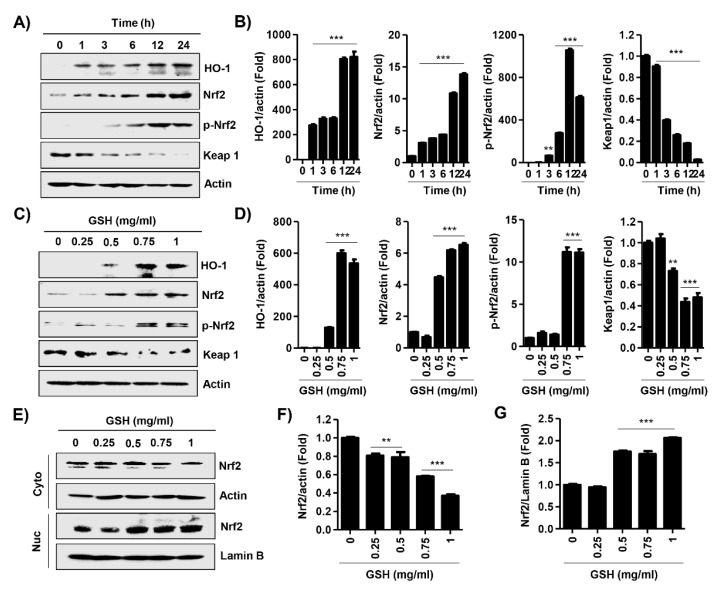
The present study investigated the immunomodulatory activity of reduced glutathione (GSH) by assessment of the macrophage polarization (MP)-mediated immune response in RAW 264.7 cells. Furthermore, we identified the signal pathway associated with immune regulation by GSH. The expressions of MP-associated cytokines and chemokines were assessed using cytokine array, nCounter Sprit platform, ELISA and immunoblotting. Phagocytosis activity and intracellular reactive oxygen species (ROS) generation were measured using fluorescence-activated cell sorter. As results of the cytokine array and nCounter gene array, GSH not only up-regulated pro-inflammatory cytokines, including interleukins and tumor necrosis factor-α, but also overexpressed neutrophil-attracting chemokines. Furthermore, GSH significantly stimulated the production of immune mediators, including nitric oxide and PGE, as well as phagocytosis activity through nuclear factor kappa B activation. In addition, GSH significantly decreased LPS-induced ROS generation, which was associated with an activation of nuclear factor erythroid-derived 2-related factor 2 (Nrf2)/ heme oxygenease-1 (HO-1) signaling pathway. Our results suggest that GSH has potential ROS scavenging capacity via the induction of Nrf2-mediated HO-1, and immune-enhancing activity by regulation of M1-like macrophage polarization, indicating that GSH may be a useful strategy to increase the human defense system.
本研究通过评估RAW 264.7细胞中巨噬细胞极化(MP)介导的免疫反应,研究了还原型谷胱甘肽(GSH)的免疫调节活性。此外,我们确定了与GSH免疫调节相关的信号通路。使用细胞因子阵列、nCounter Sprit平台、酶联免疫吸附测定和免疫印迹法评估MP相关细胞因子和趋化因子的表达。使用荧光激活细胞分选仪测量吞噬活性和细胞内活性氧(ROS)的产生。作为细胞因子阵列和nCounter基因阵列的结果,GSH不仅上调了促炎细胞因子,包括白细胞介素和肿瘤坏死因子-α,还过表达了吸引中性粒细胞的趋化因子。此外,GSH通过核因子κB激活显著刺激了免疫介质的产生,包括一氧化氮和前列腺素E,以及吞噬活性。此外,GSH显著降低了脂多糖诱导的ROS产生,这与核因子红细胞衍生2相关因子2(Nrf2)/血红素加氧酶-1(HO-1)信号通路的激活有关。我们的结果表明,GSH通过诱导Nrf2介导的HO-1具有潜在的ROS清除能力,并通过调节M1样巨噬细胞极化具有免疫增强活性,表明GSH可能是增强人体防御系统的一种有用策略。