Rheumatology, Johns Hopkins School of Medicine, Baltimore, Maryland, USA.
Oncology, Johns Hopkins School of Medicine, Baltimore, Maryland, USA.
Ann Rheum Dis. 2020 Mar;79(3):332-338. doi: 10.1136/annrheumdis-2019-216109. Epub 2019 Sep 20.
We sought to investigate the long-term outcomes of patients who develop immune checkpoint inhibitor (ICI)-induced inflammatory arthritis (IA), to define factors associated with IA persistence after ICI cessation, the need for immunosuppressants and the impact of these medications on underlying malignancies.
We conducted a prospective observational study of patients referred for IA associated with ICIs. Patients were recruited from June 2015 to December 2018. Information was obtained at the baseline visit, and follow-up visits occurred at varying intervals for up to 24 months from ICI cessation. Kaplan-Meier curves were developed to characterise IA persistence. Cox proportional hazards models were used to assess the influence of various factors on IA persistence. Logistic regression was used to evaluate the impact of IA treatment on tumour response.
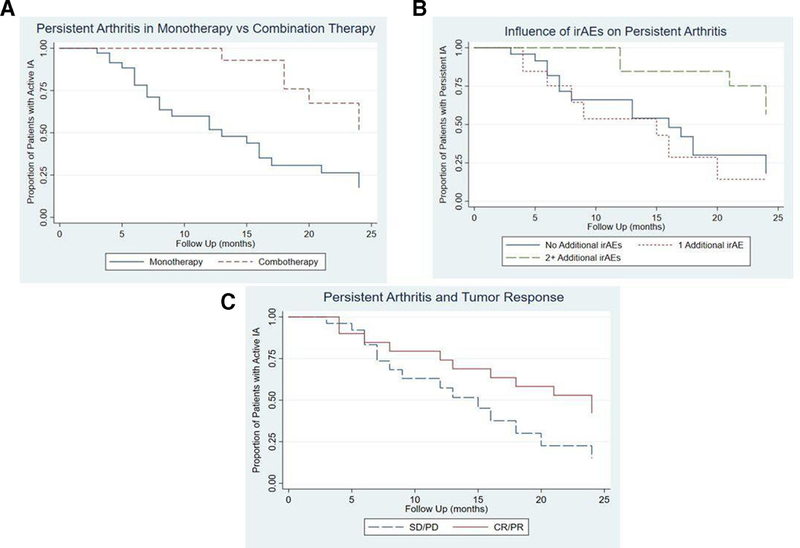
Sixty patients were monitored with a median follow-up after ICI cessation of 9 months. A majority (53.3%) had active IA at their most recent follow-up. IA was less likely to improve in those with longer duration of ICI use, in those receiving combination ICI therapy, and in patients with multiple other immune-related adverse events. Tumour response did not appear to be impacted by immunosuppression. Although not statistically significant, persistent IA was correlated with a better tumour response (complete or partial response).
ICI-induced IA can become a long-term disease necessitating management by rheumatology for immunomodulatory treatment. Importantly, the use of immunomodulatory treatment has not been shown to impact cancer outcomes in this study.
我们旨在研究发生免疫检查点抑制剂(ICI)诱导的炎症性关节炎(IA)的患者的长期结局,以确定与 ICI 停药后 IA 持续存在相关的因素、免疫抑制剂的需求以及这些药物对潜在恶性肿瘤的影响。
我们对因 ICI 相关的 IA 而就诊的患者进行了一项前瞻性观察性研究。这些患者是在 2015 年 6 月至 2018 年 12 月期间招募的。基线访视时收集了信息,并在 ICI 停药后长达 24 个月的不同时间间隔进行了随访。采用 Kaplan-Meier 曲线来描述 IA 的持续时间。采用 Cox 比例风险模型评估各种因素对 IA 持续时间的影响。采用逻辑回归评估 IA 治疗对肿瘤反应的影响。
对 60 例患者进行了监测,在 ICI 停药后中位随访时间为 9 个月。大多数患者(53.3%)在最近一次随访时仍有活动性 IA。IA 改善的可能性较小的患者包括:ICI 使用时间较长的患者、接受联合 ICI 治疗的患者以及患有多种其他免疫相关不良事件的患者。肿瘤反应似乎不受免疫抑制的影响。尽管没有统计学意义,但持续的 IA 与更好的肿瘤反应(完全或部分反应)相关。
ICI 诱导的 IA 可能成为一种长期疾病,需要风湿病学进行免疫调节治疗。重要的是,在这项研究中,免疫调节治疗的使用并未显示对癌症结局产生影响。