Navarro-Garcia Fernando, Ruiz-Perez Fernando, Cataldi Ángel, Larzábal Mariano
Department of Cell Biology, Centro de Investigación y de Estudios Avanzados del IPN (CINVESTAV-IPN), Mexico City, Mexico.
Department of Pediatrics, University of Virginia School of Medicine, Charlottesville, VA, United States.
Front Microbiol. 2019 Aug 30;10:1965. doi: 10.3389/fmicb.2019.01965. eCollection 2019.
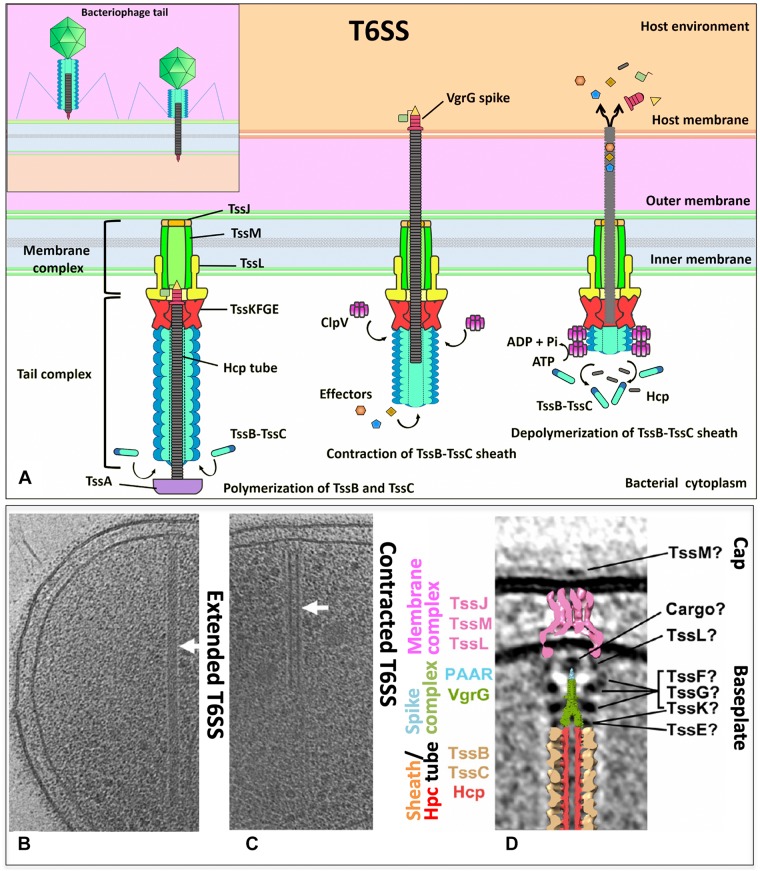
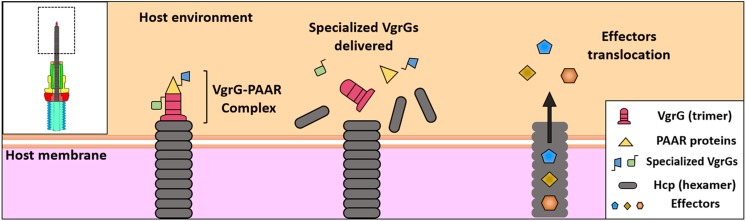
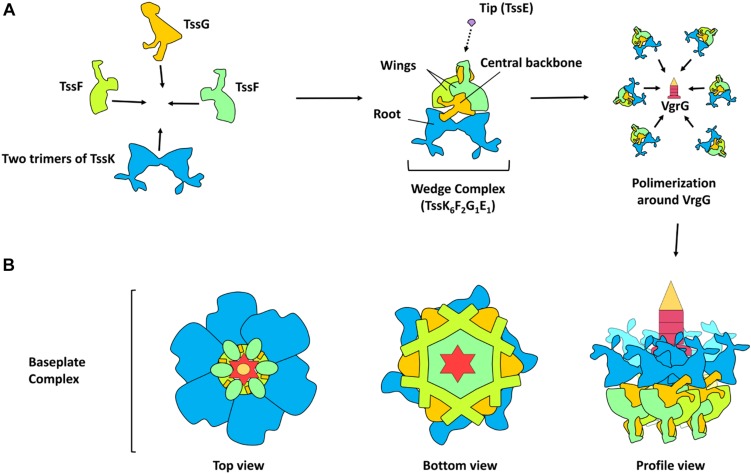
Bacterial pathogens utilize a myriad of mechanisms to invade mammalian hosts, damage tissue sites, and evade the immune system. One essential strategy of Gram-negative bacteria is the secretion of virulence factors through both inner and outer membranes to reach a potential target. Most secretion systems are harbored in mobile elements including transposons, plasmids, pathogenicity islands, and phages, and is one of the more versatile bacteria adopting this genetic information by horizontal gene transfer. Additionally, is a bacterial species with members of the commensal intestinal microbiota and pathogens associated with numerous types of infections such as intestinal, urinary, and systemic in humans and other animals. T6SS cluster plasticity suggests evolutionarily divergent systems were acquired horizontally. T6SS is a secretion nanomachine that is extended through the bacterial double membrane; from this apparatus, substrates are conveyed straight from the cytoplasm of the bacterium into a target cell or to the extracellular space. This nanomachine consists of three main complexes: proteins in the inner membrane that are T4SS component-like, the baseplate complex, and the tail complex, which are formed by components evolutionarily related to contractile bacteriophage tails. Advances in the T6SS understanding include the functional and structural characterization of at least 13 subunits (so-called core components), which are thought to comprise the minimal apparatus. So far, the main role of T6SS is on bacterial competition by using it to kill neighboring non-immune bacteria for which antibacterial proteins are secreted directly into the periplasm of the bacterial target after cell-cell contact. Interestingly, a few T6SSs have been associated directly to pathogenesis, e.g., roles in biofilm formation and macrophage survival. Here, we focus on the advances on T6SS from the perspective of pathotypes with emphasis in the secretion apparatus architecture, the mechanisms of pathogenicity of effector proteins, and the events of lateral gene transfer that led to its spread.
细菌病原体利用多种机制侵入哺乳动物宿主、破坏组织部位并逃避免疫系统。革兰氏阴性菌的一个重要策略是通过内膜和外膜分泌毒力因子以到达潜在靶点。大多数分泌系统存在于包括转座子、质粒、致病岛和噬菌体在内的可移动元件中,并且是通过水平基因转移获取这种遗传信息的较为通用的细菌之一。此外, 是一种细菌物种,其成员包括共生肠道微生物群以及与多种感染相关的病原体,如人类和其他动物的肠道、泌尿道和全身性感染。T6SS 簇的可塑性表明进化上不同的系统是通过水平方式获得的。T6SS 是一种通过细菌双膜延伸的分泌纳米机器;从这个装置中,底物直接从细菌的细胞质输送到靶细胞或细胞外空间。这个纳米机器由三个主要复合物组成:内膜中类似于 T4SS 成分的蛋白质、基板复合物和尾部复合物,它们由与收缩性噬菌体尾部进化相关的成分形成。对 T6SS 的认识进展包括至少 13 个亚基(所谓的核心成分)的功能和结构表征,这些亚基被认为构成了最小装置。到目前为止,T6SS 的主要作用是通过在细胞间接触后将抗菌蛋白直接分泌到细菌靶标的周质中来杀死邻近的非免疫细菌,从而参与细菌竞争。有趣的是,一些 T6SS 已直接与发病机制相关联,例如在生物膜形成和巨噬细胞存活中的作用。在这里,我们从 致病型的角度关注 T6SS 的进展,重点是分泌装置结构、效应蛋白的致病机制以及导致其传播的横向基因转移事件。