Department of Internal Medicine, Wake Forest University, Winston Salem, North Carolina, USA.
Department of Nutritional Sciences, University of Toronto, Toronto, Ontario, Canada.
BMJ Open Diabetes Res Care. 2019 Sep 4;7(1):e000691. doi: 10.1136/bmjdrc-2019-000691. eCollection 2019.
To examine the associations of fatty acids in the de novo lipogenesis (DNL) pathway, specifically myristic acid (14:0), palmitic acid (16:0), palmitoleic acid (c16:1 n-7), myristoleic acid (c14:1n5), stearic acid (18:0) and oleic acid (c18:1 n-9), with 5-year risk of type 2 diabetes. We hypothesized that DNL fatty acids are associated with risk of type 2 diabetes independent of insulin sensitivity.
We evaluated 719 (mean age 55.1±8.5 years, 44.2% men, 42.3% Caucasians) participants from the Insulin Resistance Atherosclerosis Study. Multivariable logistic regression models with and without adjustment of insulin sensitivity were used to assess prospective associations of DNL fatty acids with incident type 2 diabetes.
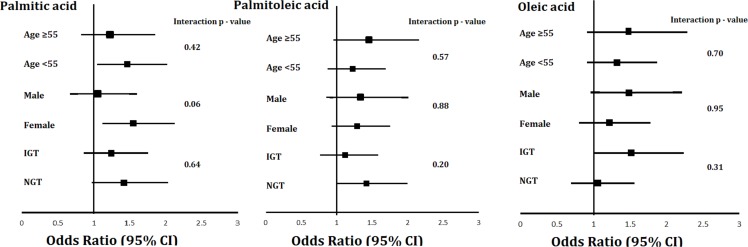
Type 2 diabetes incidence was 20.3% over 5 years. In multivariable regression models, palmitic, palmitoleic, myristic, myristoleic and oleic acids were associated with increased risk of type 2 diabetes (p<0.05). Palmitic acid had the strongest association (OR per standard unit of palmitic acid 1.46; 95% CI 1.23 to 1.76; p<0.001), which remained similar with addition of insulin sensitivity and acute insulin response (AIR) to the model (OR 1.36; 95% CI 1.09 to 1.70, p=0.01). Oleic and palmitoleic acids were also independently associated with incident type 2 diabetes. In multivariable models, ratios of fatty acids corresponding to stearoyl CoA desaturase-1 and Elovl6 enzymatic activity were significantly associated with risk of type 2 diabetes independent of insulin sensitivity and AIR.
We observed associations of DNL fatty acids with type 2 diabetes incidence independent of insulin sensitivity.
研究从头合成(DNL)途径中脂肪酸(特别是肉豆蔻酸(14:0)、棕榈酸(16:0)、棕榈油酸(c16:1n-7)、肉豆蔻油酸(c14:1n5)、硬脂酸(18:0)和油酸(c18:1n-9))与 2 型糖尿病发病风险之间的关系。我们假设 DNL 脂肪酸与胰岛素敏感性无关,与 2 型糖尿病发病风险有关。
我们评估了胰岛素抵抗动脉粥样硬化研究(Insulin Resistance Atherosclerosis Study)中的 719 名参与者(平均年龄 55.1±8.5 岁,44.2%为男性,42.3%为白种人)。使用包含和不包含胰岛素敏感性调整的多变量逻辑回归模型,评估 DNL 脂肪酸与 2 型糖尿病发病风险的前瞻性关联。
5 年内 2 型糖尿病发病率为 20.3%。在多变量回归模型中,棕榈酸、棕榈油酸、肉豆蔻酸、肉豆蔻油酸和油酸与 2 型糖尿病风险增加相关(p<0.05)。棕榈酸与风险增加的相关性最强(棕榈酸每增加一个标准单位,比值比为 1.46;95%置信区间为 1.23 至 1.76;p<0.001),在模型中加入胰岛素敏感性和急性胰岛素反应(AIR)后,这种相关性仍然相似(比值比为 1.36;95%置信区间为 1.09 至 1.70,p=0.01)。油酸和棕榈油酸也与 2 型糖尿病发病独立相关。在多变量模型中,与硬脂酰辅酶 A 去饱和酶-1 和 Elovl6 酶活性相对应的脂肪酸比值与胰岛素敏感性和 AIR 无关,与 2 型糖尿病的发病风险显著相关。
我们观察到 DNL 脂肪酸与 2 型糖尿病发病风险之间的关联,与胰岛素敏感性无关。