Computational BioMedicine Laboratory (CBML), Institute of Computer Science (ICS), Foundation for Research and Technology‑Hellas (FORTH), 70013 Heraklion, Greece.
Department of Forensic Sciences and Laboratory of Toxicology, Medical School, University of Crete, 70013 Heraklion, Greece.
Oncol Rep. 2019 Nov;42(5):2009-2015. doi: 10.3892/or.2019.7312. Epub 2019 Sep 12.
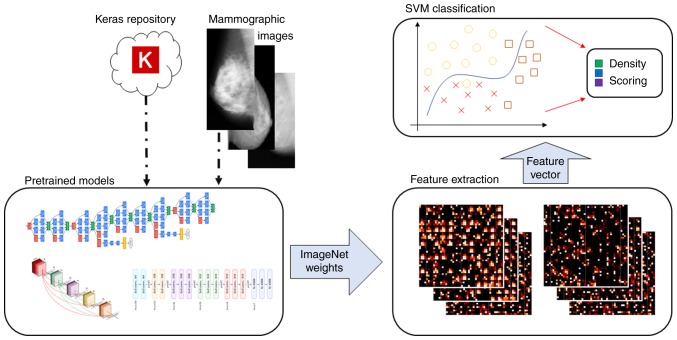
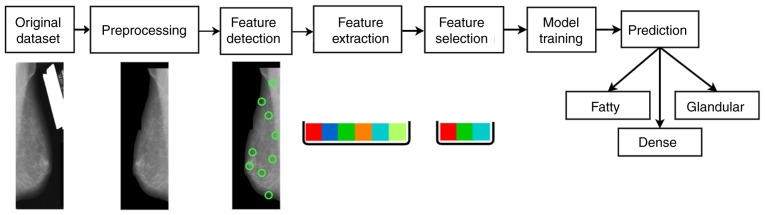
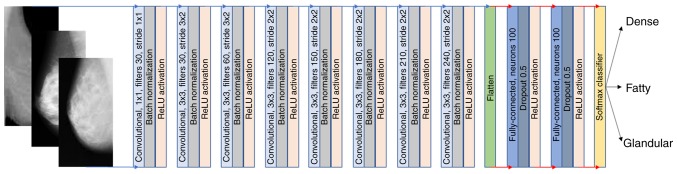
Potentially suspicious breast neoplasms could be masked by high tissue density, thus increasing the probability of a false‑negative diagnosis. Furthermore, differentiating breast tissue type enables patient pre‑screening stratification and risk assessment. In this study, we propose and evaluate advanced machine learning methodologies aiming at an objective and reliable method for breast density scoring from routine mammographic images. The proposed image analysis pipeline incorporates texture [Gabor filters and local binary pattern (LBP)] and gradient‑based features [histogram of oriented gradients (HOG) as well as speeded‑up robust features (SURF)]. Additionally, transfer learning approaches with ImageNet trained weights were also used for comparison, as well as a convolutional neural network (CNN). The proposed CNN model was fully trained on two open mammography datasets and was found to be the optimal performing methodology (AUC up to 87.3%). Thus, the findings of this study indicate that automated density scoring in mammograms can aid clinical diagnosis by introducing artificial intelligence‑powered decision‑support systems and contribute to the 'democratization' of healthcare by overcoming limitations, such as the geographic location of patients or the lack of expert radiologists.
高组织密度可能会掩盖潜在可疑的乳腺肿瘤,从而增加假阴性诊断的概率。此外,区分乳腺组织类型可以实现患者的预筛选分层和风险评估。在这项研究中,我们提出并评估了先进的机器学习方法,旨在为常规乳腺 X 光图像的乳腺密度评分提供一种客观可靠的方法。所提出的图像分析管道结合了纹理[Gabor 滤波器和局部二值模式(LBP)]和基于梯度的特征[方向梯度直方图(HOG)以及加速稳健特征(SURF)]。此外,还使用了带有 ImageNet 训练权重的迁移学习方法进行比较,以及卷积神经网络(CNN)。所提出的 CNN 模型在两个开放的乳腺 X 光数据集上进行了全面训练,被发现是表现最佳的方法(AUC 高达 87.3%)。因此,这项研究的结果表明,通过引入人工智能驱动的决策支持系统,对乳腺 X 光片进行自动密度评分可以辅助临床诊断,并通过克服患者地理位置或缺乏专家放射科医生等限制,为医疗保健的“民主化”做出贡献。