Public Health and Epidemiology Research Group, School of Medicine, Universidad de Alcalá, Alcalá de Henares, 28001 Madrid, Spain.
National Centre for Epidemiology, Instituto de Salud Carlos III (ISCIII), 28029 Madrid, Spain.
Int J Environ Res Public Health. 2019 Sep 21;16(19):3538. doi: 10.3390/ijerph16193538.
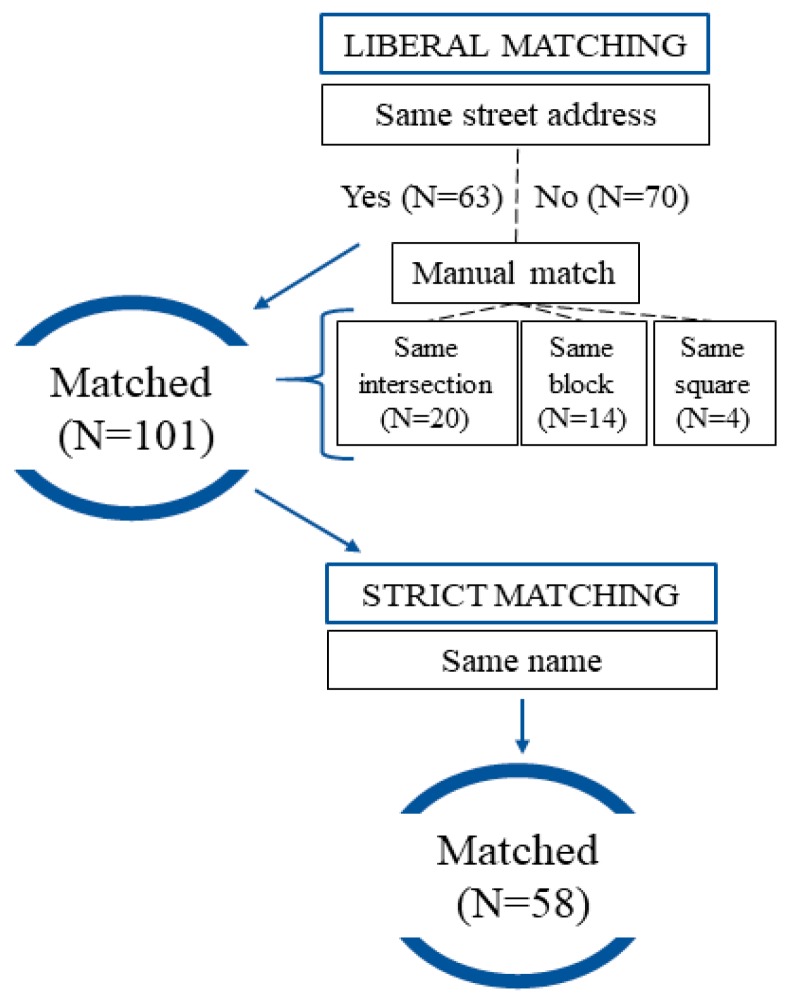
Previous studies have suggested that European settings face unique food environment issues; however, retail food environments (RFE) outside Anglo-Saxon contexts remain understudied. We assessed the completeness and accuracy of an administrative dataset against ground truthing, using the example of Madrid (Spain). Further, we tested whether its completeness differed by its area-level socioeconomic status (SES) and population density. First, we collected data on the RFE through the ground truthing of 42 census tracts. Second, we retrieved data on the RFE from an administrative dataset covering the entire city ( = 2412 census tracts), and matched outlets using location matching and location/name matching. Third, we validated the administrative dataset against the gold standard of ground truthing. Using location matching, the administrative dataset had a high sensitivity (0.95; [95% CI = 0.89, 0.98]) and positive predictive values (PPV) (0.79; [95% CI = 0.70, 0.85]), while these values were substantially lower using location/name matching (0.55 and 0.45, respectively). Accuracy was slightly higher using location/name matching ( = 0.71 vs 0.62). We found some evidence for systematic differences in PPV by area-level SES using location matching, and in both sensitivity and PPV by population density using location/name matching. Administrative datasets may offer a reliable and cost-effective source to measure retail food access; however, their accuracy needs to be evaluated before using them for research purposes.
先前的研究表明,欧洲的环境面临着独特的食品环境问题;然而,在盎格鲁-撒克逊背景之外,零售食品环境(RFE)仍未得到充分研究。我们以马德里(西班牙)为例,评估了行政数据集的完整性和准确性,并进行了实地核实。此外,我们还测试了其完整性是否因区域社会经济地位(SES)和人口密度的不同而有所差异。首先,我们通过对 42 个普查区进行实地核实来收集 RFE 的数据。其次,我们从一个覆盖整个城市的行政数据集中检索 RFE 的数据(=2412 个普查区),并使用位置匹配和位置/名称匹配来匹配网点。第三,我们将行政数据集与实地核实的黄金标准进行了验证。使用位置匹配,行政数据集具有很高的敏感性(0.95;[95%置信区间=0.89,0.98])和阳性预测值(PPV)(0.79;[95%置信区间=0.70,0.85]),而使用位置/名称匹配时,这些值要低得多(分别为 0.55 和 0.45)。使用位置/名称匹配时,准确性略高(=0.71 对 0.62)。我们发现,使用位置匹配时,按区域 SES 划分的 PPV 存在系统差异的证据,而使用位置/名称匹配时,敏感性和 PPV 均存在密度差异的证据。行政数据集可能是衡量零售食品供应的可靠且具有成本效益的来源;然而,在将其用于研究目的之前,需要对其准确性进行评估。