de Menezes Mariana Carvalho, de Matos Vanderlei Pascoal, de Pina Maria de Fátima, de Lima Costa Bruna Vieira, Mendes Larissa Loures, Pessoa Milene Cristine, de Souza-Junior Paulo Roberto Borges, de Lima Friche Amélia Augusta, Caiaffa Waleska Teixeira, de Oliveira Cardoso Letícia
National School of Public Health, Fiocruz-RJ, Rua Leopoldo Bulhões, 1480- Manguinhos, Rio de Janeiro, 21041-210, Brazil.
Instituto de Comunicação e Informação Científica e Tecnológica em Saúde, Fiocruz-RJ, Av. Brasil, 4.365 - Manguinhos, Rio de Janeiro, 21040-900, Brazil.
J Urban Health. 2021 Apr;98(2):285-295. doi: 10.1007/s11524-020-00495-x. Epub 2020 Nov 23.
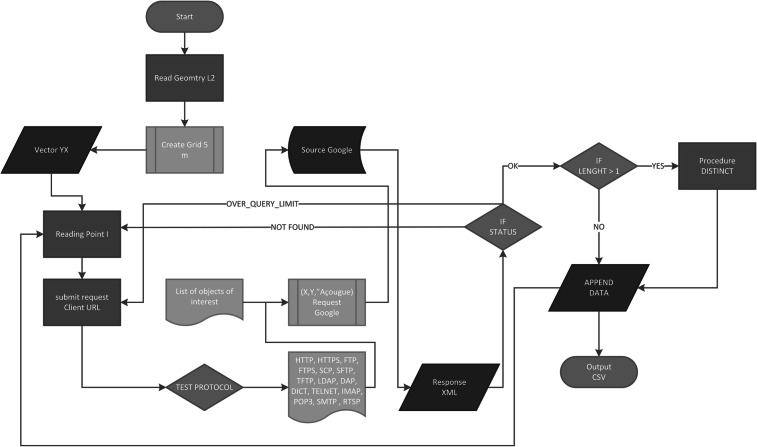
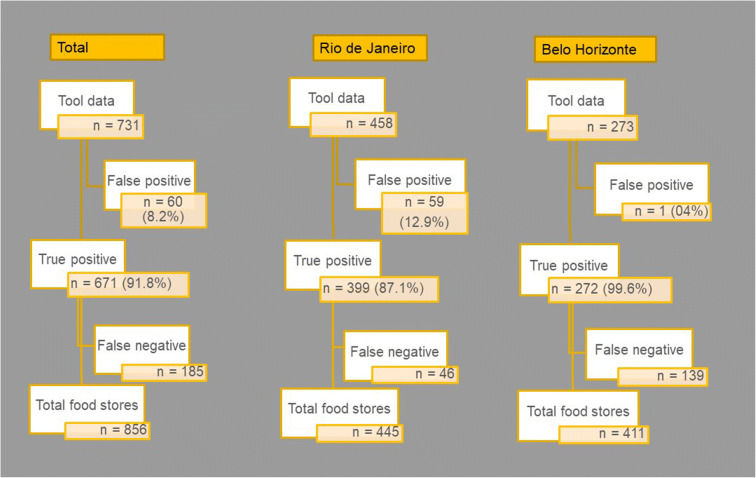
To overcome the challenge of obtaining accurate data on community food retail, we developed an innovative tool to automatically capture food retail data from Google Earth (GE). The proposed method is relevant to non-commercial use or scholarly purposes. We aimed to test the validity of web sources data for the assessment of community food retail environment by comparison to ground-truth observations (gold standard). A secondary aim was to test whether validity differs by type of food outlet and socioeconomic status (SES). The study area included a sample of 300 census tracts stratified by SES in two of the largest cities in Brazil, Rio de Janeiro and Belo Horizonte. The GE web service was used to develop a tool for automatic acquisition of food retail data through the generation of a regular grid of points. To test its validity, this data was compared with the ground-truth data. Compared to the 856 outlets identified in 285 census tracts by the ground-truth method, the GE interface identified 731 outlets. In both cities, the GE interface scored moderate to excellent compared to the ground-truth data across all of the validity measures: sensitivity, specificity, positive predictive value, negative predictive value and accuracy (ranging from 66.3 to 100%). The validity did not differ by SES strata. Supermarkets, convenience stores and restaurants yielded better results than other store types. To our knowledge, this research is the first to investigate using GE as a tool to capture community food retail data. Our results suggest that the GE interface could be used to measure the community food environment. Validity was satisfactory for different SES areas and types of outlets.
为了克服获取社区食品零售准确数据的挑战,我们开发了一种创新工具,用于自动从谷歌地球(GE)获取食品零售数据。所提出的方法适用于非商业用途或学术目的。我们旨在通过与实地观察(黄金标准)进行比较,测试网络来源数据在评估社区食品零售环境方面的有效性。第二个目的是测试有效性是否因食品销售点类型和社会经济地位(SES)而异。研究区域包括巴西最大的两个城市里约热内卢和贝洛奥里藏特中按SES分层的300个人口普查区样本。利用GE网络服务开发了一种工具,通过生成规则的点网格来自动获取食品零售数据。为了测试其有效性,将此数据与实地数据进行了比较。与实地方法在285个人口普查区中确定的856个销售点相比,GE界面识别出731个销售点。在这两个城市中,与实地数据相比,GE界面在所有有效性指标(敏感性、特异性、阳性预测值、阴性预测值和准确性,范围从66.3%到100%)上得分中等至优秀。有效性在不同SES阶层之间没有差异。超市、便利店和餐馆的结果比其他商店类型更好。据我们所知,本研究是首次调查使用GE作为获取社区食品零售数据的工具。我们的结果表明,GE界面可用于衡量社区食品环境。对于不同的SES区域和销售点类型,有效性令人满意。