Homaeigohar Shahin
Nanochemistry and Nanoengineering, Department of Chemistry and Materials Science, School of Chemical Engineering, Aalto University, Kemistintie 1, 00076 Aalto, Finland.
Nanomaterials (Basel). 2019 Sep 19;9(9):1343. doi: 10.3390/nano9091343.
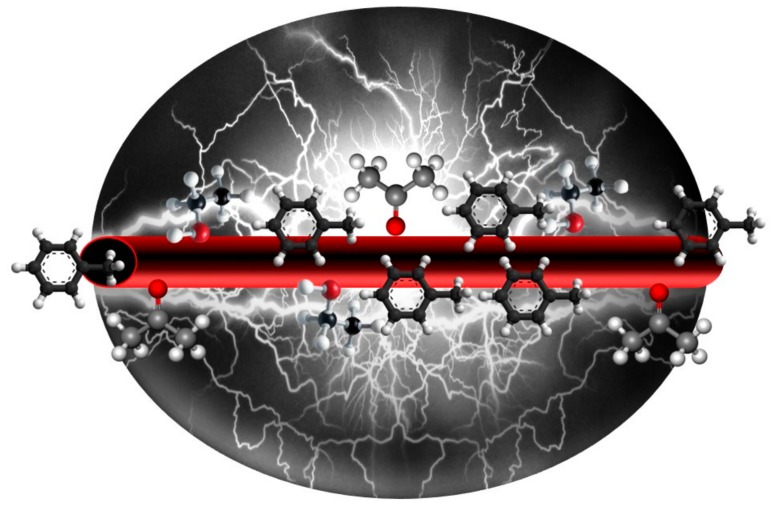
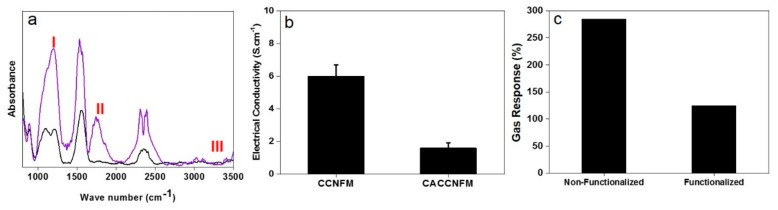
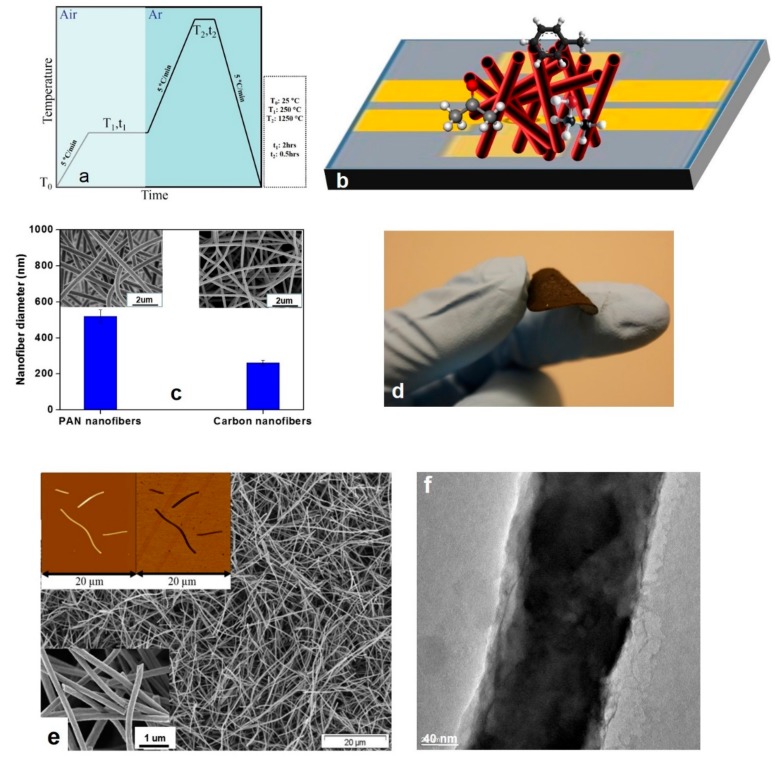
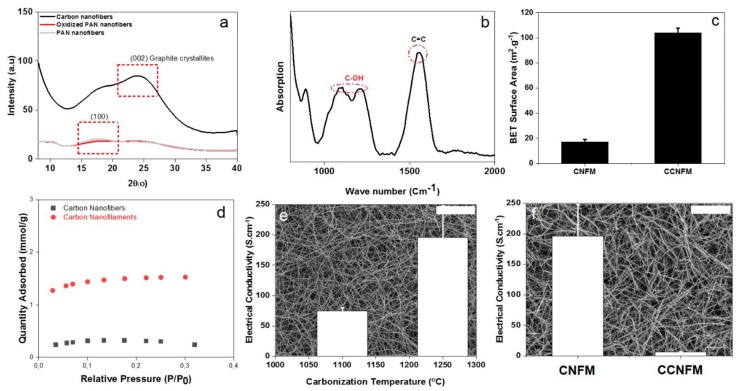
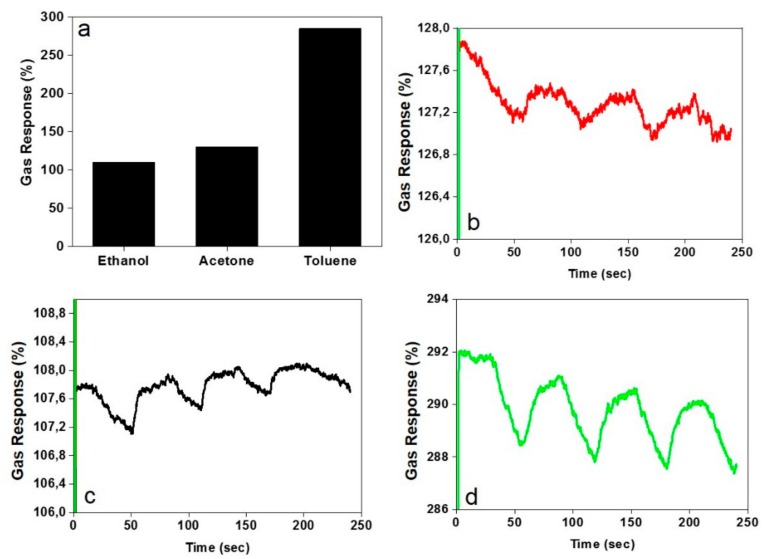
To precisely control the emission limit of volatile organic compounds (VOCs) even at trace amounts, reactive nanomaterials of, e.g., carbon are demanded. Particularly, considering the polar/non-polar nature of VOCs, amphiphilic carbon nanomaterials with a huge surface area could act as multipurpose VOC sensors. Here, for the first time, a buckypaper sensor composed of oxygenated amorphous carbon (a-CO)/graphite (G) nanofilaments is developed. Presence of the oxygen-containing groups rises the selectivity of the sensor to polar VOCs, such as ethanol and acetone through formation of hydrogen bonding, affecting the electron withdrawing ability of the group, the hole carrier density, and, thus, the resistivity. On the other hand, the electrostatic interactions between the toluene aromatic ring and the π electrons of the graphitic crystals cause a formation of charge-transfer complexes, which could be the main mechanism of high responsiveness of the sensor towards non-polar toluene. To the best of my knowledge, an amphiphilic carbon nanofilamentous buckypaper has never been reported for gas sensing, and my device sensing polar/non-polar VOCs is state of the art for environmental control.
为了精确控制挥发性有机化合物(VOCs)即使在痕量水平下的排放限值,需要诸如碳等反应性纳米材料。特别是,考虑到VOCs的极性/非极性性质,具有巨大表面积的两亲性碳纳米材料可以用作多功能VOC传感器。在此,首次开发了一种由氧化无定形碳(a-CO)/石墨(G)纳米丝组成的巴基纸传感器。含氧基团的存在通过形成氢键提高了传感器对极性VOCs(如乙醇和丙酮)的选择性,影响了基团的吸电子能力、空穴载流子密度,进而影响了电阻率。另一方面,甲苯芳香环与石墨晶体的π电子之间的静电相互作用导致形成电荷转移络合物,这可能是传感器对非极性甲苯具有高响应性的主要机制。据我所知,从未有关于用于气体传感的两亲性碳纳米丝状巴基纸的报道,并且我的用于传感极性/非极性VOCs的装置在环境控制方面处于先进水平。